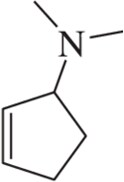
For each of the following molecules, draw one 3-D representation at only the necessary atoms (that is, the ones with four different atoms/groups attached). (c)
Verified step by step guidance
1
Identify the chiral center in the molecule. A chiral center is a carbon atom attached to four different groups. In this molecule, examine each carbon atom to determine if it meets this criterion.
Focus on the carbon atoms in the ring structure and the substituents attached to them. Check if any carbon atom has four distinct groups attached, including the NH2 group, the double bond, and other parts of the ring.
Once the chiral center is identified, represent it in a 3-D format using wedge and dash bonds. Wedge bonds indicate groups coming out of the plane towards the viewer, while dash bonds indicate groups going behind the plane.
Assign the groups around the chiral center based on their spatial arrangement. Ensure that the 3-D representation accurately reflects the stereochemistry of the molecule.
Verify the representation by checking that the chiral center has four distinct groups and that the stereochemistry is consistent with the molecule's structure.
Verified video answer for a similar problem:
This video solution was recommended by our tutors as helpful for the problem above
Video duration:
1m
Play a video:
0 Comments
Key Concepts
Here are the essential concepts you must grasp in order to answer the question correctly.
Stereochemistry
Stereochemistry is the study of the spatial arrangement of atoms in molecules and how this affects their chemical behavior. In organic chemistry, understanding stereochemistry is crucial for visualizing and representing molecules in three dimensions, especially when dealing with chiral centers that have four different substituents.
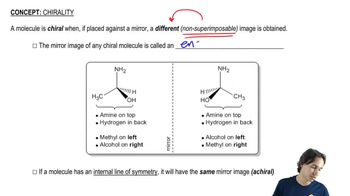
Chirality refers to the property of a molecule that makes it non-superimposable on its mirror image, much like left and right hands. Molecules with chirality often contain a carbon atom bonded to four different groups, leading to two distinct enantiomers. Recognizing chiral centers is essential for accurately drawing 3-D representations.
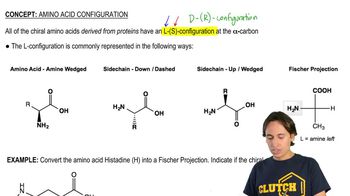
3-D molecular representation involves illustrating the three-dimensional structure of a molecule to convey its geometry and spatial orientation. Techniques such as wedge-and-dash notation or ball-and-stick models help depict the arrangement of atoms and bonds, which is vital for understanding reactivity and interactions in organic compounds.