

Ch.1 - Structure and Bonding
Wade - Organic Chemistry 9th Edition
Wade9th EditionOrganic ChemistryISBN: 9780135213728Not the one you use?Change textbook
Chapter 1, Problem 38d,e,f

Give the molecular formula of each compound shown
(d)
(e)
(f)

Verified step by step guidance
1
Identify the functional groups and carbon skeleton in each compound. For compound (d), recognize the amine group (H₂N) and carboxylic acid group (COOH) attached to a four-carbon chain.
For compound (d), count the number of each type of atom: 4 carbons (C), 9 hydrogens (H), 1 nitrogen (N), and 2 oxygens (O).
In compound (e), identify the pyrrolidinone ring with a nitrogen atom and an oxygen atom, and a tert-butyl group attached to the ring.
For compound (e), count the atoms: 8 carbons (C), 11 hydrogens (H), 1 nitrogen (N), and 1 oxygen (O).
For compound (f), identify the aldehyde group (CHO) attached to a three-carbon chain. Count the atoms: 4 carbons (C), 8 hydrogens (H), and 1 oxygen (O).

Verified video answer for a similar problem:

This video solution was recommended by our tutors as helpful for the problem above.
Video duration:
3m
Was this helpful?

Key Concepts

Here are the essential concepts you must grasp in order to answer the question correctly.

Skeletal Structure Representation

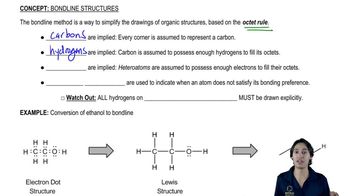
Skeletal structures are a simplified way of drawing organic molecules where carbon atoms are represented by the ends and intersections of lines, and hydrogen atoms attached to carbons are usually omitted. This representation helps in quickly visualizing the molecular framework and functional groups present in the compound.
Recommended video:
Guided course
04:03
How bondline is different from Lewis Structures.

Functional Groups

Functional groups are specific groups of atoms within molecules that have characteristic properties and reactivity. In the given image, the amino group (NH2) and the carboxylic acid group (COOH) are functional groups that define the chemical behavior of gamma-aminobutyric acid (GABA), influencing its role as a neurotransmitter.
Recommended video:
Guided course
02:36
Identifying Functional Groups

Molecular Formula Determination

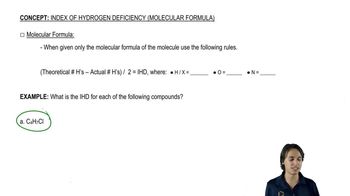
The molecular formula of a compound provides the exact number of each type of atom present in a molecule. To determine it from a skeletal structure, count the carbon atoms at the vertices and ends of lines, add the appropriate number of hydrogen atoms to satisfy carbon's tetravalency, and include any other atoms explicitly shown, such as nitrogen and oxygen in GABA.
Recommended video:
Guided course
02:17
How to use IHD with molecular formula.