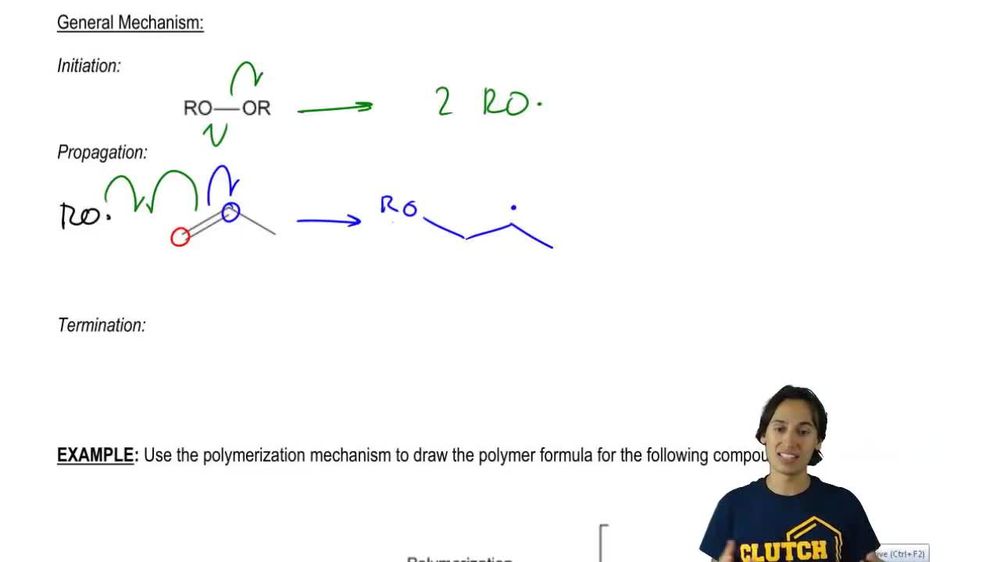
Draw Lewis structures for the following free radicals. a. The ethyl radical, CH3—ĊH2 b. The tert-butyl radical, (CH3)3C•
Verified step by step guidance
1
Step 1: Understand that a free radical is a molecule that contains an unpaired electron. This unpaired electron is typically represented as a dot (•) in Lewis structures.
Step 2: For the ethyl radical (CH3—CH2•), start by drawing the Lewis structure for ethane (CH3—CH3). Ethane consists of two carbon atoms single-bonded to each other, with each carbon atom also bonded to three hydrogen atoms.
Step 3: To convert ethane to the ethyl radical, remove one hydrogen atom from the CH2 group, leaving an unpaired electron on the second carbon atom. The structure should now be CH3—CH2•, with the dot representing the unpaired electron on the second carbon.
Step 4: For the tert-butyl radical ((CH3)3C•), begin by drawing the Lewis structure for tert-butyl cation ((CH3)3C+). This involves a central carbon atom bonded to three methyl groups (CH3).
Step 5: To form the tert-butyl radical, replace the positive charge with an unpaired electron. The central carbon atom will have three single bonds to the methyl groups and one unpaired electron, represented as (CH3)3C•.
Verified video answer for a similar problem:
This video solution was recommended by our tutors as helpful for the problem above
Video duration:
4m
Play a video:
1 Comment
Key Concepts
Here are the essential concepts you must grasp in order to answer the question correctly.
Lewis Structures
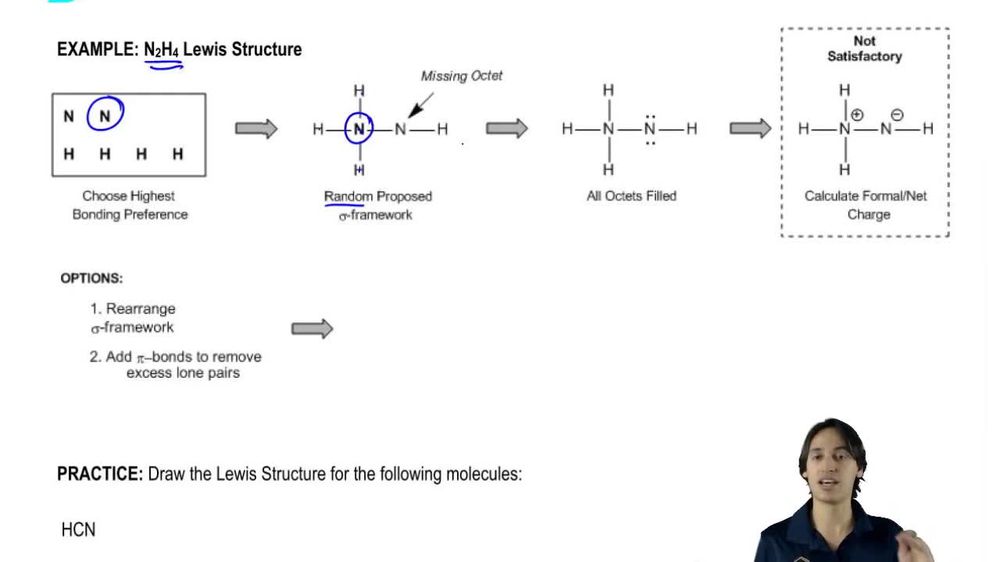
Lewis structures are diagrams that represent the bonding between atoms of a molecule and the lone pairs of electrons that may exist. They are essential for visualizing the arrangement of electrons around atoms, which helps in understanding the molecule's geometry, reactivity, and properties. In the case of free radicals, the Lewis structure will show an unpaired electron, which is crucial for identifying the radical nature of the molecule.
Free radicals are atoms or molecules that contain an unpaired electron, making them highly reactive. In organic chemistry, radicals are often intermediates in reactions and can be identified by a single dot representing the unpaired electron in their Lewis structures. Understanding free radicals is important for predicting reaction mechanisms and the stability of different radical species.
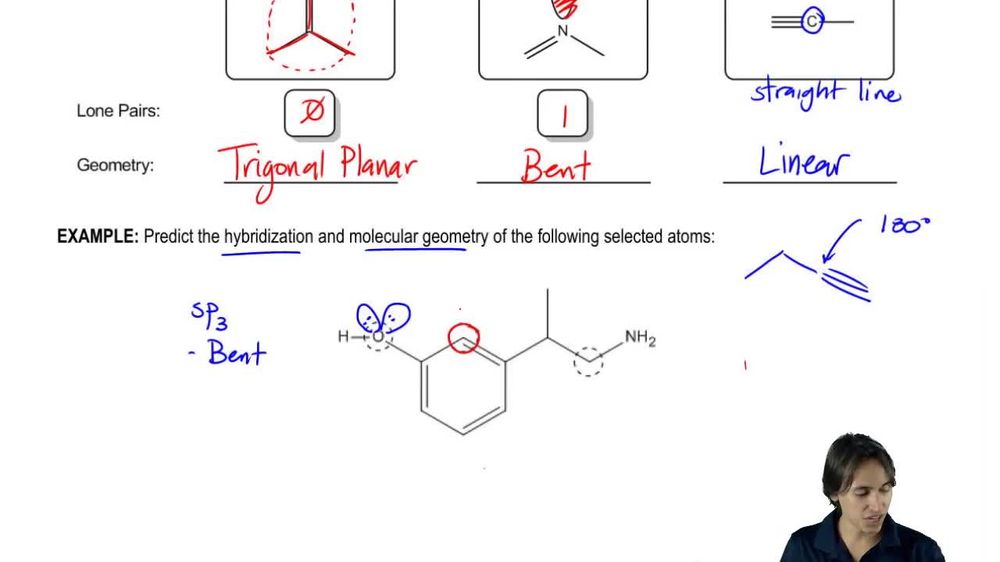
Hybridization is the concept of mixing atomic orbitals to form new hybrid orbitals, which influences the geometry and bonding properties of molecules. For example, the carbon atoms in ethyl and tert-butyl radicals are typically sp3 hybridized, leading to a tetrahedral geometry. Recognizing the hybridization helps in accurately drawing the Lewis structures and understanding the spatial arrangement of atoms and electrons in radicals.

 4:04 minutes
 Verified step by step guidance
 04:12
04:12