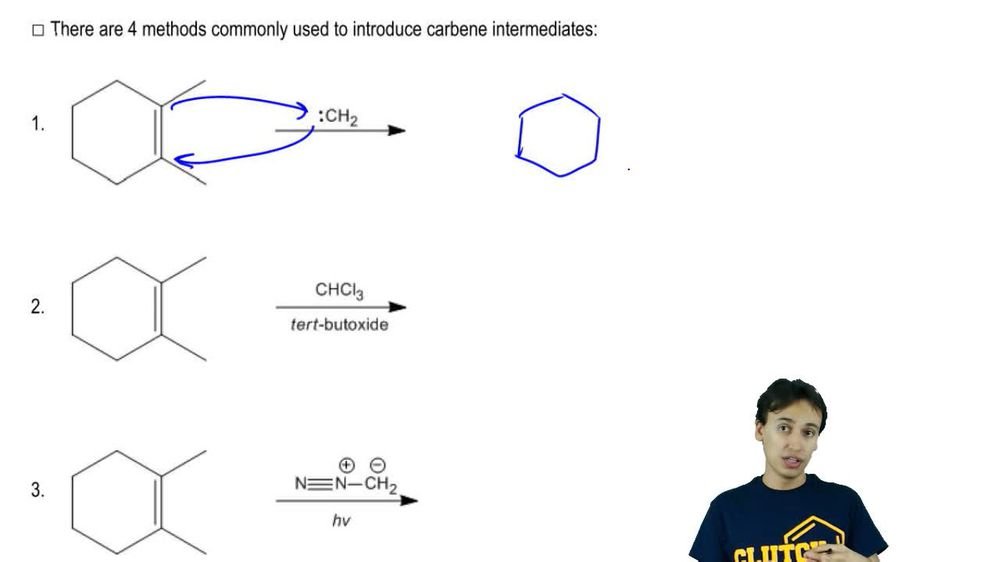
In addition to radicals, anions, and cations, a fourth class of reactive intermediates is carbenes. A neutral species, the simplest carbene has a molecular formula of CH2. (a) Draw the Lewis structure of CH2.
Verified step by step guidance
1
Step 1: Begin by identifying the molecular formula CH₂. This indicates that the molecule contains one carbon atom and two hydrogen atoms.
Step 2: Recall that carbon has four valence electrons and hydrogen has one valence electron. The total number of valence electrons in CH₂ is calculated as follows: Carbon contributes 4 electrons, and each hydrogen contributes 1 electron, giving a total of 4 + 1 + 1 = 6 valence electrons.
Step 3: Arrange the atoms with carbon as the central atom, since it is less electronegative than hydrogen. Connect the two hydrogen atoms to the carbon atom using single bonds. Each single bond represents two shared electrons.
Step 4: After forming the two single bonds, 4 electrons are used (2 electrons per bond). This leaves 2 valence electrons remaining. Place these remaining electrons as a lone pair on the carbon atom.
Step 5: Verify the structure by checking the formal charges and ensuring that the total number of valence electrons matches the calculated total. Carbon will have a lone pair and two single bonds, making it neutral, and each hydrogen atom will have a full valence shell with 2 electrons.
Verified video answer for a similar problem:
This video solution was recommended by our tutors as helpful for the problem above
Video duration:
2m
Play a video:
0 Comments
Key Concepts
Here are the essential concepts you must grasp in order to answer the question correctly.
Lewis Structures
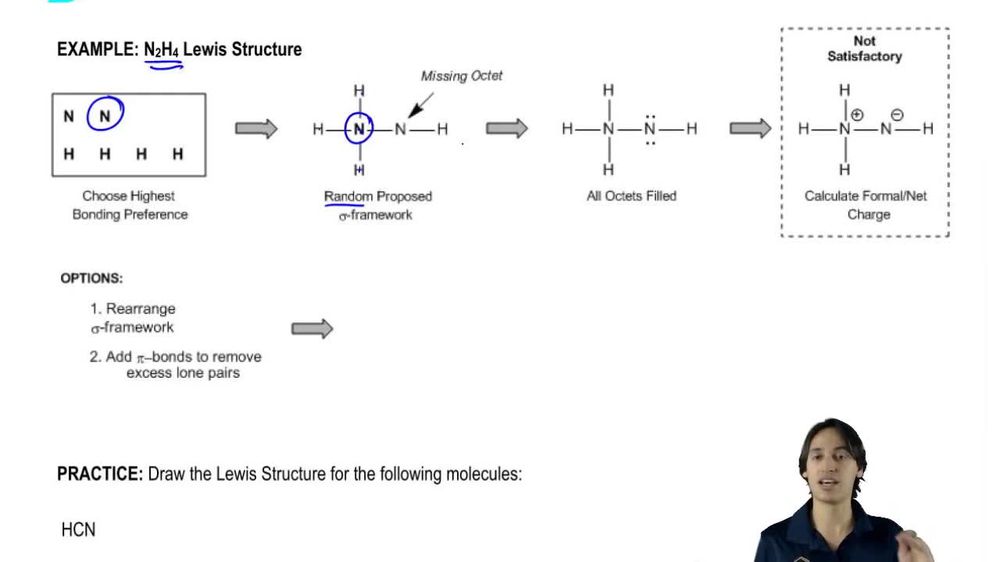
Lewis structures are diagrams that represent the bonding between atoms in a molecule and the lone pairs of electrons that may exist. They help visualize the arrangement of electrons and the connectivity of atoms, which is crucial for understanding molecular geometry and reactivity. In the case of CH₂, the Lewis structure will show how the carbon atom is bonded to two hydrogen atoms and the distribution of its valence electrons.
Carbenes are neutral reactive intermediates that contain a carbon atom with only six valence electrons, resulting in a divalent state. They can be classified as singlet or triplet carbenes based on the spin state of their unpaired electrons. Understanding carbenes is essential for grasping their role in organic reactions, as they can act as nucleophiles or electrophiles depending on their electronic configuration.
Valence electrons are the outermost electrons of an atom and are crucial for chemical bonding. In the context of CH₂, carbon has four valence electrons, while each hydrogen has one. The arrangement and sharing of these electrons determine the molecule's structure and stability, making it important to account for them when drawing Lewis structures and predicting molecular behavior.