Predict the product of the following Negishi coupling reactions. (b)
Verified step by step guidance
1
Identify the organolithium reagent: The starting material is an organolithium compound, specifically isopropyllithium, which is a strong nucleophile and base.
Convert the organolithium to an organozinc reagent: The first step involves the reaction of isopropyllithium with ZnCl2 in THF to form the corresponding organozinc compound, isopropylzinc chloride.
Recognize the role of the palladium catalyst: The Pd(PPh3)4 is a common catalyst used in Negishi coupling reactions, facilitating the cross-coupling between the organozinc reagent and the organic halide.
Identify the organic halide: The organic halide in this reaction is a bromocyclopentane with a fluorine substituent, which will undergo coupling with the organozinc reagent.
Predict the product: The Negishi coupling will result in the formation of a new carbon-carbon bond between the isopropyl group from the organozinc reagent and the carbon atom of the cyclopentane ring that was bonded to the bromine, yielding the coupled product.
Verified video answer for a similar problem:
This video solution was recommended by our tutors as helpful for the problem above
Video duration:
4m
Play a video:
0 Comments
Key Concepts
Here are the essential concepts you must grasp in order to answer the question correctly.
Negishi Coupling Reaction
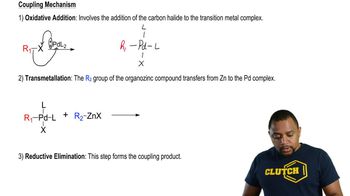
Negishi coupling is a palladium-catalyzed cross-coupling reaction that forms carbon-carbon bonds between organozinc compounds and organic halides. It is widely used in organic synthesis to construct complex molecules. The reaction typically involves a transition metal catalyst, such as palladium, and proceeds through oxidative addition, transmetalation, and reductive elimination steps.
Transmetalation is a key step in many cross-coupling reactions, including Negishi coupling, where an organometallic compound transfers its organic group to a metal catalyst. In this reaction, the organozinc species formed from the reaction of lithium reagent with ZnCl2 transfers its organic group to the palladium catalyst, facilitating the formation of the carbon-carbon bond with the organic halide.
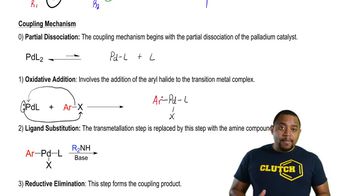
Palladium catalysis is crucial in facilitating cross-coupling reactions like Negishi coupling. Palladium complexes, such as Pd(PPh3)4, are used to activate organic halides through oxidative addition, allowing the subsequent transmetalation and reductive elimination steps to occur. This catalysis enables the formation of new carbon-carbon bonds efficiently and selectively, making it a powerful tool in organic synthesis.