Ch. 3 - An Introduction to Organic Compounds:Nomenclature, Physical Properties, and Structure
Bruice - Organic Chemistry 8th Edition
Bruice8th EditionOrganic ChemistryISBN: 9780135213711Not the one you use?Change textbook
Chapter 4, Problem 88

Using the data obtained in Problem 81, calculate the percentage of molecules of trans-1,2-dimethylcyclohexane that will have both methyl groups in equatorial positions.

Verified step by step guidance
1
Step 1: Understand the conformational analysis of trans-1,2-dimethylcyclohexane. In this molecule, the trans configuration means that one methyl group is positioned above the plane of the cyclohexane ring and the other is below the plane. The equatorial positions are generally more stable due to reduced steric hindrance compared to axial positions.
Step 2: Recall that cyclohexane adopts a chair conformation, and each carbon atom alternates between axial and equatorial positions. For trans-1,2-dimethylcyclohexane, both methyl groups can occupy equatorial positions in one of the chair conformations.
Step 3: Use the data from Problem 81 to determine the relative stability of the chair conformations. The stability is influenced by the steric interactions of the substituents. Typically, the conformation with both methyl groups in equatorial positions is more stable.
Step 4: Apply the Boltzmann distribution formula to calculate the percentage of molecules in the more stable conformation. The formula is: Pequatorial=1/1+e-ΔGRT, where ΔG is the free energy difference between the conformations, R is the gas constant, and T is the temperature in Kelvin.
Step 5: Substitute the values for ΔG, R, and T into the Boltzmann distribution formula to calculate the percentage of molecules with both methyl groups in equatorial positions. Ensure the units are consistent when performing the calculation.

Verified video answer for a similar problem:

This video solution was recommended by our tutors as helpful for the problem above.
Was this helpful?

Key Concepts

Here are the essential concepts you must grasp in order to answer the question correctly.

Chair Conformation of Cyclohexane

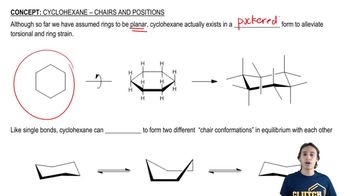
Cyclohexane can adopt a chair conformation that minimizes steric strain. In this conformation, substituents can occupy either equatorial or axial positions. Equatorial positions are generally more stable for larger groups, as they reduce steric hindrance with other axial substituents.
Recommended video:
Guided course
01:05
What is a chair conformation?

Stability of Substituted Cyclohexanes

The stability of substituted cyclohexanes is influenced by the positioning of substituents. For 1,2-dimethylcyclohexane, the most stable configuration occurs when both methyl groups are in equatorial positions, as this arrangement minimizes steric interactions and torsional strain.
Recommended video:
Guided course
05:58
Determining Carbocation Stability

Equilibrium Between Chair Conformations

Substituted cyclohexanes can interconvert between different chair conformations. The percentage of molecules in each conformation can be calculated using the Gibbs free energy difference between the conformations, which affects the distribution of equatorial versus axial substituents in a dynamic equilibrium.
Recommended video:
Guided course
05:12
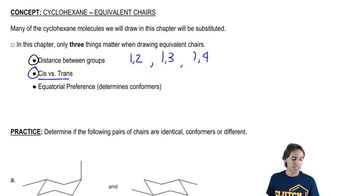
The 3 important factors when drawing chairs