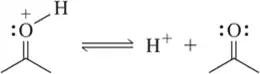
Provide an arrow-pushing mechanism for the following hypothetical acid half-reactions. [These are only intended to help you learn about arrow pushing in acid–base reactions.] (b)
Verified step by step guidance
1
Step 1: Identify the acid and conjugate base in the reaction. The molecule on the left with the protonated oxygen (O⁺) is the acid, and the molecule on the right with the neutral oxygen is the conjugate base.
Step 2: Recognize the key bond-breaking event. The O-H bond in the acid will break, resulting in the release of a proton (H⁺). This is an acid dissociation reaction.
Step 3: Use curved arrows to show electron movement. Draw a curved arrow starting from the lone pair on the oxygen atom and pointing toward the bond between oxygen and hydrogen. This indicates that the lone pair is forming a double bond with the carbon, while the O-H bond is breaking.
Step 4: Show the formation of the conjugate base. After the O-H bond breaks, the oxygen atom becomes neutral, and the proton (H⁺) is released as a free ion.
Step 5: Verify the charge balance. Ensure that the charge is conserved in the reaction. The acid starts with a positive charge (O⁺), and after dissociation, the conjugate base is neutral, while the released proton carries a positive charge.
Verified video answer for a similar problem:
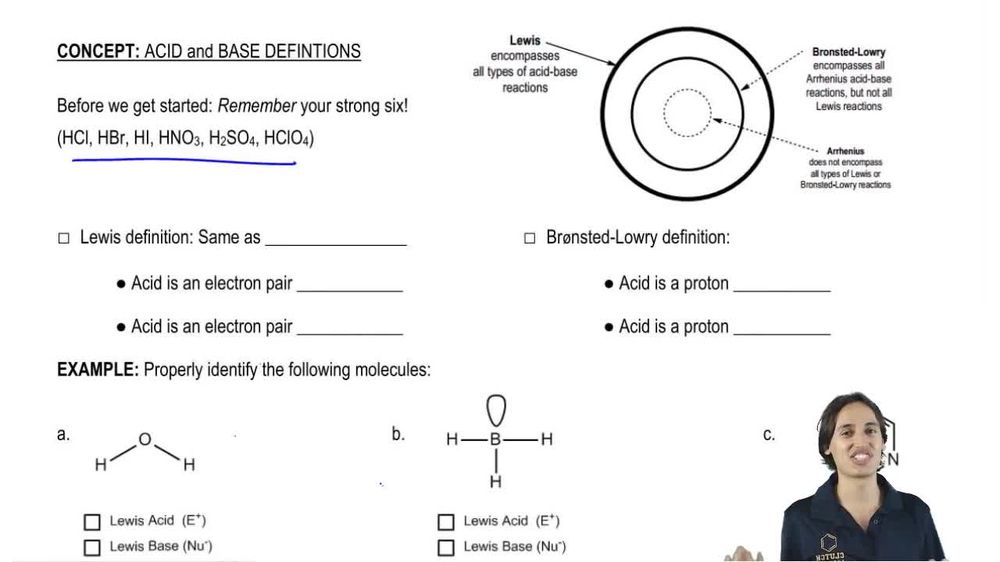
This video solution was recommended by our tutors as helpful for the problem above
Video duration:
1m
Play a video:
0 Comments
Key Concepts
Here are the essential concepts you must grasp in order to answer the question correctly.
Acid-Base Reactions
Acid-base reactions involve the transfer of protons (H+) between species. In organic chemistry, acids are proton donors, while bases are proton acceptors. Understanding the role of acids and bases is crucial for predicting the direction of the reaction and the stability of the resulting species.
The arrow-pushing mechanism is a method used to illustrate the movement of electrons during chemical reactions. Curved arrows represent the flow of electron pairs, indicating bond formation and breaking. This technique helps visualize the stepwise process of reactions, particularly in acid-base chemistry, where proton transfers are involved.
Resonance structures are different ways of drawing the same molecule that illustrate the delocalization of electrons. In acid-base reactions, resonance can stabilize charged intermediates, influencing the reaction pathway and the stability of products. Recognizing resonance is essential for predicting the behavior of reactive intermediates in organic reactions.