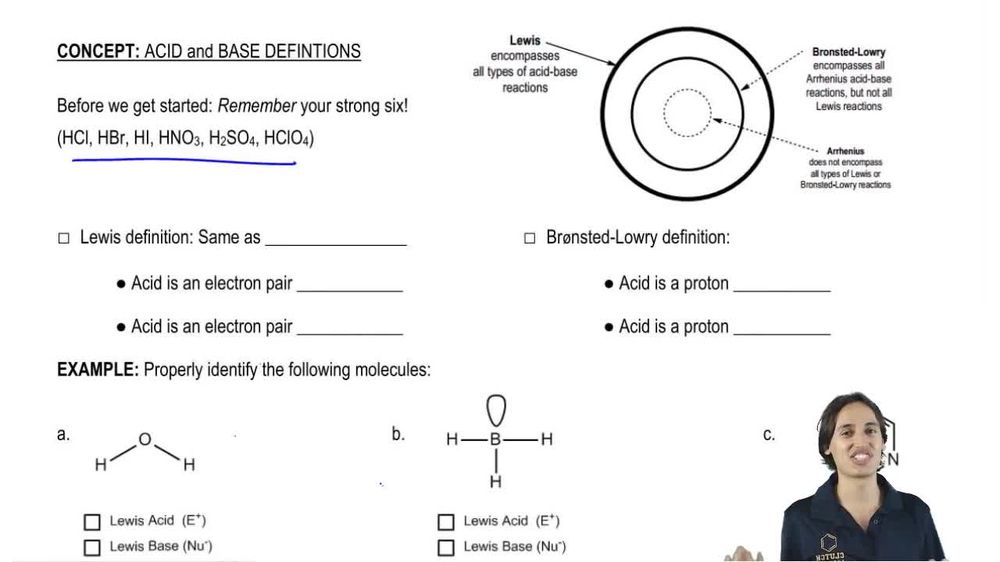
Provide an arrow-pushing mechanism for the following hypothetical base half-reactions. (c)
Verified step by step guidance
1
Identify the base in the reaction. A base is a species that donates a pair of electrons to accept a proton (H⁺). Look for a lone pair of electrons or a negative charge on the base molecule.
Locate the acidic proton (H⁺) in the reaction. This is typically a hydrogen atom bonded to an electronegative atom, such as oxygen or nitrogen, which makes it more likely to be donated.
Draw a curved arrow starting from the lone pair of electrons on the base and pointing toward the acidic proton. This represents the base using its electrons to form a bond with the proton.
If the acidic proton is part of a bond (e.g., O-H or N-H), draw a second curved arrow starting from the bond between the proton and its atom, pointing toward the atom (e.g., oxygen or nitrogen). This shows the bond breaking and the electrons moving to the electronegative atom.
Verify the products of the reaction. The base should now have gained a proton (forming its conjugate acid), and the acidic molecule should have lost a proton (forming its conjugate base). Ensure the charges and electron counts are balanced in the final structures.
Verified video answer for a similar problem:
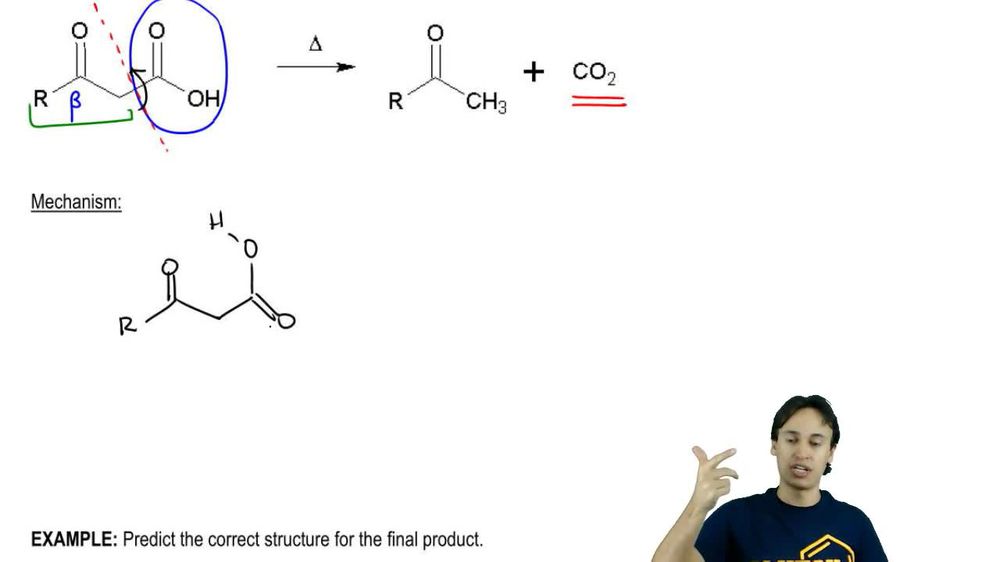
This video solution was recommended by our tutors as helpful for the problem above
Video duration:
1m
Play a video:
0 Comments
Key Concepts
Here are the essential concepts you must grasp in order to answer the question correctly.
Arrow-Pushing Mechanism
The arrow-pushing mechanism is a visual representation used in organic chemistry to illustrate the movement of electrons during chemical reactions. Arrows indicate the direction of electron flow, showing how bonds are formed or broken. This technique is essential for understanding reaction mechanisms, particularly in acid-base reactions, where proton transfer occurs.
Acid-base reactions involve the transfer of protons (H+) between reactants. An acid is defined as a proton donor, while a base is a proton acceptor. Understanding the strength of acids and bases, as well as their conjugate pairs, is crucial for predicting the outcome of these reactions and for applying the arrow-pushing mechanism effectively.
Conjugate acid-base pairs consist of two species that differ by the presence or absence of a proton. When an acid donates a proton, it forms its conjugate base, and when a base accepts a proton, it forms its conjugate acid. Recognizing these pairs is vital for understanding the equilibrium of acid-base reactions and for applying the arrow-pushing mechanism correctly.