Calculate the formal charge on the non-hydrogen atoms in the molecules shown. Use the arrow-pushing formalism to 'move' an electron pair such that it is shared between two (formerly) charged atoms. Your arrow should account for the formation of the molecule on the right from the molecule on the left.
Verified step by step guidance
1
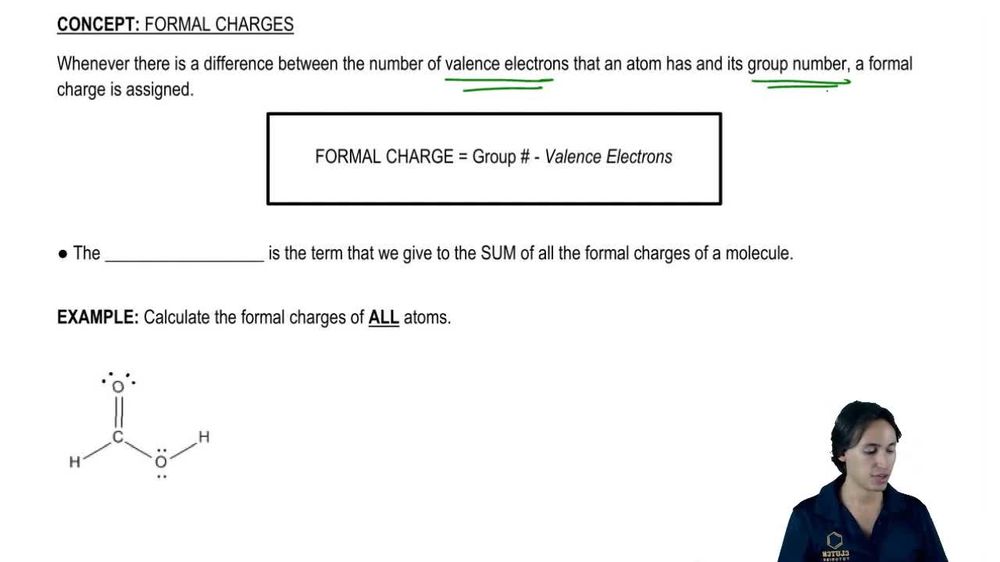
Identify the formal charge formula: Formal charge = (Valence electrons of the atom) - (Non-bonding electrons) - (1/2 × Bonding electrons).
For each non-hydrogen atom in the molecule on the left, calculate its formal charge using the formula. Count the valence electrons, non-bonding electrons, and bonding electrons for each atom.
Examine the arrow-pushing formalism provided. Arrows indicate the movement of electron pairs. Follow the arrows to determine how electrons are redistributed between atoms.
Recalculate the formal charges for the non-hydrogen atoms in the molecule on the right after the electron redistribution. Use the same formal charge formula.
Compare the formal charges of the atoms in the molecule on the left and the molecule on the right. Verify that the electron movement accounts for the change in formal charges and ensures overall charge conservation.
Verified video answer for a similar problem:
This video solution was recommended by our tutors as helpful for the problem above
Video duration:
3m
Play a video:
0 Comments
Key Concepts
Here are the essential concepts you must grasp in order to answer the question correctly.
Formal Charge
Formal charge is a theoretical charge assigned to an atom in a molecule, calculated by considering the number of valence electrons, the number of bonds, and the number of non-bonding electrons. It helps in determining the most stable structure of a molecule by minimizing the charge separation. The formula is: Formal Charge = Valence Electrons - (Non-bonding Electrons + 1/2 Bonding Electrons).
Arrow-pushing formalism is a method used in organic chemistry to illustrate the movement of electrons during chemical reactions. Arrows indicate the direction of electron flow, with a double-headed arrow showing the movement of a pair of electrons and a single-headed arrow indicating the movement of a single electron. This technique is essential for visualizing reaction mechanisms and understanding how reactants transform into products.
Molecular structure refers to the arrangement of atoms within a molecule and the types of bonds that hold them together. Understanding bonding, including covalent and ionic interactions, is crucial for predicting molecular behavior and reactivity. The formation of new bonds during a reaction often involves the sharing or transfer of electron pairs, which is central to the arrow-pushing formalism and the calculation of formal charges.

 3:54 minutes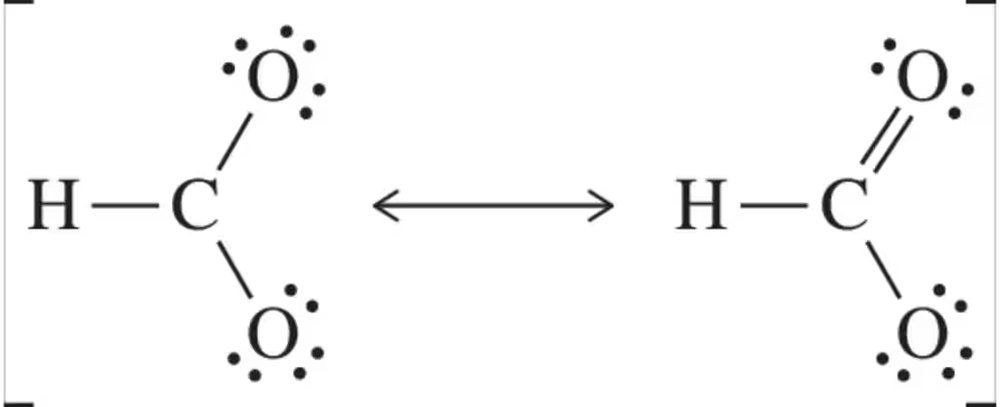
 Verified step by step guidance
 01:34
01:34