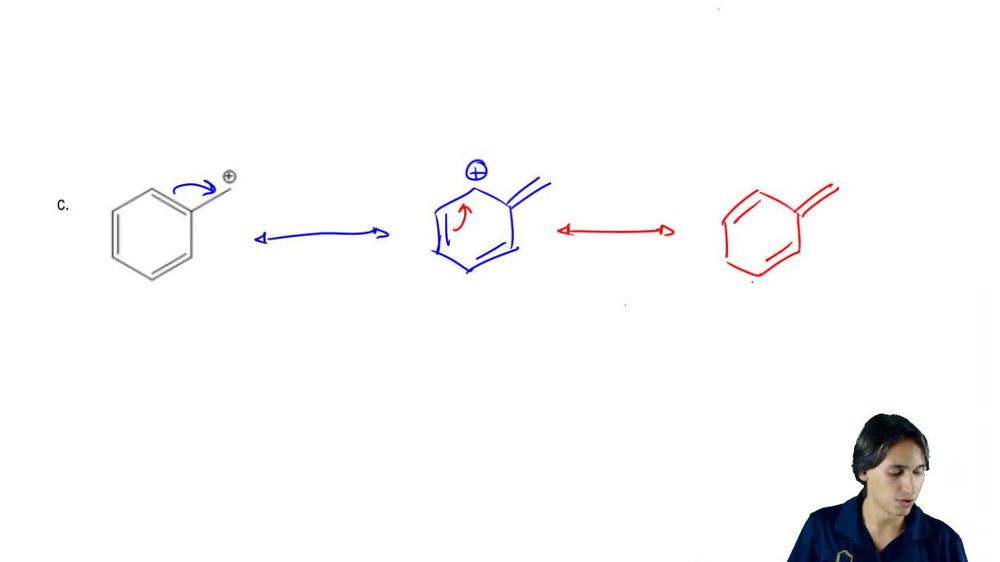
Calculate the formal charge of the indicated atom in the following molecules or ions. (d)
Verified step by step guidance
1
Step 1: Recall the formula for calculating formal charge: Formal Charge = (Valence Electrons) - (Non-bonding Electrons) - (1/2 × Bonding Electrons).
Step 2: Identify the atom in question and determine the number of valence electrons it has based on its position in the periodic table.
Step 3: Count the number of non-bonding electrons (lone pairs) around the atom. Each lone pair contributes 2 electrons.
Step 4: Count the number of bonding electrons (shared electrons in bonds) around the atom. Each bond contributes 2 electrons, but only half of these are assigned to the atom in question.
Step 5: Substitute the values for valence electrons, non-bonding electrons, and bonding electrons into the formula to calculate the formal charge of the atom.
Verified video answer for a similar problem:
This video solution was recommended by our tutors as helpful for the problem above
Video duration:
1m
Play a video:
0 Comments
Key Concepts
Here are the essential concepts you must grasp in order to answer the question correctly.
Formal Charge
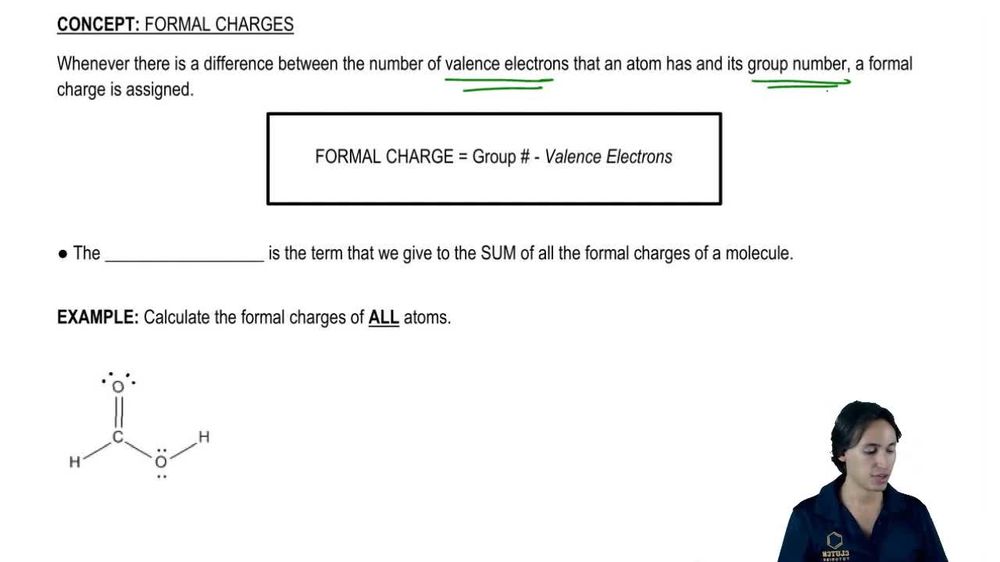
Formal charge is a theoretical charge assigned to an atom in a molecule, calculated based on the number of valence electrons, the number of non-bonding electrons, and the number of bonds. The formula is: Formal Charge = Valence Electrons - (Non-bonding Electrons + 1/2 Bonding Electrons). This concept helps in understanding the distribution of electrons in a molecule and assessing the stability of different resonance structures.
Lewis structures are diagrams that represent the bonding between atoms in a molecule and the lone pairs of electrons that may exist. They provide a visual representation of the arrangement of electrons and help in predicting the formal charge of atoms. Understanding how to draw and interpret Lewis structures is essential for calculating formal charges accurately.
Resonance structures are different ways of drawing the same molecule that show the delocalization of electrons. They are used when a single Lewis structure cannot adequately represent the electron distribution. Recognizing resonance structures is important for understanding the stability of a molecule and the implications for formal charge, as the actual structure is a hybrid of all possible resonance forms.

 1:42 minutes
 Verified step by step guidance
 01:34
01:34