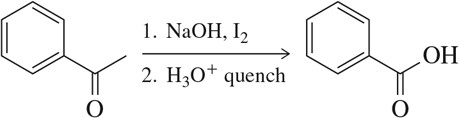
Identify the following reactions as oxidation or reduction (based on what happens to the organic molecule). (b)
Verified step by step guidance
1
Step 1: Analyze the starting material, 1-(p-tolyl)ethanone. It contains a methyl group attached to a benzene ring and a ketone functional group.
Step 2: Examine the product, terephthalic acid. It contains two carboxylic acid groups attached to the benzene ring, replacing the methyl group and the ketone group.
Step 3: Identify the reagents used in the reaction. Potassium permanganate (KMnO4) in basic conditions (KOH) followed by acidification (H3O+) is a strong oxidizing agent.
Step 4: Determine the changes in the organic molecule. The methyl group and the ketone group are oxidized to carboxylic acid groups, indicating an increase in the oxidation state of the carbon atoms.
Step 5: Conclude that this reaction is an oxidation reaction because the organic molecule undergoes an increase in oxidation state due to the conversion of the methyl and ketone groups into carboxylic acid groups.
Verified video answer for a similar problem:
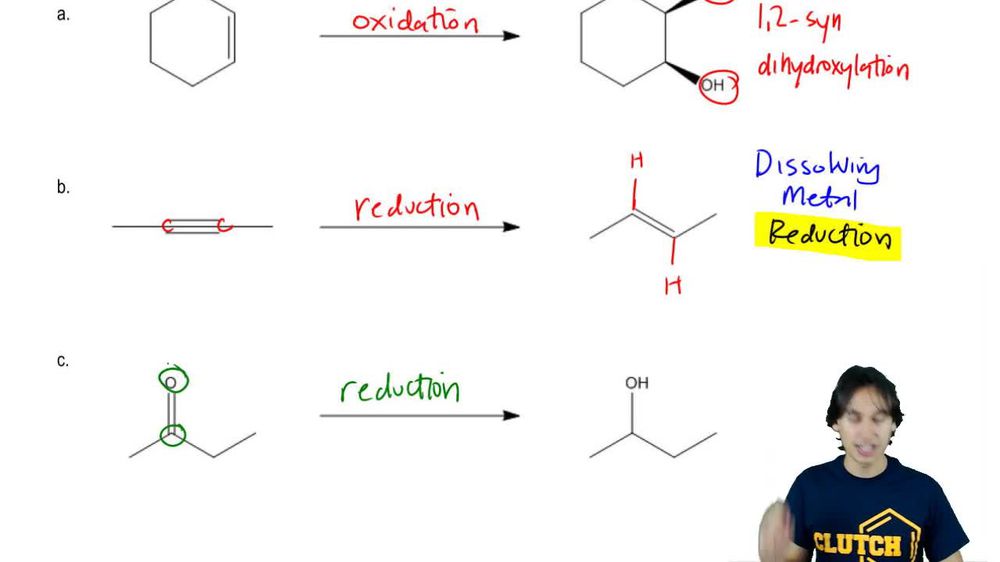
This video solution was recommended by our tutors as helpful for the problem above
Video duration:
2m
Play a video:
0 Comments
Key Concepts
Here are the essential concepts you must grasp in order to answer the question correctly.
Oxidation and Reduction
Oxidation and reduction are fundamental concepts in organic chemistry that describe the transfer of electrons between molecules. Oxidation involves the loss of electrons or an increase in oxidation state, while reduction involves the gain of electrons or a decrease in oxidation state. Understanding these processes is crucial for identifying the nature of chemical reactions, particularly in organic transformations.
Oxidizing agents are substances that facilitate the oxidation of other compounds by accepting electrons. In the given reaction, potassium permanganate (KMnO4) acts as a strong oxidizing agent, converting 1-(p-tolyl)ethanone into terephthalic acid. Recognizing the role of oxidizing agents helps in predicting the products of oxidation reactions in organic chemistry.
Functional group transformation refers to the conversion of one functional group into another during a chemical reaction. In this case, the carbonyl group (C=O) of 1-(p-tolyl)ethanone is oxidized to form carboxylic acid groups (-COOH) in terephthalic acid. Understanding functional group transformations is essential for predicting the outcomes of organic reactions and the properties of the resulting compounds.