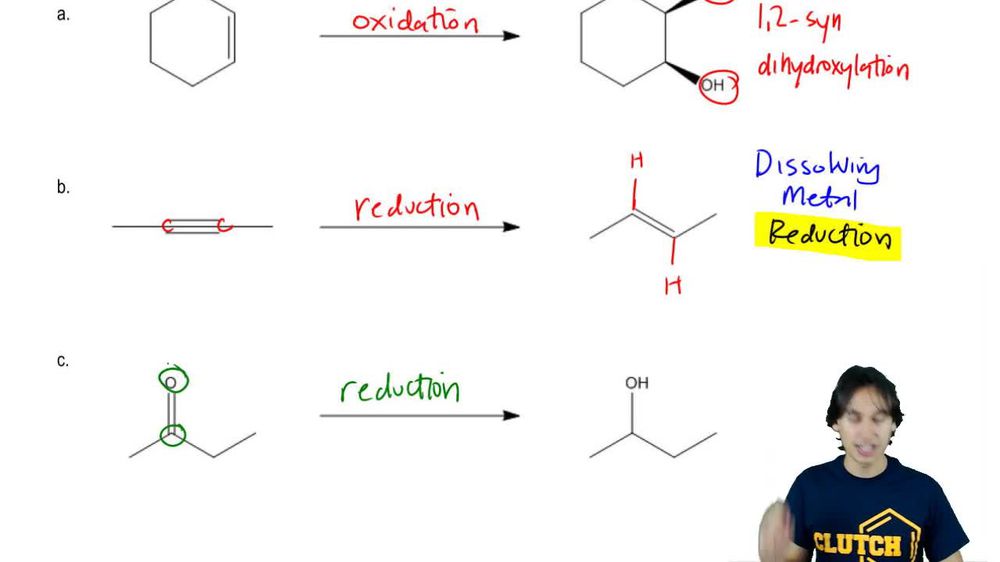
Identify the following reactions as oxidation or reduction (based on what happens to the organic molecule). (a)
Verified step by step guidance
1
Step 1: Analyze the starting material and the product. The starting material contains a double bond in the cyclohexane ring, while the product has a fully saturated cyclohexane ring without any double bonds.
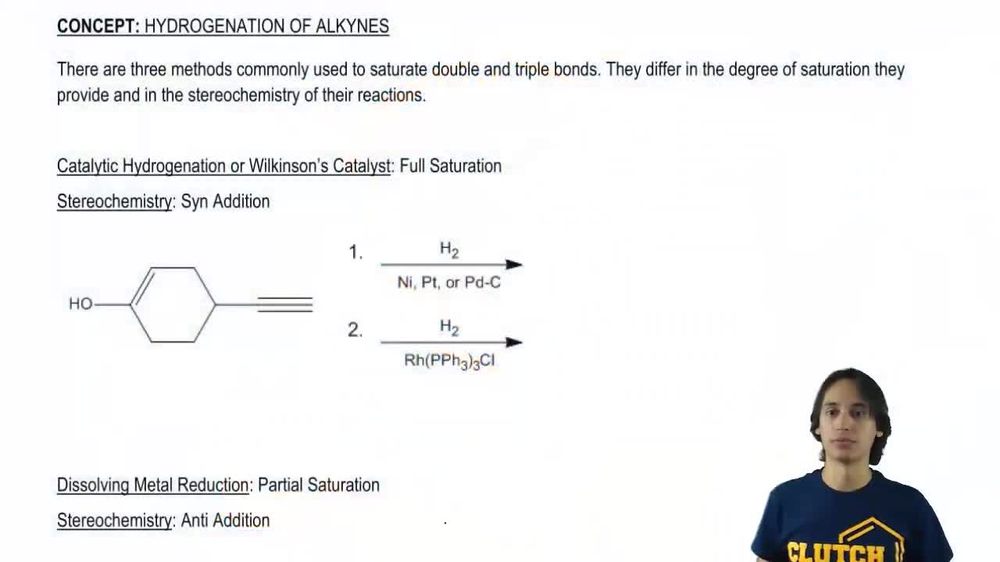
Step 2: Recognize the reaction conditions. The reaction involves hydrogen gas (H₂) and a palladium catalyst (Pd/C), which is a typical setup for catalytic hydrogenation.
Step 3: Understand the process of catalytic hydrogenation. In this reaction, hydrogen atoms are added across the double bond, converting the unsaturated compound (with a double bond) into a saturated compound (without a double bond).
Step 4: Determine whether the reaction is oxidation or reduction. Reduction involves the gain of hydrogen atoms or the loss of oxygen atoms. Since hydrogen is added to the molecule, this reaction is classified as a reduction.
Step 5: Conclude that the organic molecule undergoes a reduction in this reaction, as the double bond is reduced to a single bond through the addition of hydrogen.
Verified video answer for a similar problem:
This video solution was recommended by our tutors as helpful for the problem above
Video duration:
2m
Play a video:
0 Comments
Key Concepts
Here are the essential concepts you must grasp in order to answer the question correctly.
Oxidation and Reduction
In organic chemistry, oxidation refers to the loss of electrons or an increase in oxidation state, while reduction involves the gain of electrons or a decrease in oxidation state. These processes often involve the addition or removal of specific atoms or groups, such as oxygen or hydrogen, to or from a molecule.
Hydrogenation is a specific type of reduction reaction where hydrogen (H2) is added to an unsaturated compound, such as an alkene or alkyne, converting it into a saturated compound. This process typically requires a catalyst, such as palladium on carbon (Pd/C), to facilitate the reaction and lower the activation energy.
Catalysts are substances that increase the rate of a chemical reaction without being consumed in the process. In the context of hydrogenation, catalysts like Pd/C provide a surface for the reaction to occur, allowing hydrogen to effectively add to the double bond of the alkene, thus promoting the reduction of the molecule.

 2:24 minutes
 Verified step by step guidance
 00:54
00:54