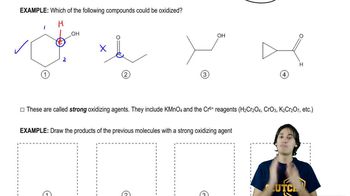
Calculate the oxidation number for the indicated carbons. (a)
Verified step by step guidance
1
Identify the carbon atom for which you need to calculate the oxidation number. In organic molecules, this is often indicated by a specific label or context within the problem.
Understand the general rule for calculating oxidation numbers: the oxidation number of a carbon atom is determined by the number of electrons it 'owns' compared to the number of electrons it would own in its elemental state.
Assign oxidation numbers to the atoms directly bonded to the carbon in question. Typically, hydrogen is +1, oxygen is -2, and other carbons are 0. Halogens are usually -1.
Calculate the oxidation number of the carbon atom by considering the bonds it forms. For each bond to a more electronegative atom (like oxygen), subtract 1. For each bond to a less electronegative atom (like hydrogen), add 1. Bonds to other carbons do not affect the oxidation number.
Sum the contributions from each bond to determine the oxidation number of the carbon atom. Remember that the sum of oxidation numbers in a neutral molecule must equal zero, and in an ion, it must equal the charge of the ion.
Verified video answer for a similar problem:
This video solution was recommended by our tutors as helpful for the problem above
Play a video:
0 Comments
Key Concepts
Here are the essential concepts you must grasp in order to answer the question correctly.
Oxidation Number
The oxidation number is a theoretical charge assigned to an atom in a molecule, reflecting its electron control relative to a neutral atom. It helps determine the electron transfer in redox reactions. For carbon, it varies based on its bonding with other atoms, especially electronegative ones like oxygen.
Electronegativity is the tendency of an atom to attract electrons in a chemical bond. It influences the oxidation number calculation, as more electronegative atoms pull electron density away from carbon, increasing its oxidation state. Understanding electronegativity differences is crucial for assigning oxidation numbers accurately.
The type of bonds and molecular structure around a carbon atom affect its oxidation number. Single, double, or triple bonds, as well as the presence of heteroatoms, alter electron distribution. Analyzing the bonding environment helps determine how electrons are shared or transferred, impacting the oxidation state.