(a) The reaction of butan-2-ol with concentrated aqueous HBr goes with partial racemization, giving more inversion than retention of configuration. Propose a mechanism that accounts for racemization with excess inversion.
Verified step by step guidance
1
Identify the type of reaction: The reaction of butan-2-ol with concentrated HBr is an example of a nucleophilic substitution reaction. Specifically, it proceeds via the SN1 mechanism due to the formation of a stable carbocation intermediate.
Step 1: Protonation of the alcohol group. The hydroxyl group (-OH) of butan-2-ol is protonated by HBr, forming a good leaving group, water (H₂O). This step can be represented as: .
Step 2: Formation of the carbocation. The protonated alcohol group (H₂O) leaves, generating a secondary carbocation at the second carbon of butane. This step is the rate-determining step and can be represented as: .
Step 3: Racemization occurs due to the planar nature of the carbocation. The carbocation intermediate is sp² hybridized and planar, allowing the nucleophile (Br⁻) to attack from either side. This leads to the formation of both retention and inversion products. However, inversion is slightly favored due to steric and electronic factors during the attack.
Step 4: Excess inversion is explained by the fact that the leaving group (H₂O) may partially block one side of the carbocation, making the opposite side more accessible for the nucleophile (Br⁻). This results in a higher proportion of inversion products compared to retention products.
Verified video answer for a similar problem:
This video solution was recommended by our tutors as helpful for the problem above
Video duration:
9m
Play a video:
0 Comments
Key Concepts
Here are the essential concepts you must grasp in order to answer the question correctly.
Racemization
Racemization is the process by which an optically active compound is converted into a racemic mixture, containing equal amounts of both enantiomers. In the context of organic reactions, this often occurs when a chiral center is involved in a reaction that allows for the formation of both configurations. Understanding this concept is crucial for analyzing reactions that lead to products with varying stereochemistry.
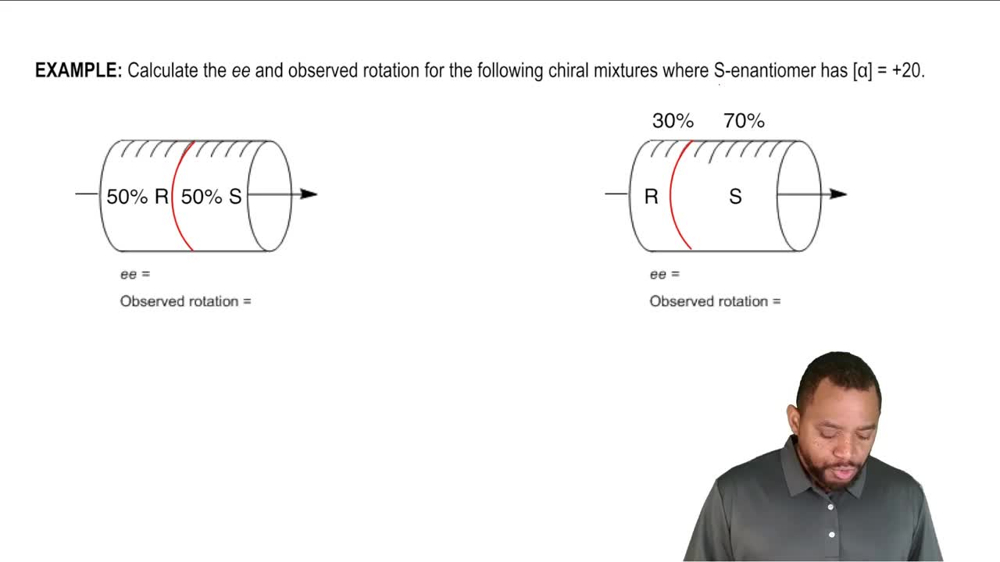
Calculating Enantiomeric Excess and Observed Rotation
Nucleophilic Substitution Mechanisms
Nucleophilic substitution mechanisms, such as SN1 and SN2, describe how nucleophiles replace leaving groups in organic compounds. The SN1 mechanism involves a two-step process where the leaving group departs first, forming a carbocation intermediate, which can then be attacked by the nucleophile from either side, leading to racemization. In contrast, the SN2 mechanism is a one-step process that results in inversion of configuration due to the backside attack of the nucleophile.
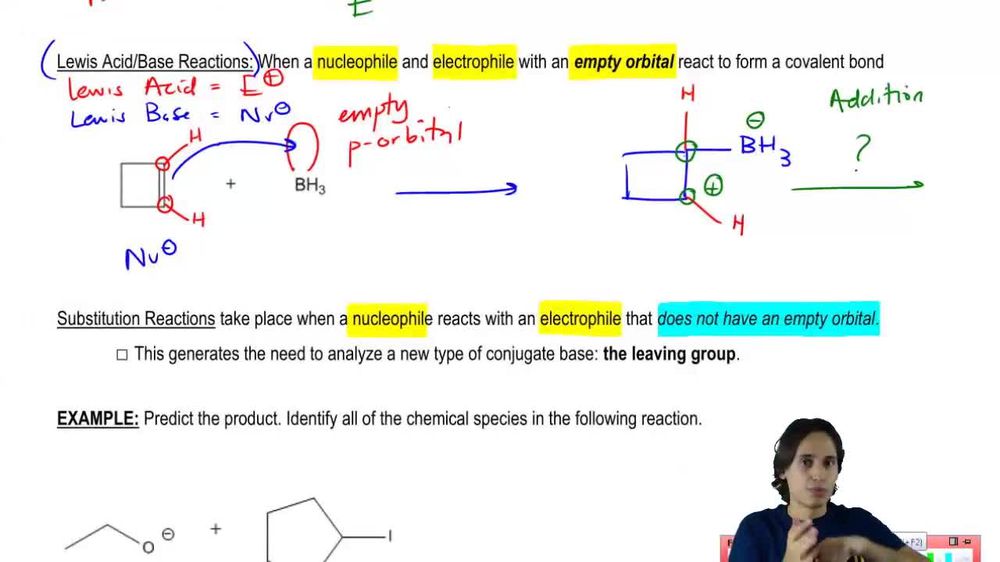
Nucleophiles and Electrophiles can react in Substitution Reactions.
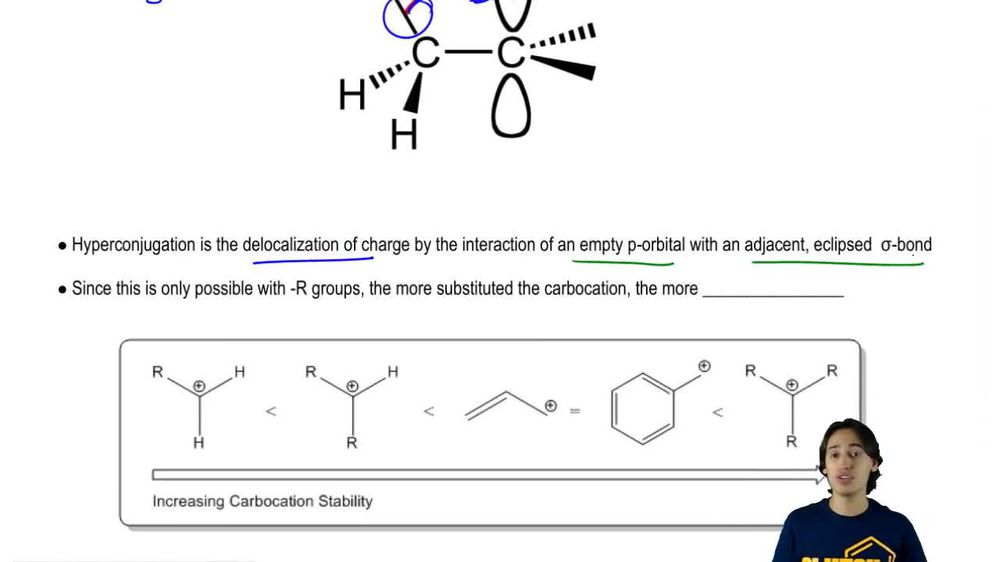
Carbocation Stability
Carbocation stability is a key factor in determining the pathway of nucleophilic substitution reactions. Tertiary carbocations are more stable than secondary or primary ones due to hyperconjugation and inductive effects from surrounding alkyl groups. In the case of butan-2-ol reacting with HBr, the formation of a stable carbocation intermediate facilitates the reaction and influences the extent of racemization, as the intermediate can lead to both inversion and retention of configuration.

 9:04 minutes
 Verified step by step guidance
 03:59
03:59