When cis-2-methylcyclohexanol reacts with the Lucas reagent, the major product is 1-chloro-1-methylcyclohexane. Propose a mechanism to explain the formation of this product.
Verified step by step guidance
1
Step 1: Understand the Lucas reagent reaction. The Lucas reagent is a mixture of concentrated hydrochloric acid (HCl) and zinc chloride (ZnCl₂). It is used to convert alcohols into alkyl chlorides via an SN1 or SN2 mechanism, depending on the structure of the alcohol. Tertiary alcohols typically undergo an SN1 mechanism due to the stability of the carbocation intermediate.
Step 2: Analyze the structure of cis-2-methylcyclohexanol. The hydroxyl (-OH) group is attached to a secondary carbon, and the molecule has a methyl group on the adjacent carbon. This secondary alcohol is likely to undergo an SN1 mechanism because the resulting carbocation can be stabilized by hyperconjugation and inductive effects from the methyl group.
Step 3: Protonation of the hydroxyl group. In the presence of the Lucas reagent, the hydroxyl group is protonated by HCl, forming water as a leaving group. This step increases the electrophilicity of the carbon attached to the hydroxyl group, making it more susceptible to nucleophilic attack.
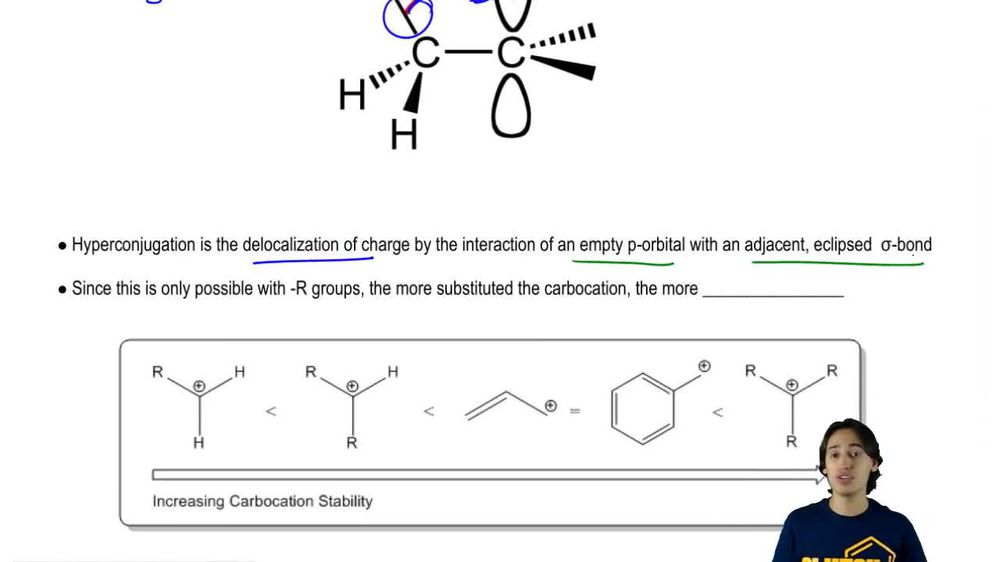
Step 4: Formation of the carbocation intermediate. After the water molecule leaves, a carbocation is formed at the secondary carbon. This carbocation is stabilized by the adjacent methyl group through hyperconjugation and inductive effects. The stability of the carbocation is crucial for the SN1 mechanism.
Step 5: Nucleophilic attack by chloride ion. The chloride ion (Cl⁻) from HCl acts as a nucleophile and attacks the carbocation, forming 1-chloro-1-methylcyclohexane as the major product. The stereochemistry of the product is determined by the planar nature of the carbocation, allowing the chloride ion to attack from either side.
Verified video answer for a similar problem:
This video solution was recommended by our tutors as helpful for the problem above
Video duration:
3m
Play a video:
0 Comments
Key Concepts
Here are the essential concepts you must grasp in order to answer the question correctly.
Cis-Trans Isomerism
Cis-trans isomerism refers to the different spatial arrangements of atoms in a molecule, particularly in cyclic compounds. In the case of cis-2-methylcyclohexanol, the methyl group and the hydroxyl group are on the same side of the cyclohexane ring, influencing the reactivity and sterics during reactions. Understanding this concept is crucial for predicting how the molecule will interact with reagents like the Lucas reagent.
The Lucas reagent, typically a mixture of zinc chloride and hydrochloric acid, is used to convert alcohols into alkyl halides. It works through the formation of a carbocation intermediate, which is more favorable for secondary and tertiary alcohols. Recognizing how the Lucas reagent functions helps in understanding the mechanism of the reaction and the stability of the resulting carbocation.
Carbocation stability is a key concept in organic chemistry, as the stability of the carbocation intermediate significantly influences the reaction pathway. Tertiary carbocations are more stable than secondary or primary ones due to hyperconjugation and inductive effects. In the reaction of cis-2-methylcyclohexanol with the Lucas reagent, the formation of a stable carbocation leads to the major product, 1-chloro-1-methylcyclohexane.

 3:31 minutes
 Verified step by step guidance
 00:44
00:44