What is the major product obtained from the acid-catalyzed hydration of each of the following alkenes? a. CH3CH2CH2CH=CH2
Verified step by step guidance
1
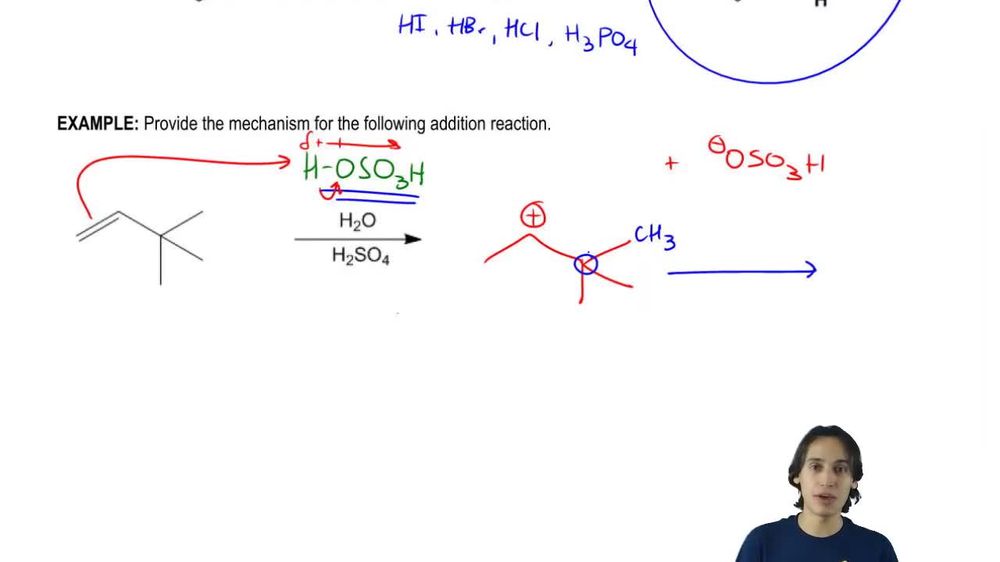
Step 1: Understand the reaction mechanism. Acid-catalyzed hydration of alkenes involves the addition of water (H₂O) across the double bond in the presence of an acid catalyst, typically H₂SO₄ or H₃PO₄. The reaction proceeds via a Markovnikov addition, where the hydroxyl group (-OH) attaches to the more substituted carbon atom.
Step 2: Identify the structure of the alkene provided in the problem. Determine the position of the double bond and the substituents attached to the carbon atoms involved in the double bond.
Step 3: Protonation of the alkene. The acid catalyst donates a proton (H⁺), which adds to one of the carbon atoms in the double bond, forming a carbocation intermediate. The stability of the carbocation is crucial, as the reaction will favor the formation of the most stable carbocation (tertiary > secondary > primary).
Step 4: Nucleophilic attack by water. The water molecule acts as a nucleophile and attacks the carbocation, forming an oxonium ion (R-OH₂⁺). This step leads to the addition of the hydroxyl group (-OH) to the more substituted carbon atom.
Step 5: Deprotonation. The oxonium ion loses a proton (H⁺) to form the final alcohol product. The major product is determined by the Markovnikov rule, where the -OH group is added to the more substituted carbon atom of the original double bond.
Verified video answer for a similar problem:
This video solution was recommended by our tutors as helpful for the problem above
Video duration:
4m
Play a video:
0 Comments
Key Concepts
Here are the essential concepts you must grasp in order to answer the question correctly.
Acid-Catalyzed Hydration
Acid-catalyzed hydration is a reaction where an alkene reacts with water in the presence of an acid catalyst, typically sulfuric acid. This process involves the formation of a carbocation intermediate, which is then attacked by water, leading to the formation of an alcohol. The regioselectivity of the reaction follows Markovnikov's rule, where the more substituted carbon of the alkene becomes bonded to the hydroxyl group.
Markovnikov's rule states that in the addition of HX (where X is a halogen or hydroxyl group) to an alkene, the hydrogen atom will attach to the carbon with the greater number of hydrogen atoms already attached. This rule helps predict the major product of the reaction, as it favors the formation of the more stable carbocation, which is typically more substituted and thus more stable due to hyperconjugation and inductive effects.
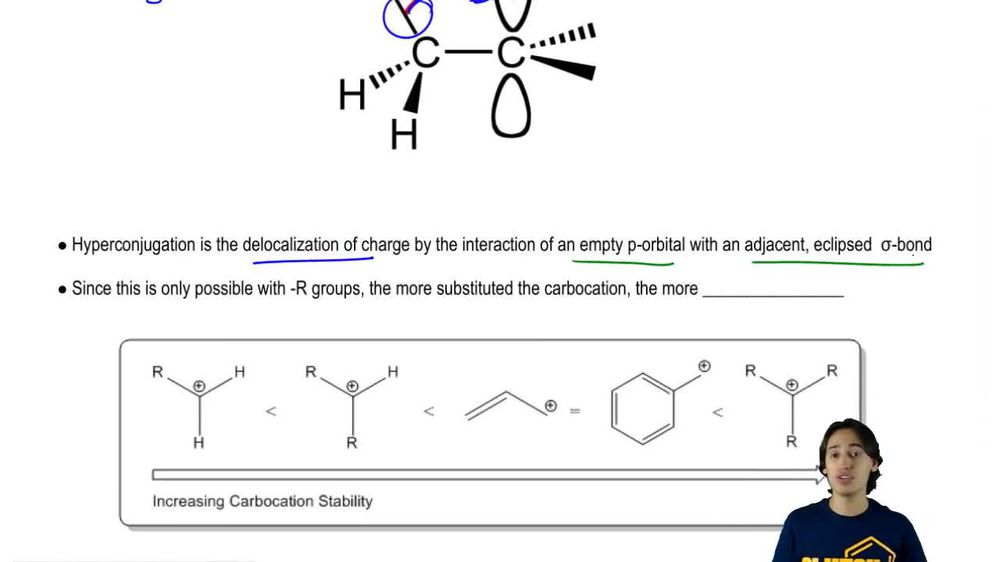
Carbocation stability is a key concept in organic chemistry that refers to the relative stability of positively charged carbon species. Carbocations are classified as primary, secondary, or tertiary based on the number of alkyl groups attached to the positively charged carbon. Tertiary carbocations are the most stable due to greater hyperconjugation and inductive effects from surrounding alkyl groups, making them more favorable intermediates in reactions such as acid-catalyzed hydration.