A good Williamson synthesis of ethyl methyl ether would be What is wrong with the following proposed synthesis of ethyl methyl ether? First, ethanol is treated with acid to protonate the hydroxy group (making it a good leaving group), and then sodium methoxide is added to displace water.
Verified step by step guidance
1
Step 1: Understand the Williamson synthesis mechanism. It involves the reaction of an alkoxide ion (nucleophile) with a primary alkyl halide (electrophile) to form an ether. The reaction proceeds via an SN2 mechanism, which requires a good nucleophile and a suitable leaving group.
Step 2: Analyze the proposed synthesis. Ethanol is treated with acid to protonate the hydroxyl group, forming water as a leaving group. Sodium methoxide is then added to displace water and form ethyl methyl ether.
Step 3: Identify the issue with the proposed synthesis. Protonating ethanol with acid creates a positively charged intermediate, which is prone to elimination reactions rather than substitution. This is because the acidic conditions favor the formation of alkenes via E1 elimination rather than the desired ether via SN2 substitution.
Step 4: Consider the role of sodium methoxide. Sodium methoxide is a strong base and nucleophile. Under acidic conditions, it may react with the protonated ethanol to form an alkene instead of displacing the leaving group to form the ether.
Step 5: Suggest a better approach. A good Williamson synthesis of ethyl methyl ether would involve using sodium ethoxide (the alkoxide ion) and methyl iodide (a primary alkyl halide with a good leaving group, iodide). This setup ensures an SN2 reaction proceeds efficiently to form the desired ether.
Verified video answer for a similar problem:
This video solution was recommended by our tutors as helpful for the problem above
Video duration:
3m
Play a video:
0 Comments
Key Concepts
Here are the essential concepts you must grasp in order to answer the question correctly.
Williamson Ether Synthesis
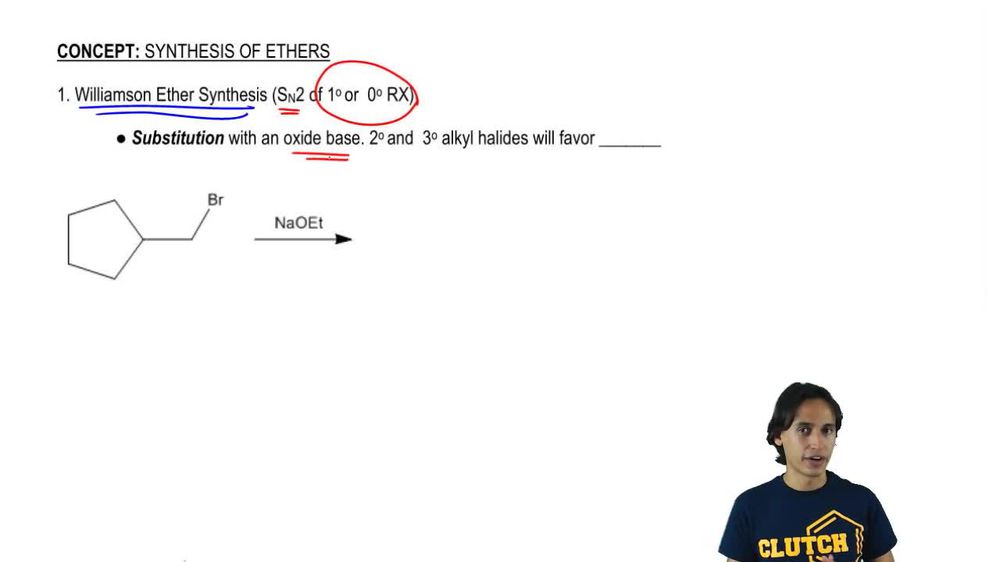
The Williamson ether synthesis is a method for creating ethers through the nucleophilic substitution of an alkoxide ion with a primary alkyl halide. This reaction typically involves the deprotonation of an alcohol to form an alkoxide, which then acts as a nucleophile to attack an electrophilic carbon in an alkyl halide, resulting in ether formation. The choice of reactants and conditions is crucial for the success of this synthesis.
Protonation of alcohols involves the addition of a proton (H+) to the hydroxyl group (-OH), converting it into a better leaving group, typically water (H2O). This process is essential in reactions where the alcohol is transformed into a more reactive species, facilitating nucleophilic substitution. However, protonation can lead to carbocation formation, which may result in rearrangements or elimination reactions instead of the desired substitution.
Nucleophilic substitution mechanisms, such as SN1 and SN2, describe how nucleophiles replace leaving groups in organic reactions. In SN2 reactions, a strong nucleophile attacks the electrophilic carbon simultaneously as the leaving group departs, leading to a concerted mechanism. In contrast, SN1 involves the formation of a carbocation intermediate, followed by nucleophilic attack. Understanding these mechanisms is vital for predicting the outcomes of reactions involving ethers and alcohols.

 3:56 minutes

 Verified step by step guidance
 03:50
03:50