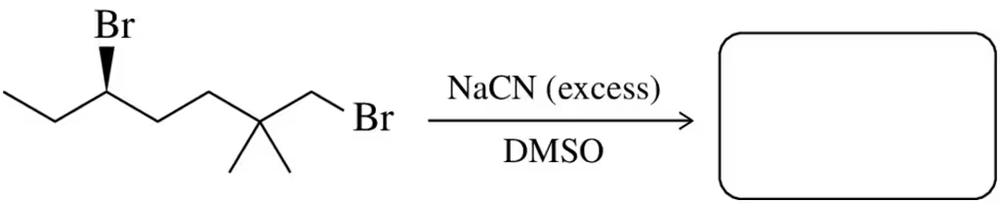
Even with an excess of cyanide, only one equivalent will react with the following dibromoalkane. To which carbon will the cyanide add? Predict the product and explain your choice.
Verified step by step guidance
1
Analyze the structure of the dibromoalkane: The molecule contains two bromine atoms attached to different carbons. One bromine is attached to a secondary carbon (chiral center), and the other bromine is attached to a primary carbon.
Consider the reaction conditions: Sodium cyanide (NaCN) in DMSO is a nucleophilic substitution reaction (SN2 mechanism). The cyanide ion (CN⁻) is a strong nucleophile, and DMSO is a polar aprotic solvent that favors SN2 reactions.
Evaluate the reactivity of the two carbons: In an SN2 reaction, the nucleophile attacks the carbon attached to the leaving group (bromine) with the least steric hindrance. The primary carbon is less sterically hindered compared to the secondary carbon, making it the preferred site for nucleophilic attack.
Predict the product: The cyanide ion will replace the bromine atom on the primary carbon, forming a nitrile group (-C≡N) at that position. The secondary bromine will remain intact because only one equivalent of cyanide reacts.
Explain the choice: The preference for the primary carbon is due to the steric accessibility required for the SN2 mechanism. The secondary carbon is more hindered, making it less favorable for nucleophilic attack under these conditions.
Verified video answer for a similar problem:
This video solution was recommended by our tutors as helpful for the problem above
Play a video:
0 Comments
Key Concepts
Here are the essential concepts you must grasp in order to answer the question correctly.
Nucleophilic Substitution Reactions
Nucleophilic substitution reactions involve the replacement of a leaving group (like bromine) by a nucleophile (such as cyanide). The nucleophile attacks the electrophilic carbon atom bonded to the leaving group, leading to the formation of a new bond. Understanding the mechanism, whether it follows an SN1 or SN2 pathway, is crucial for predicting the product of the reaction.
Nucleophiles and Electrophiles can react in Substitution Reactions.
Steric Hindrance
Steric hindrance refers to the repulsion between bulky groups in a molecule, which can affect the reactivity of certain sites. In this case, the presence of bulky groups near the bromine atoms can influence which carbon atom the cyanide will attack. The less hindered carbon is typically more accessible for nucleophilic attack, guiding the prediction of the product.
Alkyl halides, such as dibromoalkanes, vary in reactivity based on the structure of the carbon atoms to which the halides are attached. Primary alkyl halides are generally more reactive towards nucleophiles than secondary or tertiary ones. In this scenario, recognizing the type of alkyl halide and the stability of the resulting carbocation (if applicable) is essential for predicting the outcome of the reaction.

 Verified step by step guidance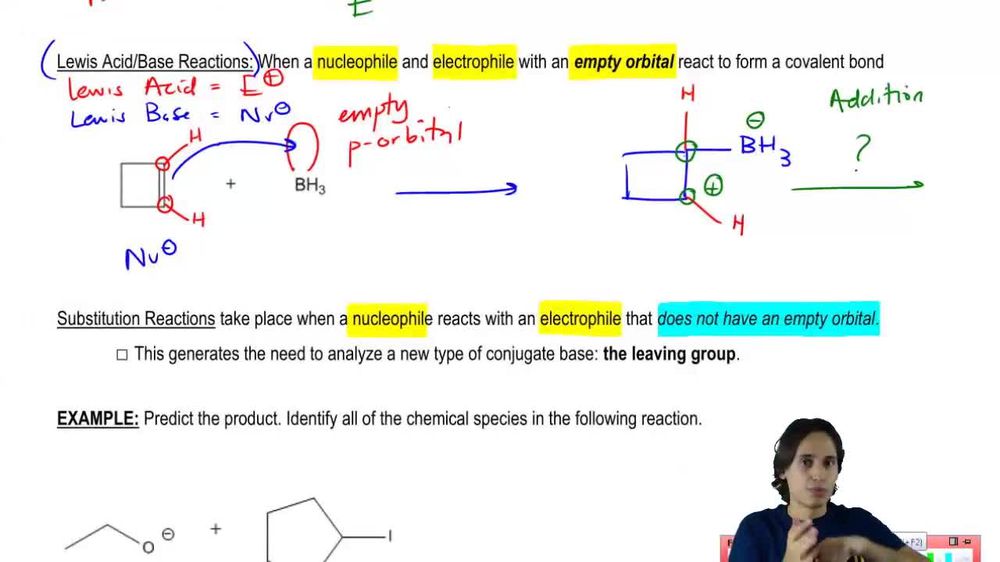
 01:47
01:47