Which of the following reactions take place more rapidly when the concentration of the nucleophile is increased?
Verified step by step guidance
1
Step 1: Analyze the reaction mechanisms for each reaction. Reaction A involves a secondary alkyl bromide and CH3O− as the nucleophile. Reaction B involves a primary alkyl bromide and CH3S− as the nucleophile. Reaction C involves a tertiary alkyl bromide and CH3COO− as the nucleophile.
Step 2: Determine the type of substitution mechanism (SN1 or SN2) for each reaction. SN2 reactions are bimolecular and depend on the concentration of both the nucleophile and the substrate, while SN1 reactions are unimolecular and depend only on the substrate concentration.
Step 3: Reaction A likely proceeds via an SN2 mechanism because the secondary alkyl bromide is accessible to the nucleophile, and CH3O− is a strong nucleophile. SN2 reactions are faster when the nucleophile concentration is increased.
Step 4: Reaction B also likely proceeds via an SN2 mechanism because the primary alkyl bromide is highly accessible to the nucleophile, and CH3S− is a strong nucleophile. Increasing the nucleophile concentration will speed up the reaction.
Step 5: Reaction C likely proceeds via an SN1 mechanism because the tertiary alkyl bromide forms a stable carbocation intermediate. The rate of an SN1 reaction is independent of the nucleophile concentration, so increasing the nucleophile concentration will not affect the reaction rate.
Verified video answer for a similar problem:
This video solution was recommended by our tutors as helpful for the problem above
Video duration:
3m
Play a video:
0 Comments
Key Concepts
Here are the essential concepts you must grasp in order to answer the question correctly.
Nucleophilicity
Nucleophilicity refers to the ability of a nucleophile to donate an electron pair to an electrophile during a chemical reaction. It is influenced by factors such as charge, electronegativity, and steric hindrance. A stronger nucleophile will react more readily with an electrophile, making the reaction faster as the concentration of the nucleophile increases.
The reaction mechanism describes the step-by-step process by which reactants are converted into products. Understanding whether a reaction proceeds via a single step or multiple steps is crucial, as it affects how changes in nucleophile concentration influence the reaction rate. For example, in a bimolecular nucleophilic substitution (SN2) reaction, increasing nucleophile concentration directly increases the reaction rate.
The rate law is an equation that relates the rate of a reaction to the concentration of its reactants. It is expressed in the form Rate = k [A]^m [B]^n, where k is the rate constant, and m and n are the orders of the reaction with respect to reactants A and B. For reactions where the nucleophile is a reactant, increasing its concentration will typically increase the reaction rate, as indicated by the rate law.

 3:43 minutes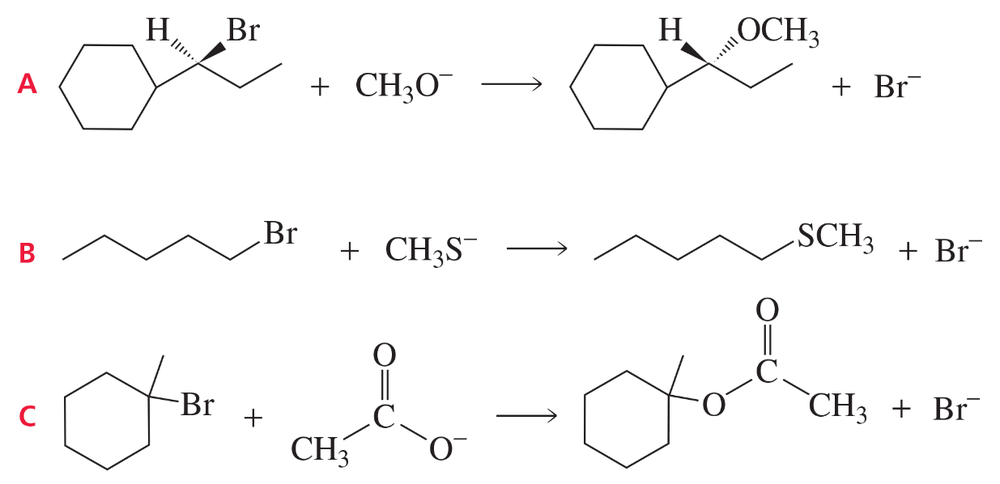
 Verified step by step guidance
 08:27
08:27