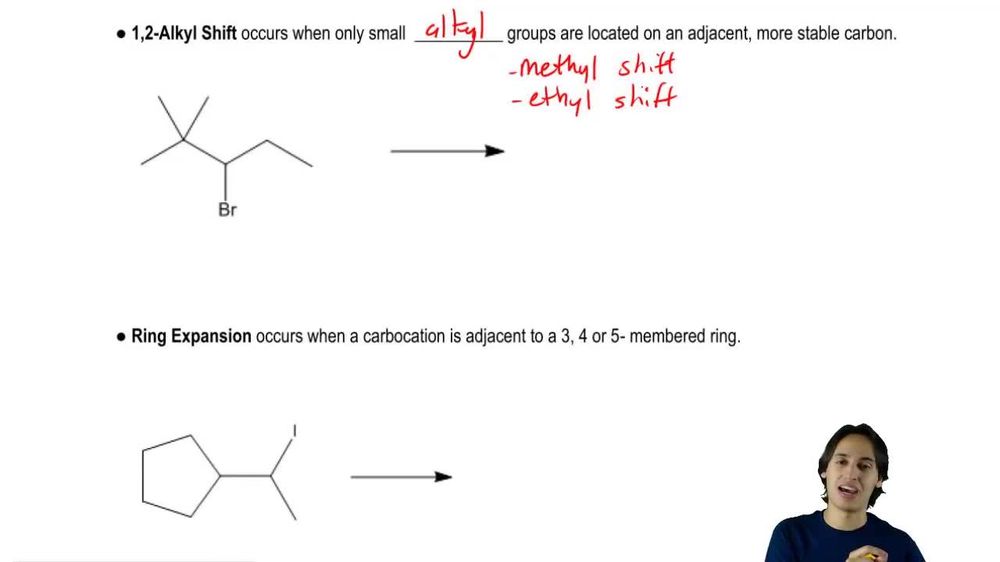
The following reaction is called the pinacol rearrangement. The reaction begins with an acid-promoted ionization to give a carbocation. This carbocation undergoes a methyl shift to give a more stable, resonance-stabilized cation. Loss of a proton gives the observed product. Propose a mechanism for the pinacol rearrangement.
Verified step by step guidance
1
Step 1: Protonation of one of the hydroxyl groups occurs in the presence of sulfuric acid (H2SO4). This converts the hydroxyl group into a better leaving group, forming water.
Step 2: The water molecule leaves, generating a carbocation at the carbon where the hydroxyl group was initially attached. This carbocation is relatively unstable.
Step 3: A methyl group undergoes a 1,2-shift (methyl migration) to stabilize the carbocation. This results in the formation of a resonance-stabilized tertiary carbocation.
Step 4: A deprotonation step occurs, where a proton is removed from the carbocation intermediate. This leads to the formation of a ketone group (C=O) at the migrated carbon.
Step 5: The final product, pinacolone (H3CC(=O)C(CH3)3), is formed as a result of the rearrangement and stabilization of the molecule.
Verified video answer for a similar problem:
This video solution was recommended by our tutors as helpful for the problem above
Video duration:
4m
Play a video:
0 Comments
Key Concepts
Here are the essential concepts you must grasp in order to answer the question correctly.
Carbocation Stability
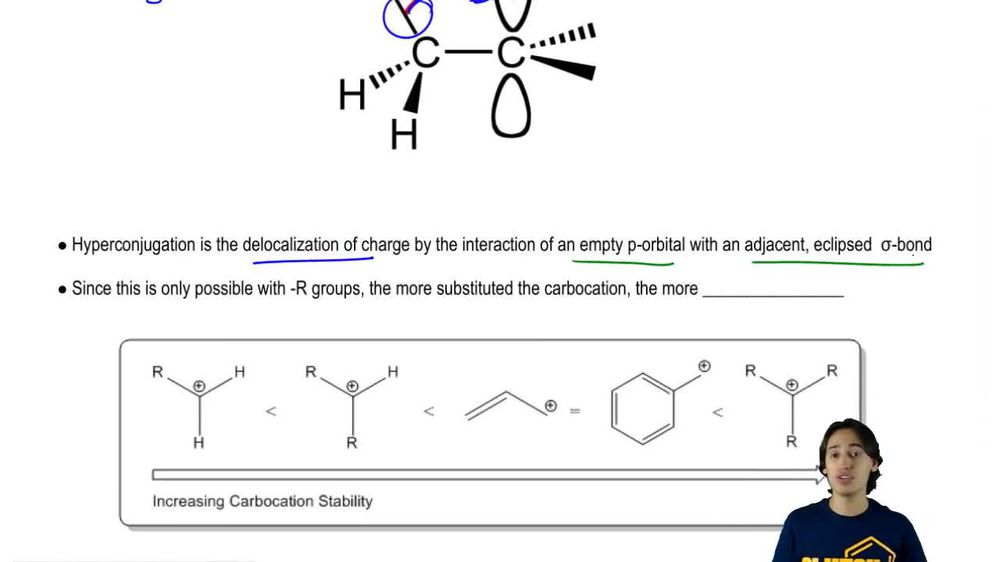
Carbocations are positively charged species that are highly reactive. Their stability is influenced by the degree of substitution; tertiary carbocations are more stable than secondary or primary ones due to hyperconjugation and inductive effects. In the pinacol rearrangement, the formation of a more stable carbocation through a methyl shift is crucial for the reaction's progression.
A methyl shift is a type of rearrangement where a methyl group moves from one carbon to an adjacent carbon, resulting in the formation of a more stable carbocation. This process is essential in the pinacol rearrangement, as it allows the reaction to proceed through a more stable intermediate, ultimately leading to the formation of the product, pinacolone.
The pinacol rearrangement is an acid-catalyzed reaction, meaning that the presence of an acid (like H2SO4) facilitates the ionization of the starting material, pinacol. This ionization generates a carbocation, which is a key intermediate in the reaction mechanism. The acid not only promotes the formation of the carbocation but also helps in the subsequent steps leading to the final product.

 4:20 minutes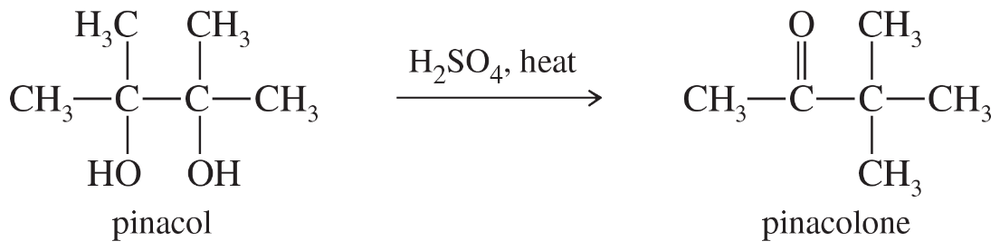
 Verified step by step guidance
 05:58
05:58