Arrange the following compounds in order of decreasing acidity. CH3COOH, CH3OH, CH3CH3, CH3SO3H, CH3NH2, CH3SH, CH3C≡CH
Verified step by step guidance
1
Step 1: Understand the concept of acidity. Acidity is determined by the ability of a compound to donate a proton (H⁺). The more stable the conjugate base formed after losing a proton, the stronger the acid.
Step 2: Analyze the functional groups in each compound. CH3COOH (acetic acid) contains a carboxylic acid group, CH3OH (methanol) contains an alcohol group, CH3CH3 (ethane) is an alkane, CH3SO3H (methanesulfonic acid) contains a sulfonic acid group, CH3NH2 (methylamine) contains an amine group, CH3SH (methanethiol) contains a thiol group, and CH3C≡CH (propyne) contains an alkyne group.
Step 3: Compare the electron-withdrawing effects of the functional groups. Electron-withdrawing groups stabilize the conjugate base, increasing acidity. Sulfonic acid (CH3SO3H) is highly acidic due to strong electron-withdrawing effects. Carboxylic acid (CH3COOH) is next, followed by thiol (CH3SH), alcohol (CH3OH), alkyne (CH3C≡CH), amine (CH3NH2), and alkane (CH3CH3).
Step 4: Consider resonance stabilization. CH3COOH and CH3SO3H have resonance stabilization in their conjugate bases, making them more acidic. CH3C≡CH has some acidity due to the sp hybridization of the carbon atom bonded to the hydrogen, which increases electronegativity.
Step 5: Arrange the compounds in order of decreasing acidity based on the analysis: CH3SO3H > CH3COOH > CH3SH > CH3OH > CH3C≡CH > CH3NH2 > CH3CH3.
Verified video answer for a similar problem:
This video solution was recommended by our tutors as helpful for the problem above
Video duration:
3m
Play a video:
0 Comments
Key Concepts
Here are the essential concepts you must grasp in order to answer the question correctly.
Acidity and pKa
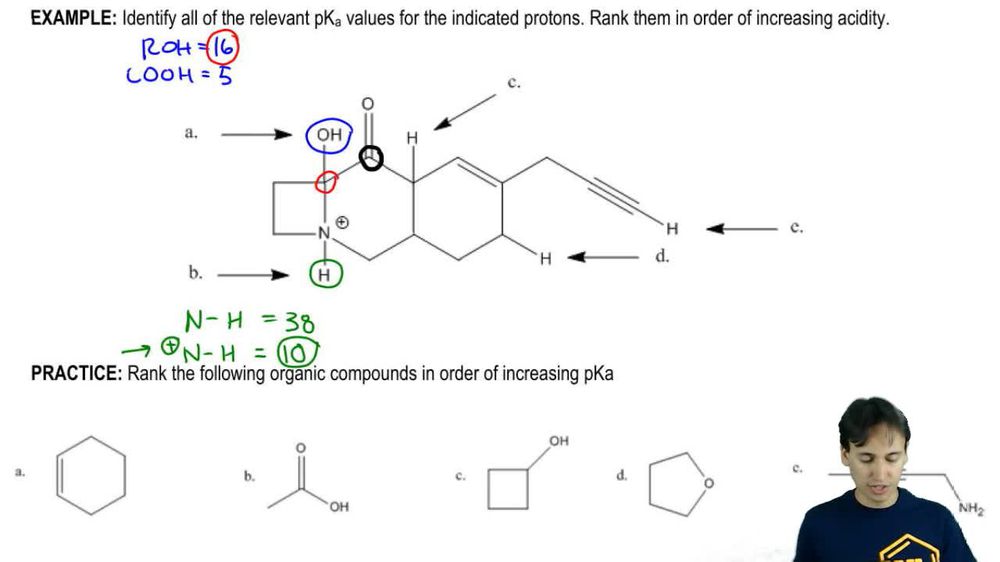
Acidity refers to the ability of a compound to donate a proton (H+) in a solution. The strength of an acid is often measured by its pKa value, where lower pKa values indicate stronger acids. Understanding the relationship between structure and acidity is crucial for predicting the order of acidity among different compounds.
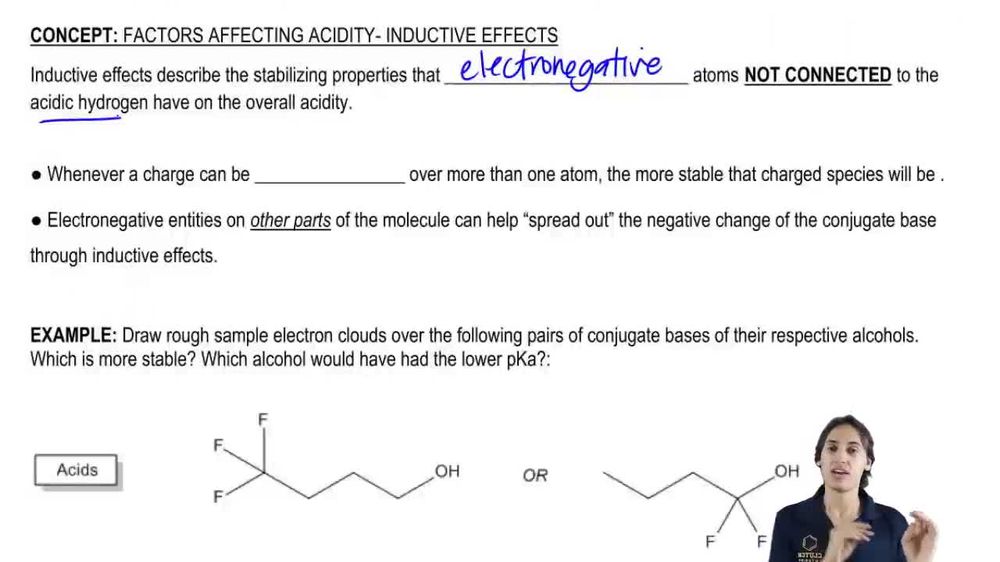
Different functional groups influence the acidity of a compound. For example, carboxylic acids (like CH3COOH) are generally more acidic than alcohols (like CH3OH) due to the stability of their conjugate bases. Recognizing how electronegative atoms and resonance can stabilize negative charges is essential for comparing acidity.
The inductive effect refers to the electron-withdrawing or electron-donating effects of substituents on a molecule, which can influence acidity. Additionally, resonance can stabilize the conjugate base of an acid, enhancing its acidity. Understanding these concepts helps in predicting the relative acidity of compounds based on their molecular structure.