Give a mechanism for the following substitution and elimination reactions. (a)
Verified step by step guidance
1
Identify the type of substitution or elimination reaction. Determine whether the reaction is SN1, SN2, E1, or E2 based on the substrate (primary, secondary, or tertiary alkyl halide), the nucleophile/base strength, and the solvent (polar protic or aprotic).
For substitution reactions: If the reaction is SN1, draw the mechanism starting with the formation of a carbocation intermediate after the leaving group departs. If the reaction is SN2, show a single concerted step where the nucleophile attacks the electrophilic carbon from the opposite side of the leaving group, leading to inversion of configuration.
For elimination reactions: If the reaction is E1, show the formation of a carbocation intermediate after the leaving group departs, followed by the removal of a β-hydrogen by the base to form a double bond. If the reaction is E2, depict a single concerted step where the base abstracts a β-hydrogen while the leaving group departs, forming a double bond.
Consider regioselectivity and stereoselectivity: For elimination reactions, apply Zaitsev's rule (the more substituted alkene is favored) unless steric hindrance or a bulky base favors the Hofmann product. For substitution reactions, consider stereochemical outcomes (e.g., inversion in SN2).
Draw the complete step-by-step mechanism for the reaction, including all intermediates, transition states, and curved arrows to indicate electron flow. Ensure that all charges and lone pairs are properly accounted for in the mechanism.
Verified video answer for a similar problem:
This video solution was recommended by our tutors as helpful for the problem above
Video duration:
5m
Play a video:
0 Comments
Key Concepts
Here are the essential concepts you must grasp in order to answer the question correctly.
Nucleophilic Substitution
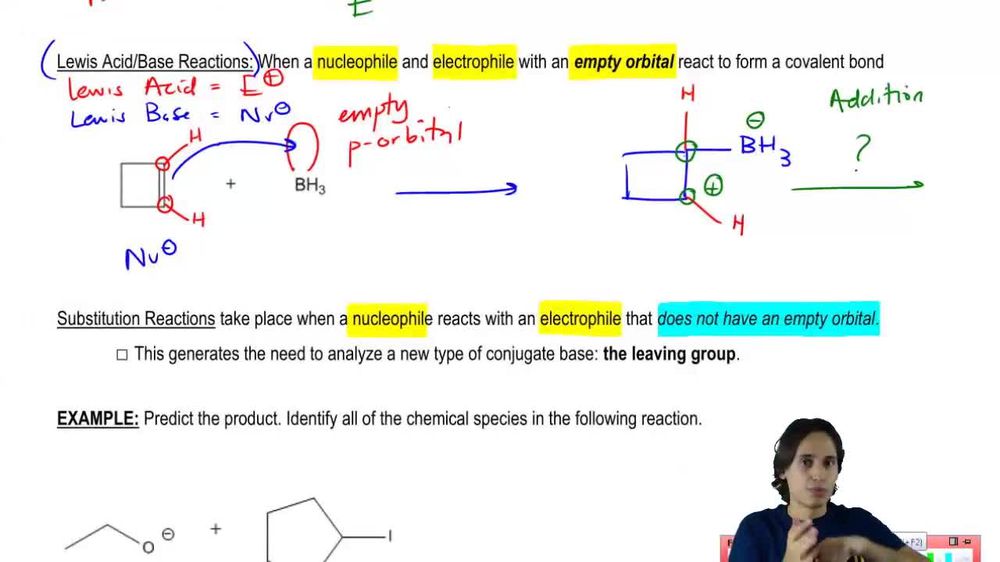
Nucleophilic substitution is a fundamental reaction in organic chemistry where a nucleophile attacks an electrophile, resulting in the replacement of a leaving group. This process can occur via two main mechanisms: SN1, which involves a two-step process with a carbocation intermediate, and SN2, which is a one-step process where the nucleophile attacks the electrophile simultaneously as the leaving group departs. Understanding the conditions that favor each mechanism is crucial for predicting the outcome of substitution reactions.
Nucleophiles and Electrophiles can react in Substitution Reactions.
Elimination Reactions
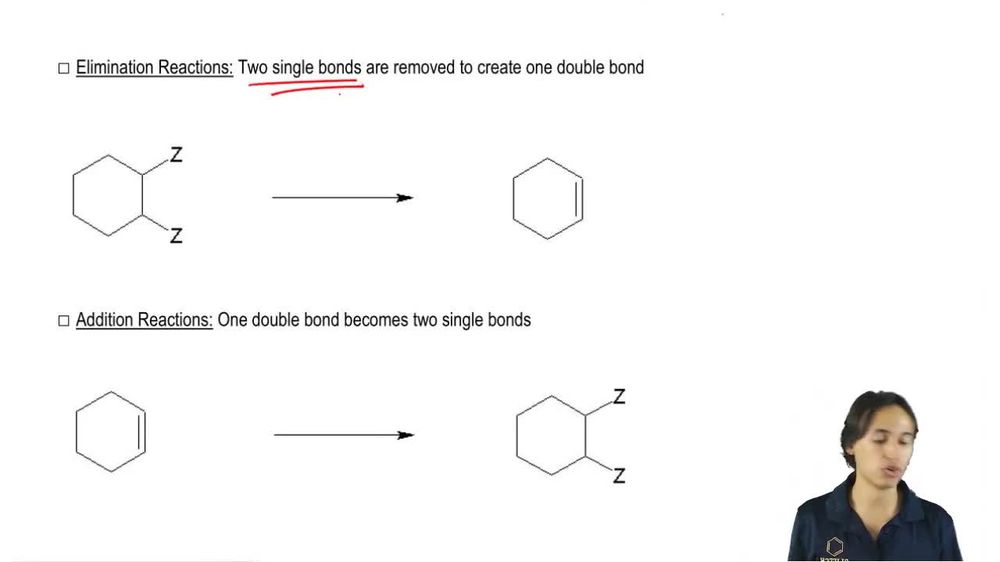
Elimination reactions involve the removal of a small molecule, typically water or hydrogen halide, from a larger molecule, resulting in the formation of a double bond. The two primary types are E1, which is a two-step process involving a carbocation intermediate, and E2, which is a concerted one-step process where the base abstracts a proton while the leaving group departs. The choice between substitution and elimination often depends on the structure of the substrate and the reaction conditions.
A reaction mechanism is a detailed description of the step-by-step process by which reactants are converted into products in a chemical reaction. It includes the identification of intermediates, transition states, and the order of bond breaking and forming. Understanding the mechanism is essential for predicting the products of a reaction, as well as the conditions under which different pathways (substitution vs. elimination) are favored.

 5:03 minutes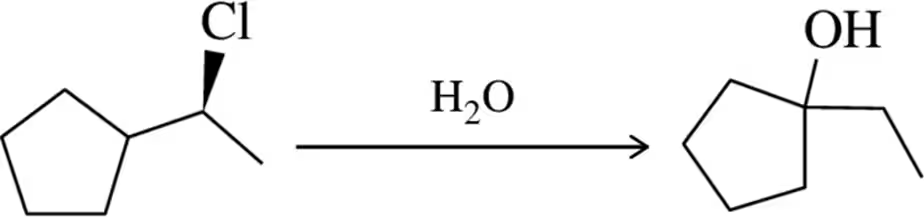
 Verified step by step guidance
 01:47
01:47