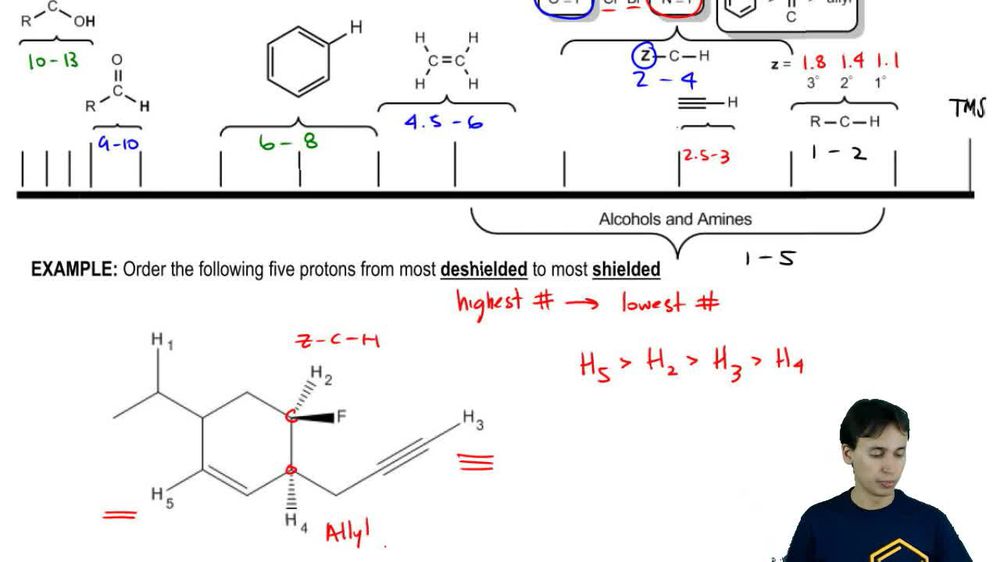
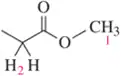
For the following molecules, give the chemical shift for each indicated hydrogen. (e)
Verified step by step guidance
1
Identify the molecular structure and locate the hydrogen atoms for which the chemical shift needs to be determined. This involves understanding the environment around each hydrogen atom, including nearby atoms and functional groups.
Consider the electronic environment of each hydrogen atom. Chemical shifts in NMR spectroscopy are influenced by the electron density around the hydrogen. Electronegative atoms or groups can deshield the hydrogen, causing a downfield shift (higher ppm value).
Analyze the hybridization of the carbon atom to which the hydrogen is attached. For example, hydrogens attached to sp3 hybridized carbons typically appear upfield (lower ppm), while those attached to sp2 or sp hybridized carbons appear downfield.
Take into account any aromatic or conjugated systems. Hydrogens in aromatic systems, such as benzene rings, often appear in a distinct chemical shift range due to the ring current effect.
Use reference tables or literature values to estimate the chemical shift range for each type of hydrogen in the molecule. Compare the environments of the hydrogens in your molecule to these standard values to predict their chemical shifts.
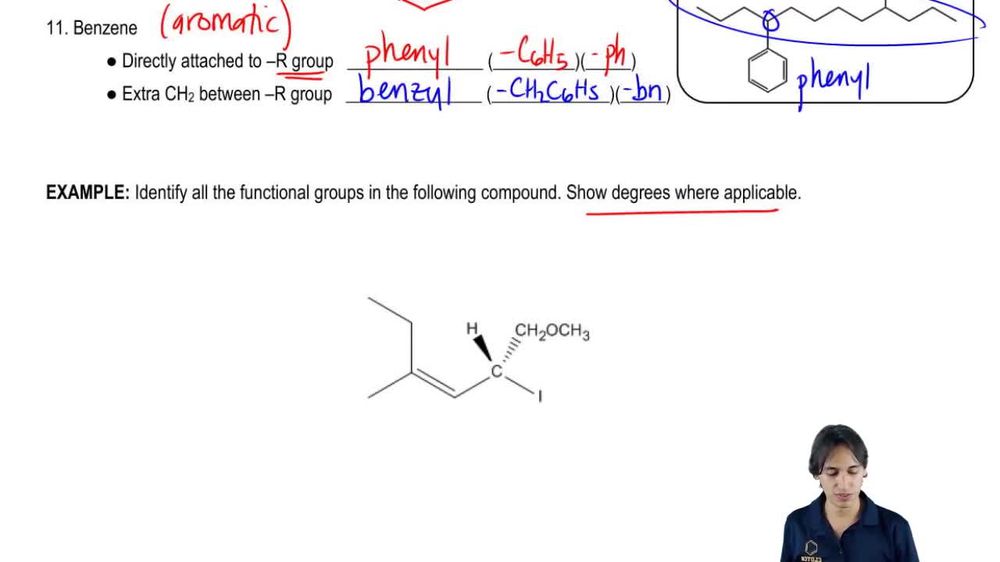
Verified video answer for a similar problem:
This video solution was recommended by our tutors as helpful for the problem above
Play a video:
0 Comments
Key Concepts
Here are the essential concepts you must grasp in order to answer the question correctly.
Chemical Shift
Chemical shift refers to the position on the NMR spectrum where a particular hydrogen atom resonates. It is influenced by the electronic environment surrounding the hydrogen, which affects its magnetic field. The chemical shift is measured in parts per million (ppm) and provides insights into the structure and functional groups present in the molecule.
Shielding occurs when electrons around a hydrogen atom create a local magnetic field that opposes the external magnetic field, resulting in a lower chemical shift. Deshielding happens when the electron density is reduced, often due to electronegative atoms or groups, leading to a higher chemical shift. Understanding these effects is crucial for predicting chemical shifts in NMR spectroscopy.
Functional groups significantly impact the chemical shift of hydrogens in a molecule. For instance, hydrogens attached to carbon atoms near electronegative atoms or within aromatic rings typically exhibit higher chemical shifts due to deshielding. Recognizing the presence and type of functional groups helps in estimating the chemical shift values accurately.

 Verified step by step guidance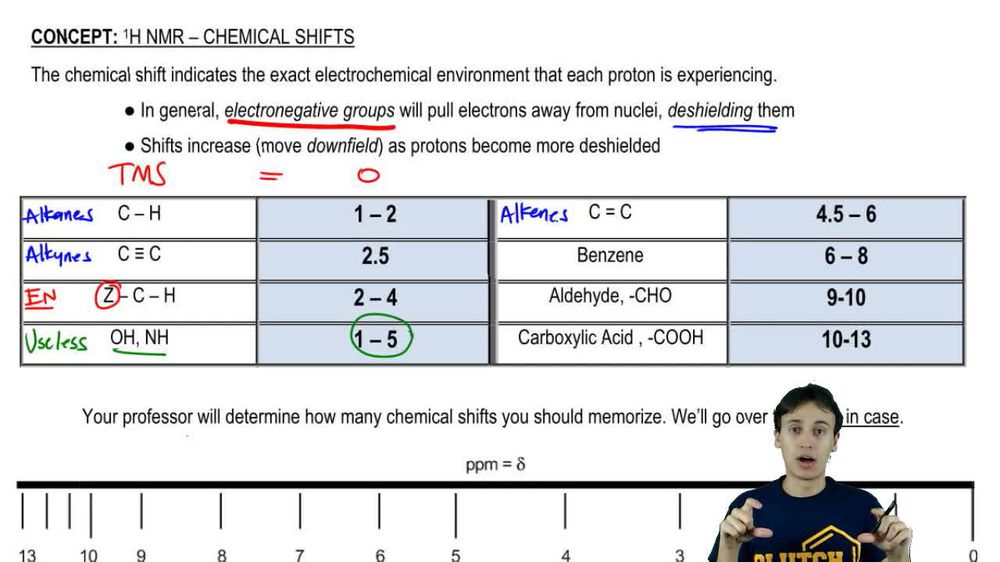
 11:44
11:44