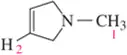
For the following molecules, give the chemical shift for each indicated hydrogen. (d)
Verified step by step guidance
1
Identify the molecular structure and locate the hydrogen atoms for which the chemical shift needs to be determined.
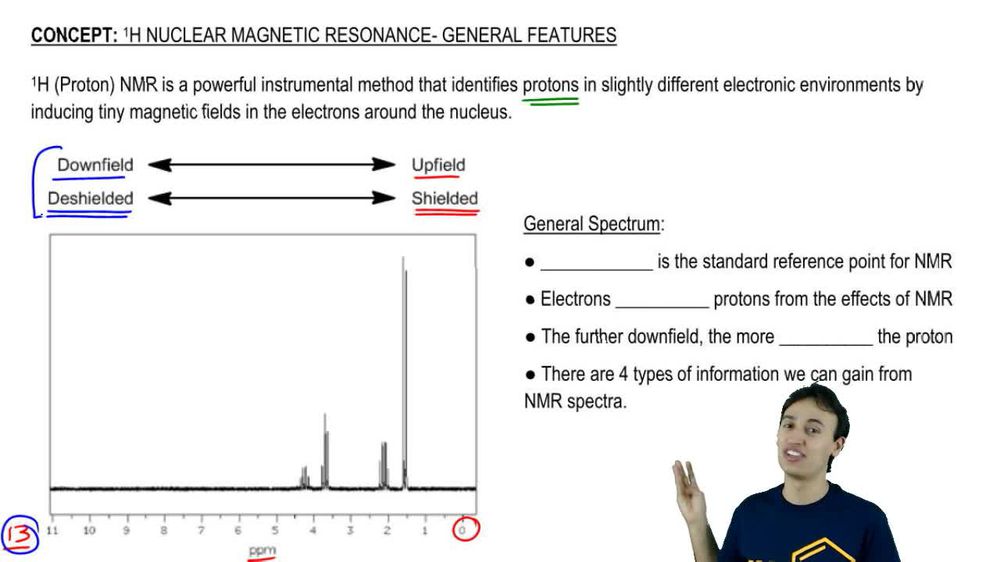
Understand the concept of chemical shift in NMR spectroscopy, which is influenced by the electronic environment surrounding the hydrogen atoms.
Consider the electronic effects such as electronegativity of nearby atoms, hybridization of the carbon atom to which the hydrogen is attached, and any resonance effects that might deshield or shield the hydrogen.
Use typical chemical shift ranges for different types of hydrogen environments: alkane (0.9-1.5 ppm), alkene (4.5-6.5 ppm), aromatic (6.0-8.5 ppm), and others, to estimate the chemical shift.
Compare the hydrogen environments in the molecule to known reference values or tables to assign a chemical shift range for each indicated hydrogen.
Verified video answer for a similar problem:
This video solution was recommended by our tutors as helpful for the problem above
Play a video:
0 Comments
Key Concepts
Here are the essential concepts you must grasp in order to answer the question correctly.
Chemical Shift
Chemical shift refers to the resonant frequency of a nucleus relative to a standard in nuclear magnetic resonance (NMR) spectroscopy. It provides information about the electronic environment surrounding a nucleus, which can be influenced by factors such as electronegativity and hybridization of nearby atoms. Chemical shifts are measured in parts per million (ppm) and are crucial for identifying different types of hydrogen atoms in a molecule.
NMR spectroscopy is a technique used to observe the local magnetic fields around atomic nuclei. It is particularly useful in organic chemistry for determining the structure of a molecule, including the arrangement of atoms and the identification of functional groups. By analyzing the chemical shifts, coupling constants, and integration of signals, chemists can deduce the molecular structure and dynamics.
Several factors influence the chemical shift of hydrogen atoms in NMR spectroscopy, including electronegativity of adjacent atoms, hybridization of the carbon atom to which the hydrogen is attached, and the presence of electron-withdrawing or electron-donating groups. These factors alter the electron density around the hydrogen, affecting its resonance frequency and thus its chemical shift.

 Verified step by step guidance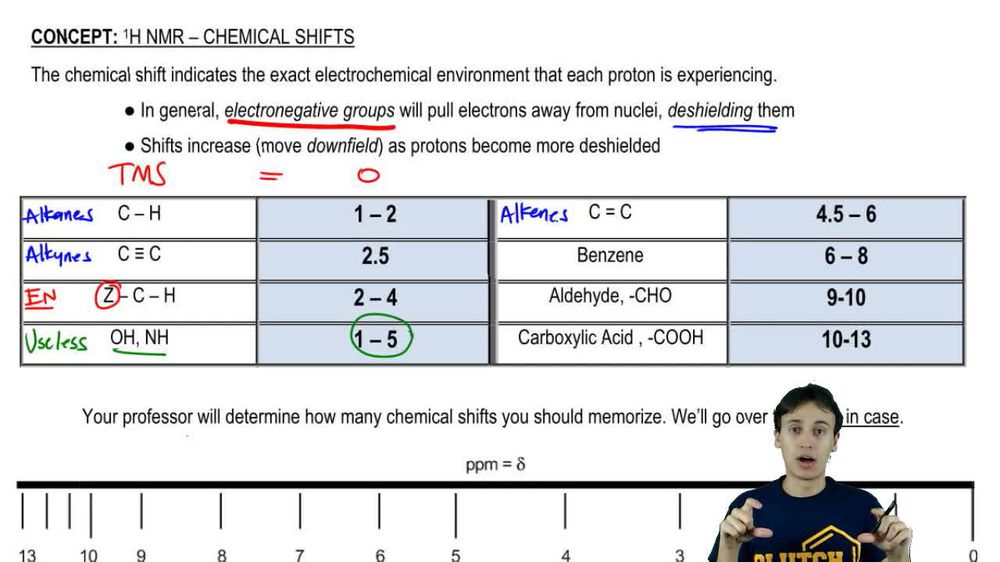
 11:44
11:44