Show how hex-1-yne might be converted to e. 2-bromohexane.
Verified step by step guidance
1
Identify the starting material (hex-1-yne) and the target product (2-bromohexane). Hex-1-yne is an alkyne, and 2-bromohexane is an alkane with a bromine atom on the second carbon. This suggests a multi-step reaction involving reduction and halogenation.
Step 1: Perform a partial reduction of hex-1-yne to hex-1-ene. Use a Lindlar catalyst (Pd/CaCO₃ poisoned with lead or quinoline) and hydrogen gas (H₂). This will selectively reduce the alkyne to a cis-alkene without further reducing it to an alkane.
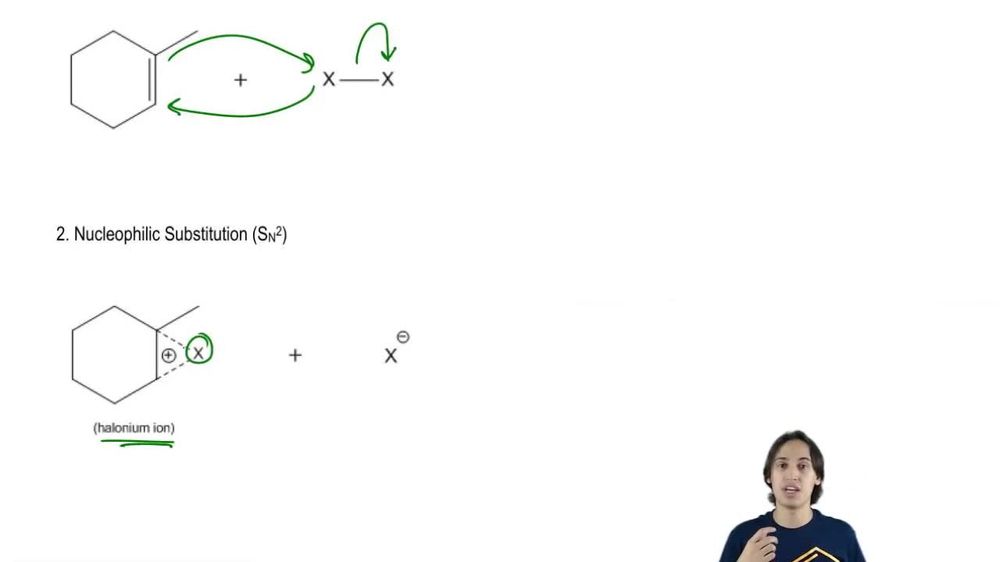
Step 2: Carry out a hydrohalogenation reaction to add a bromine atom to the second carbon of the hex-1-ene. Use HBr (hydrobromic acid) as the reagent. According to Markovnikov's rule, the bromine will add to the more substituted carbon (C-2), while the hydrogen will add to the less substituted carbon (C-1).
Step 3: Verify the product structure. The resulting compound should be 2-bromohexane, with the bromine atom attached to the second carbon of the hexane chain.
Step 4: Purify the product if necessary, using techniques such as distillation or recrystallization, to isolate 2-bromohexane in its pure form.
Verified video answer for a similar problem:
This video solution was recommended by our tutors as helpful for the problem above
Video duration:
1m
Play a video:
0 Comments
Key Concepts
Here are the essential concepts you must grasp in order to answer the question correctly.
Alkyne Reactivity
Alkynes, such as hex-1-yne, are hydrocarbons containing a carbon-carbon triple bond. This triple bond makes them more reactive than alkenes and alkanes, allowing them to undergo various reactions, including halogenation. Understanding the reactivity of alkynes is crucial for predicting the products of their reactions.
Halogenation is a chemical reaction where halogens (like bromine) are added to a compound. In the case of converting hex-1-yne to 2-bromohexane, the triple bond can be converted to a double bond through partial hydrogenation, followed by the addition of bromine. This process is essential for introducing halogen substituents into organic molecules.
Markovnikov's Rule states that in the addition of HX (where X is a halogen) to an alkene, the hydrogen atom will attach to the carbon with the greater number of hydrogen atoms already attached. This principle helps predict the regioselectivity of the reaction, guiding the formation of 2-bromohexane from hex-1-yne by favoring the more stable carbocation during the reaction.

 1:32 minutes
 Verified step by step guidance
 09:11
09:11