When 3-methyl-1-butene reacts with HBr, two alkyl halides are formed: 2-bromo-3-methylbutane and 2-bromo-2-methylbutane. Propose a mechanism that explains the formation of these two products.
Verified step by step guidance
1
Step 1: Begin by identifying the structure of 3-methyl-1-butene. It is an alkene with a double bond between the first and second carbons, and a methyl group attached to the third carbon. The molecular formula is C5H10.
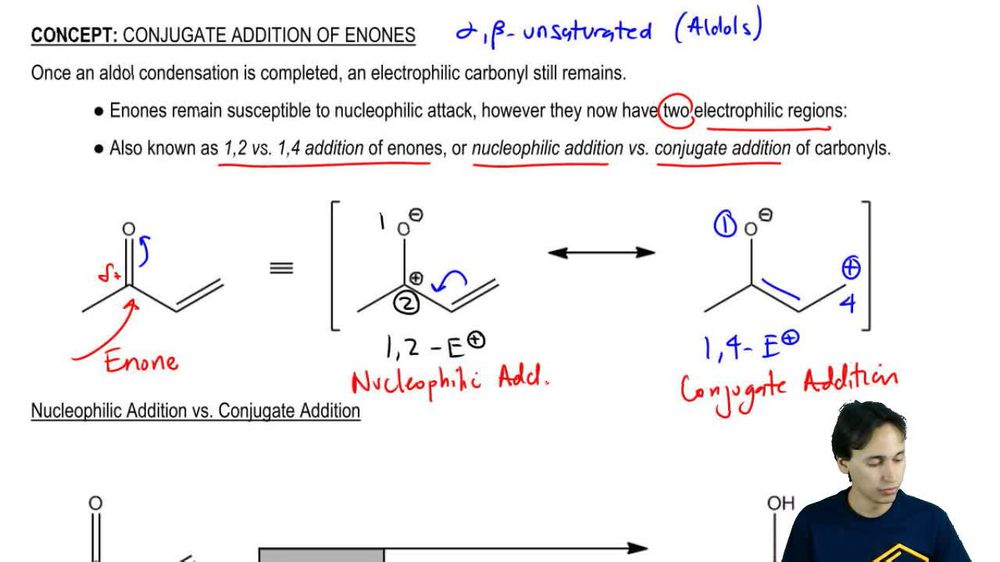
Step 2: Recognize that the reaction involves the addition of HBr to the alkene. This is an electrophilic addition reaction, where the π-electrons of the double bond act as a nucleophile and attack the electrophilic hydrogen (H) of HBr.
Step 3: The first step of the mechanism involves protonation of the double bond. The π-electrons of the double bond attack the hydrogen atom of HBr, leading to the formation of a carbocation intermediate. Depending on which carbon of the double bond gets protonated, two possible carbocations can form: a secondary carbocation at C2 or a tertiary carbocation at C3.
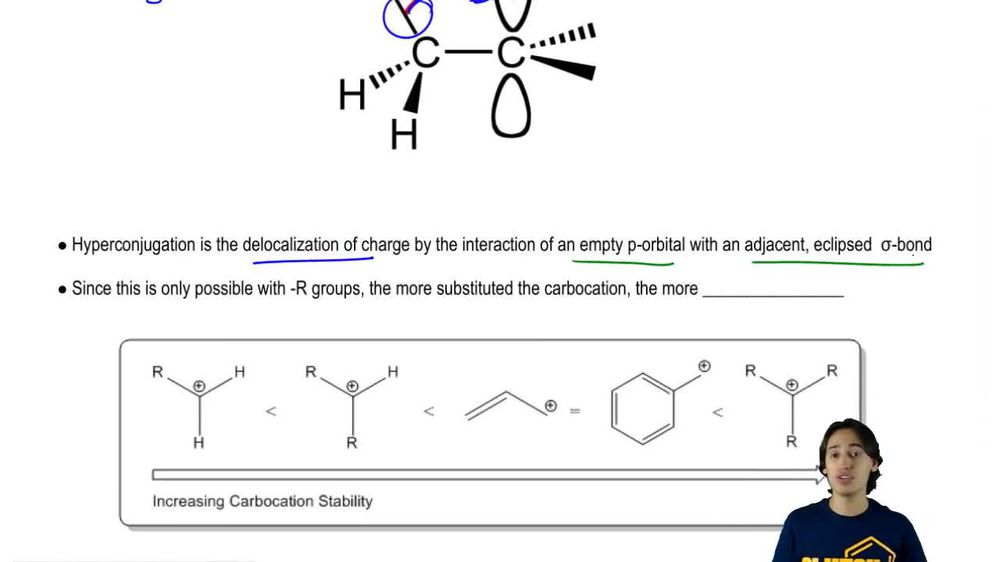
Step 4: Analyze the stability of the carbocations. The tertiary carbocation at C3 is more stable due to hyperconjugation and inductive effects from the methyl groups. However, the secondary carbocation at C2 can also form, albeit less favorably. Both intermediates are possible, leading to two different products.
Step 5: In the final step, the bromide ion (Br⁻), which is the nucleophile, attacks the carbocation. If the secondary carbocation at C2 is attacked, the product is 2-bromo-3-methylbutane. If the tertiary carbocation at C3 is attacked, the product is 2-bromo-2-methylbutane. This explains the formation of the two alkyl halides.
Verified video answer for a similar problem:
This video solution was recommended by our tutors as helpful for the problem above
Video duration:
2m
Play a video:
0 Comments
Key Concepts
Here are the essential concepts you must grasp in order to answer the question correctly.
Electrophilic Addition
Electrophilic addition is a fundamental reaction mechanism in organic chemistry where an electrophile reacts with a nucleophile, leading to the formation of a more saturated compound. In the case of alkenes like 3-methyl-1-butene, the double bond acts as a nucleophile, attacking the electrophilic hydrogen in HBr, resulting in the formation of a carbocation intermediate.
Carbocation stability is crucial in determining the outcome of reactions involving carbocations. Tertiary carbocations are more stable than secondary or primary ones due to hyperconjugation and inductive effects. In the reaction of 3-methyl-1-butene with HBr, the formation of a more stable carbocation leads to the preferential formation of certain alkyl halides, such as 2-bromo-2-methylbutane.
Markovnikov's Rule states that in the addition of HX to an alkene, the hydrogen atom will attach to the carbon with the greater number of hydrogen atoms already attached. This rule helps predict the major product in electrophilic addition reactions. In this case, the addition of HBr to 3-methyl-1-butene results in the formation of 2-bromo-3-methylbutane and 2-bromo-2-methylbutane, illustrating the application of this rule.

 2:08 minutes
 Verified step by step guidance
 09:23
09:23