Which of the following has a polar covalent bond? CH3NH2 CH3CH3 CH3F CH3OH
Verified step by step guidance
1
Step 1: Understand the concept of polar covalent bonds. A polar covalent bond occurs when two atoms share electrons unequally due to a difference in their electronegativities. The atom with higher electronegativity pulls the shared electrons closer, creating a partial negative charge (δ-) on that atom and a partial positive charge (δ+) on the other atom.
Step 2: Analyze the electronegativity of the atoms in each molecule. For example, fluorine (F) and oxygen (O) are highly electronegative, while carbon (C) and hydrogen (H) have lower electronegativities. Nitrogen (N) is moderately electronegative.
Step 3: Examine each molecule:
- CH3NH2: The bond between N and H is polar because N is more electronegative than H.
- CH3CH3: All bonds are between C and H or C and C, which are nonpolar due to similar electronegativities.
- CH3F: The bond between C and F is polar because F is much more electronegative than C.
- CH3OH: The bond between O and H is polar because O is more electronegative than H.
Step 4: Compare the molecules and identify which ones contain polar covalent bonds. Molecules with bonds between atoms of significantly different electronegativities will have polar covalent bonds.
Step 5: Conclude that CH3NH2, CH3F, and CH3OH contain polar covalent bonds, while CH3CH3 does not because it only contains nonpolar bonds.
Verified video answer for a similar problem:
This video solution was recommended by our tutors as helpful for the problem above
Video duration:
2m
Play a video:
0 Comments
Key Concepts
Here are the essential concepts you must grasp in order to answer the question correctly.
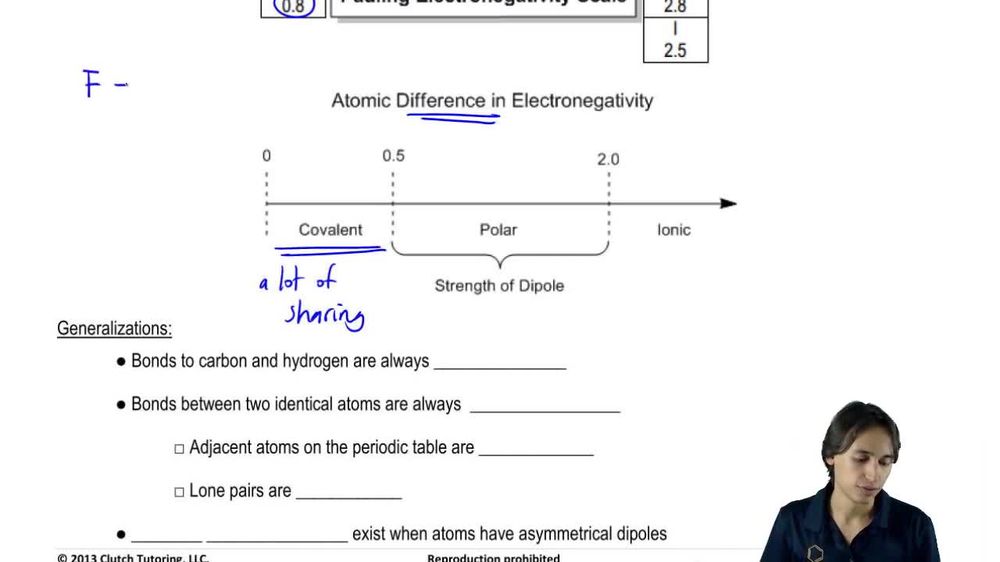
Polar Covalent Bonds
Polar covalent bonds occur when two atoms share electrons unequally due to a difference in electronegativity. In such bonds, the atom with higher electronegativity attracts the shared electrons more strongly, resulting in a partial negative charge on that atom and a partial positive charge on the other. This creates a dipole moment, making the molecule polar.
Differences between ionic, polar and covalent bonds
Electronegativity
Electronegativity is a measure of an atom's ability to attract and hold onto electrons in a chemical bond. The scale of electronegativity, developed by Linus Pauling, ranges from 0 to 4, with fluorine being the most electronegative element. Understanding electronegativity helps predict the nature of bonds between different atoms, particularly whether they will be ionic, polar covalent, or nonpolar covalent.
Molecular polarity refers to the distribution of electrical charge across a molecule, which is influenced by the presence of polar bonds and the molecule's shape. A molecule is polar if it has a net dipole moment, meaning that the vector sum of all dipole moments does not cancel out. This property affects the molecule's physical characteristics, such as solubility and boiling point.

 2:06 minutes
 Verified step by step guidance
 11:33
11:33

