Which of the following molecules would you expect to have a dipole moment of zero? g. BeCl2 h. BF3
Verified step by step guidance
1
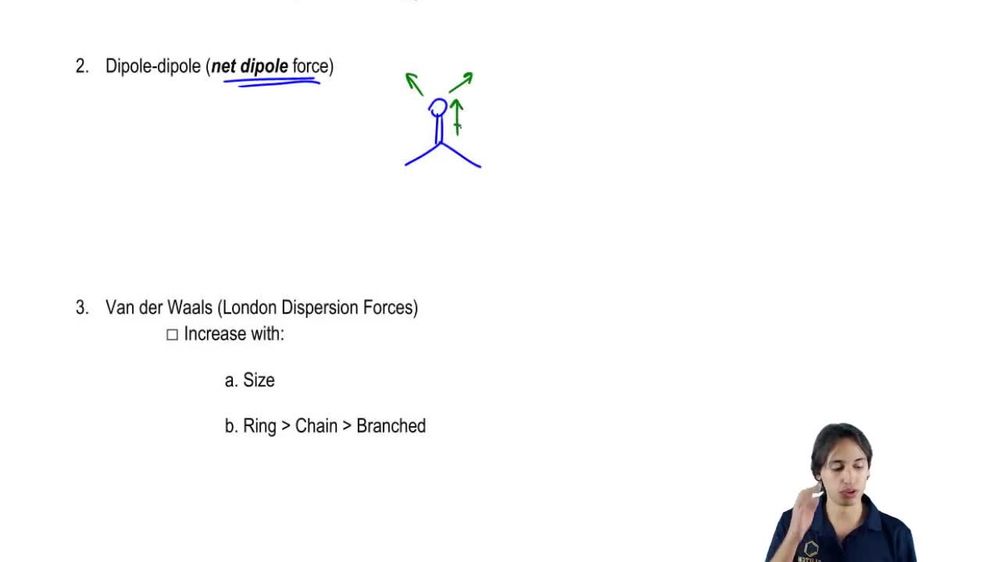
Step 1: Understand the concept of dipole moment. A dipole moment arises when there is an uneven distribution of electron density in a molecule due to differences in electronegativity between atoms. For a molecule to have a dipole moment of zero, the individual bond dipoles must cancel each other out due to symmetry.
Step 2: Analyze the geometry of BeCl2. Beryllium chloride (BeCl2) has a linear molecular geometry because beryllium forms two bonds with chlorine atoms and has no lone pairs. The bond dipoles between Be and Cl point in opposite directions along the same axis, and due to the linear geometry, they cancel each other out, resulting in a dipole moment of zero.
Step 3: Analyze the geometry of BF3. Boron trifluoride (BF3) has a trigonal planar molecular geometry because boron forms three bonds with fluorine atoms and has no lone pairs. The bond dipoles between B and F are directed outward at 120° angles from each other. Due to the symmetrical trigonal planar geometry, the bond dipoles cancel each other out, resulting in a dipole moment of zero.
Step 4: Compare the symmetry of both molecules. Both BeCl2 and BF3 exhibit high symmetry in their molecular geometries, which is the key factor that leads to the cancellation of dipole moments.
Step 5: Conclude that both BeCl2 and BF3 have a dipole moment of zero due to their symmetrical molecular geometries, which cause the bond dipoles to cancel each other out.
Verified video answer for a similar problem:
This video solution was recommended by our tutors as helpful for the problem above
Video duration:
4m
Play a video:
0 Comments
Key Concepts
Here are the essential concepts you must grasp in order to answer the question correctly.
Molecular Geometry
Molecular geometry refers to the three-dimensional arrangement of atoms within a molecule. The shape of a molecule is determined by the number of bonding pairs and lone pairs of electrons around the central atom. Understanding molecular geometry is crucial for predicting the polarity of a molecule, as symmetrical shapes often lead to nonpolar characteristics.
A dipole moment is a measure of the separation of positive and negative charges in a molecule, indicating its polarity. It arises when there is an uneven distribution of electron density, leading to partial positive and negative charges. Molecules with a dipole moment are polar, while those with a dipole moment of zero are nonpolar, often due to symmetrical arrangements of bonds.
Symmetry in molecules plays a key role in determining their physical properties, including polarity. Molecules that exhibit high symmetry, such as linear or trigonal planar structures, can cancel out individual bond dipoles, resulting in a net dipole moment of zero. Recognizing the symmetry of a molecule helps predict whether it will be polar or nonpolar.

 4:38 minutes
 Verified step by step guidance

 07:44
07:44