Order the following sets of substituents via their priority using the CIP rules. (R = positionof attachment to the asymmetric center.) (a)
Verified step by step guidance
1
Step 1: Understand the CIP (Cahn-Ingold-Prelog) priority rules. These rules are used to assign priorities to substituents attached to a chiral center based on atomic number, isotopic mass, and connectivity. The substituent with the highest atomic number directly attached to the chiral center gets the highest priority.
Step 2: Analyze the substituents provided: R-N (amine group), R-OH (hydroxyl group), R-NH2 (amino group), and R-Br (bromo group). Focus on the atom directly attached to the chiral center (R).
Step 3: Compare the atomic numbers of the atoms directly attached to the chiral center: Nitrogen (N, atomic number 7), Oxygen (O, atomic number 8), Bromine (Br, atomic number 35). Bromine has the highest atomic number, followed by Oxygen, then Nitrogen.
Step 4: For substituents with the same atom directly attached (e.g., R-N and R-NH2), consider the connectivity and the number of bonds to other atoms. R-N has a nitrogen atom bonded to two other groups, while R-NH2 has a nitrogen atom bonded to one hydrogen and one group. R-N will have higher priority than R-NH2.
Step 5: Order the substituents based on priority: R-Br > R-OH > R-N > R-NH2. This ranking follows the CIP rules considering atomic number and connectivity.
Verified video answer for a similar problem:
This video solution was recommended by our tutors as helpful for the problem above
Play a video:
0 Comments
Key Concepts
Here are the essential concepts you must grasp in order to answer the question correctly.
CIP Rules
The Cahn-Ingold-Prelog (CIP) rules are a set of guidelines used to assign priority to substituents attached to a chiral center in organic molecules. These rules prioritize substituents based on atomic number, with higher atomic numbers receiving higher priority. If two substituents have the same atom, the priority is determined by the next atoms in the substituent chain, continuing until a difference is found.
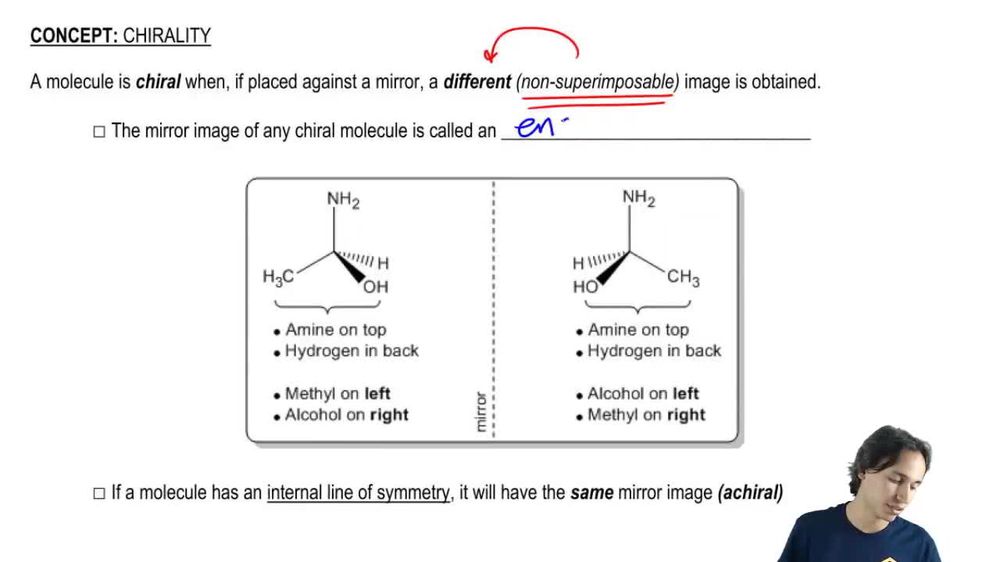
Chirality refers to the geometric property of a molecule that makes it non-superimposable on its mirror image, much like left and right hands. Molecules that possess chirality typically have a carbon atom bonded to four different substituents, creating an asymmetric center. Understanding chirality is crucial for determining the stereochemistry of compounds and their interactions in biological systems.
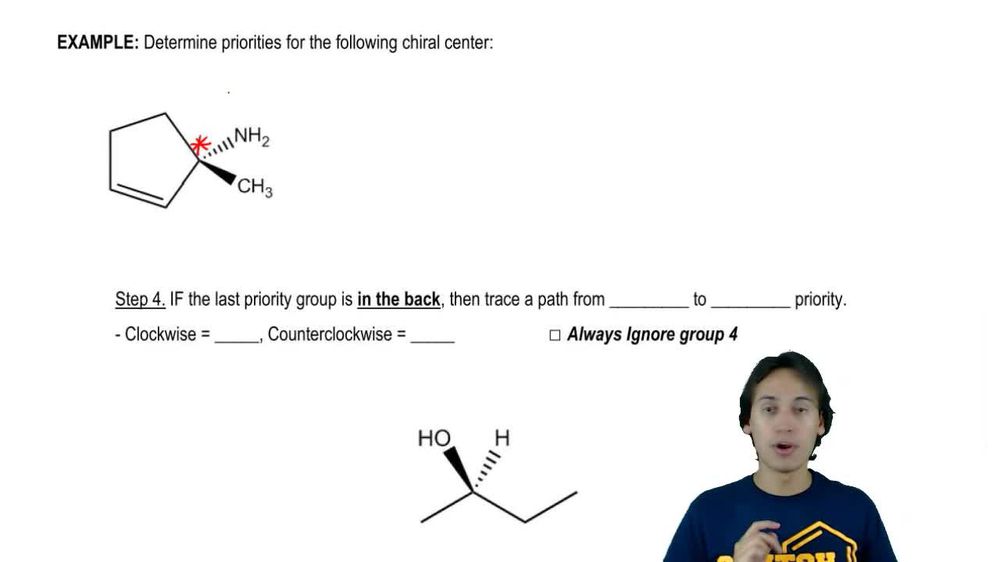
Substituent priority is the ranking of different groups attached to a chiral center based on the CIP rules. This ranking is essential for determining the configuration of the chiral center, which can be designated as either R (rectus) or S (sinister) based on the arrangement of the substituents. Correctly identifying the priority of substituents is vital for accurately describing the stereochemistry of organic compounds.


 Verified step by step guidance
 03:54
03:54