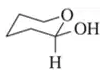
Prioritize the substituents at each chiral center and then, by each of the two methods discussed in Section 6.3.2.4, determine the absolute configuration. [Do not use your models, except to check your answers.] (c)
Verified step by step guidance
1
Step 1: Identify the chiral center in the molecule. A chiral center is a carbon atom bonded to four different substituents. In the given structure, the carbon atom attached to the hydroxyl group (-OH), the hydrogen atom (-H), the oxygen atom in the cyclic ether, and the rest of the cyclic structure is the chiral center.
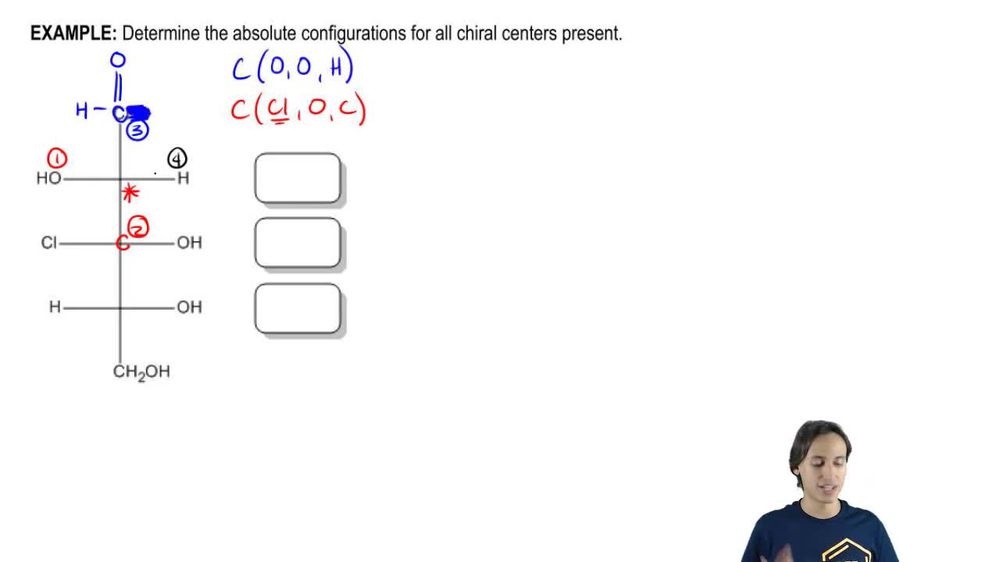
Step 2: Assign priorities to the substituents based on the Cahn-Ingold-Prelog (CIP) rules. The substituent with the highest atomic number gets the highest priority. Here, the priorities are: (1) Oxygen in the hydroxyl group (-OH), (2) Oxygen in the cyclic ether, (3) The cyclic structure (carbon chain), and (4) Hydrogen (-H) as the lowest priority.
Step 3: Orient the molecule so that the lowest priority group (hydrogen) is pointing away from you. This ensures that you are viewing the molecule in the correct orientation for determining the absolute configuration.
Step 4: Determine the order of the remaining three substituents (1, 2, and 3) in a clockwise or counterclockwise direction. If the order is clockwise, the configuration is R. If the order is counterclockwise, the configuration is S.
Step 5: Verify your result using the Fischer projection method or another visualization technique discussed in Section 6.3.2.4. This involves redrawing the molecule in a 2D format and confirming the absolute configuration based on the substituent priorities and orientation.
Verified video answer for a similar problem:
This video solution was recommended by our tutors as helpful for the problem above
Play a video:
0 Comments
Key Concepts
Here are the essential concepts you must grasp in order to answer the question correctly.
Chirality and Chiral Centers
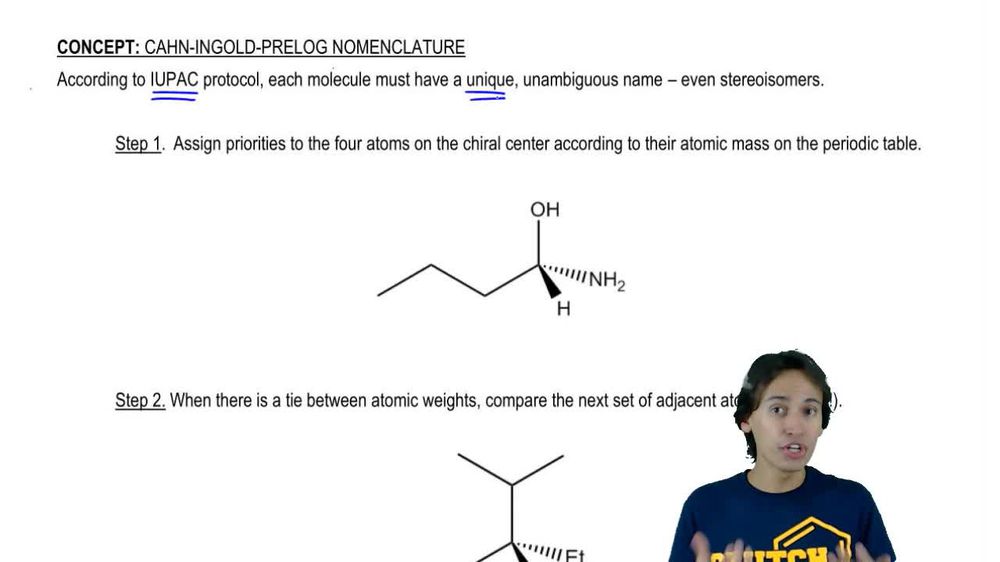
Chirality refers to the geometric property of a molecule having non-superimposable mirror images, known as enantiomers. A chiral center, typically a carbon atom, is bonded to four different substituents, leading to two distinct configurations. Understanding chirality is essential for determining the absolute configuration of molecules, which is crucial in organic chemistry, especially in the context of stereochemistry.
The Cahn-Ingold-Prelog (CIP) priority rules are a set of guidelines used to assign priorities to substituents attached to a chiral center. According to these rules, substituents are ranked based on the atomic number of the atoms directly attached to the chiral center, with higher atomic numbers receiving higher priority. This ranking is fundamental for determining the absolute configuration (R or S) of chiral centers in organic molecules.
Absolute configuration refers to the specific three-dimensional arrangement of atoms around a chiral center, designated as either R (rectus) or S (sinister) based on the CIP priority rules. To determine the absolute configuration, one must visualize the molecule in three dimensions and apply the rules to ascertain the orientation of the highest priority substituent. This concept is vital for understanding the behavior and reactivity of chiral compounds in chemical reactions.

 Verified step by step guidance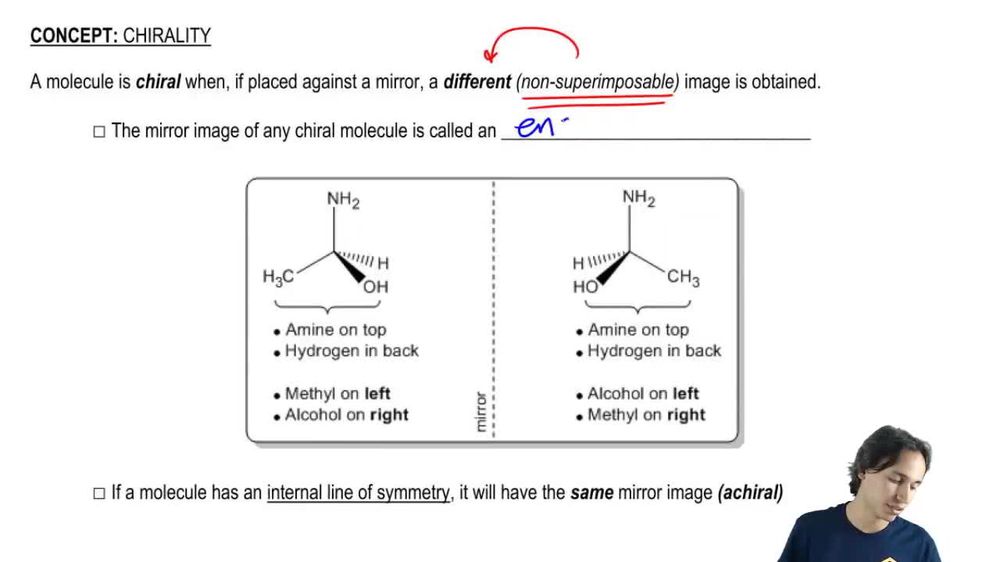
 05:10
05:10