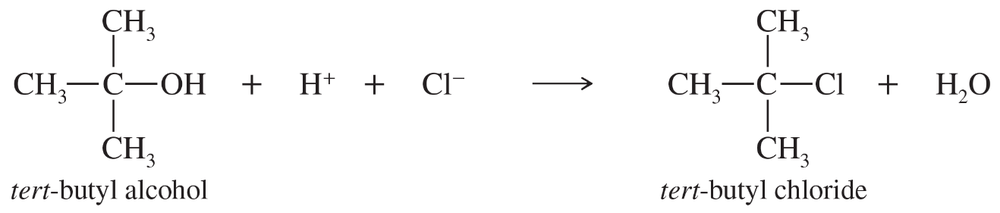
Treatment of tert-butyl alcohol with concentrated HCl gives tert-butyl chloride. When the concentration of H+ is doubled, the reaction rate doubles. When the concentration of tert-butyl alcohol is tripled, the reaction rate triples. When the chloride ion concentration is quadrupled, however, the reaction rate is unchanged. Write the rate equation for this reaction.
Verified step by step guidance
1
Step 1: Analyze the reaction mechanism. The reaction involves tert-butyl alcohol reacting with concentrated HCl to form tert-butyl chloride and water. This is a substitution reaction, likely proceeding via an SN1 mechanism due to the tertiary alcohol structure.
Step 2: Examine the rate dependence on reactants. The problem states that doubling the concentration of H+ doubles the reaction rate, and tripling the concentration of tert-butyl alcohol triples the reaction rate. This indicates that both tert-butyl alcohol and H+ are involved in the rate-determining step.
Step 3: Consider the role of chloride ion (Cl⁻). The problem states that increasing the concentration of Cl⁻ does not affect the reaction rate. This suggests that Cl⁻ is not involved in the rate-determining step but participates in a subsequent step.
Step 4: Write the rate equation based on the observations. Since the rate depends on the concentrations of tert-butyl alcohol and H+, the rate equation can be expressed as: rate = k[tert-butyl alcohol][H⁺], where k is the rate constant.
Step 5: Confirm the SN1 mechanism. In an SN1 reaction, the rate-determining step is the formation of the carbocation intermediate, which depends on the concentration of the substrate (tert-butyl alcohol) and the acid catalyst (H⁺). The chloride ion then reacts with the carbocation in a fast step to form tert-butyl chloride.
Verified video answer for a similar problem:
This video solution was recommended by our tutors as helpful for the problem above
Video duration:
1m
Play a video:
0 Comments
Key Concepts
Here are the essential concepts you must grasp in order to answer the question correctly.
Reaction Rate
The reaction rate is a measure of how quickly reactants are converted into products in a chemical reaction. It can be influenced by various factors, including the concentration of reactants, temperature, and the presence of catalysts. In this case, the rate of the reaction is directly proportional to the concentrations of tert-butyl alcohol and H+, indicating a first-order dependence on each of these reactants.
The rate law expresses the relationship between the rate of a chemical reaction and the concentration of its reactants. It is typically formulated as rate = k[A]^m[B]^n, where k is the rate constant, and m and n are the orders of the reaction with respect to reactants A and B. For the given reaction, the observations suggest that the rate law can be derived from the changes in concentration of tert-butyl alcohol and H+, while the chloride ion does not affect the rate.
The order of a reaction refers to the power to which the concentration of a reactant is raised in the rate law. It indicates how the rate of reaction is affected by changes in concentration. In this scenario, the reaction is first order with respect to both tert-butyl alcohol and H+, as their concentration changes directly affect the reaction rate, while the chloride ion appears to have zero order, indicating it does not influence the rate.