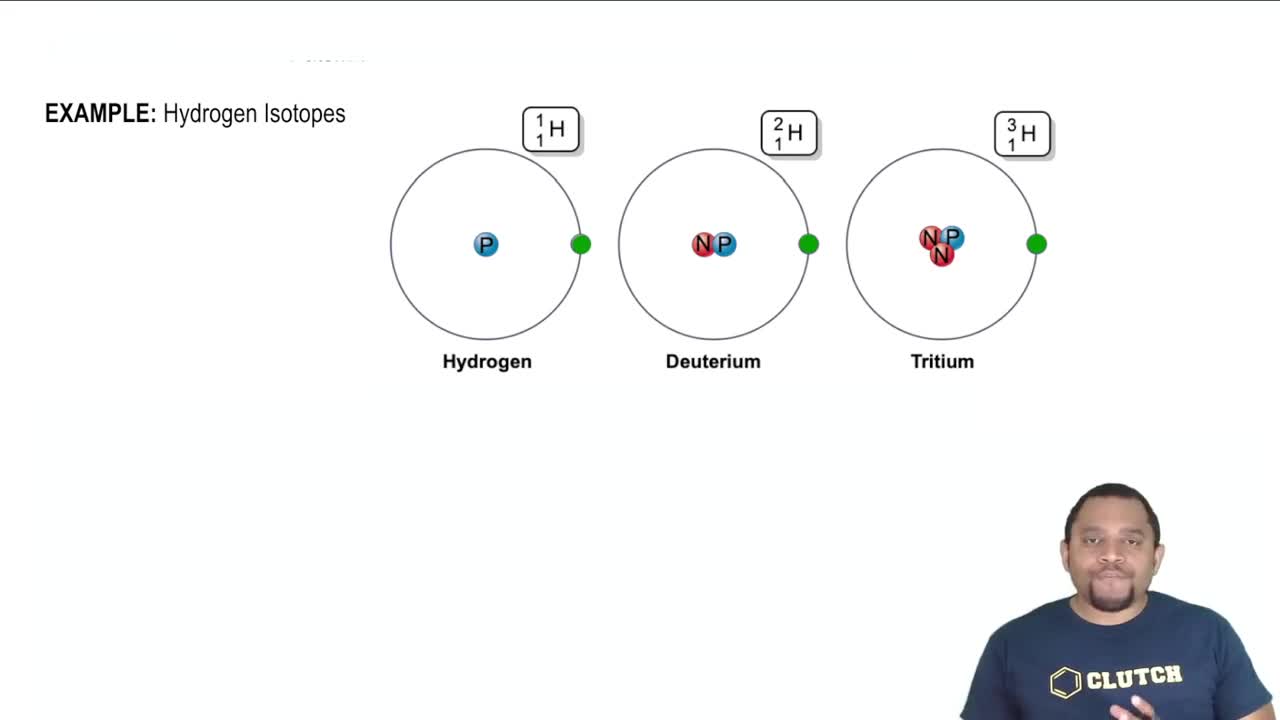
Deuterium (D) is the hydrogen isotope of mass number 2, with a proton and a neutron in its nucleus. The chemistry of deuterium is nearly identical to the chemistry of hydrogen, except that the C―D bond is slightly stronger than the C―H bond by 5.0 kJ/mol (1.2 kcal/mol). Reaction rates tend to be slower when a C―D bond (as opposed to a C―H bond) is broken in a rate-limiting step. This effect, called a kinetic isotope effect, is clearly seen in the chlorination of methane. Methane undergoes free-radical chlorination 12 times as fast as tetradeuteriomethane (CD4). b. Monochlorination of deuterioethane (C2H5D) leads to a mixture containing 93% C2H4DCl and 7% C2H5Cl. Calculate the relative rates of abstraction per hydrogen and deuterium in the chlorination of deuterioethane.
Verified step by step guidance
1
Step 1: Understand the problem. The goal is to calculate the relative rates of abstraction for hydrogen (H) and deuterium (D) in the chlorination of deuterioethane (C₂H₅D). The problem provides the product distribution: 93% C₂H₄DCl and 7% C₂H₅Cl. This distribution reflects the relative rates of abstraction of H and D by the chlorine radical (Cl⋅).
Step 2: Define the relationship between product distribution and relative rates. The relative rates of abstraction are proportional to the product distribution. Specifically, the rate of H abstraction (k_H) and the rate of D abstraction (k_D) are related to the percentages of C₂H₅Cl and C₂H₄DCl, respectively. Use the formula: \( \frac{k_H}{k_D} = \frac{\text{Percentage of C₂H₅Cl}}{\text{Percentage of C₂H₄DCl}} \).
Step 3: Substitute the given percentages into the formula. From the problem, the percentage of C₂H₅Cl is 7%, and the percentage of C₂H₄DCl is 93%. Substitute these values into the formula: \( \frac{k_H}{k_D} = \frac{7}{93} \).
Step 4: Simplify the ratio. Simplify the fraction \( \frac{7}{93} \) to express the relative rates of abstraction of H and D. This will give you the ratio \( k_H : k_D \).
Step 5: Interpret the result. The calculated ratio \( k_H : k_D \) represents how much faster hydrogen is abstracted compared to deuterium. This difference is due to the kinetic isotope effect, where the C–D bond is stronger and harder to break than the C–H bond.
Verified video answer for a similar problem:
This video solution was recommended by our tutors as helpful for the problem above
Video duration:
5m
Play a video:
0 Comments
Key Concepts
Here are the essential concepts you must grasp in order to answer the question correctly.
Kinetic Isotope Effect
The kinetic isotope effect (KIE) refers to the change in reaction rate that occurs when an atom in a molecule is replaced by one of its isotopes. In organic reactions, bonds involving heavier isotopes, like deuterium, are typically stronger and break more slowly than those involving lighter isotopes, such as hydrogen. This results in observable differences in reaction rates, which can be quantitatively analyzed to provide insights into reaction mechanisms.
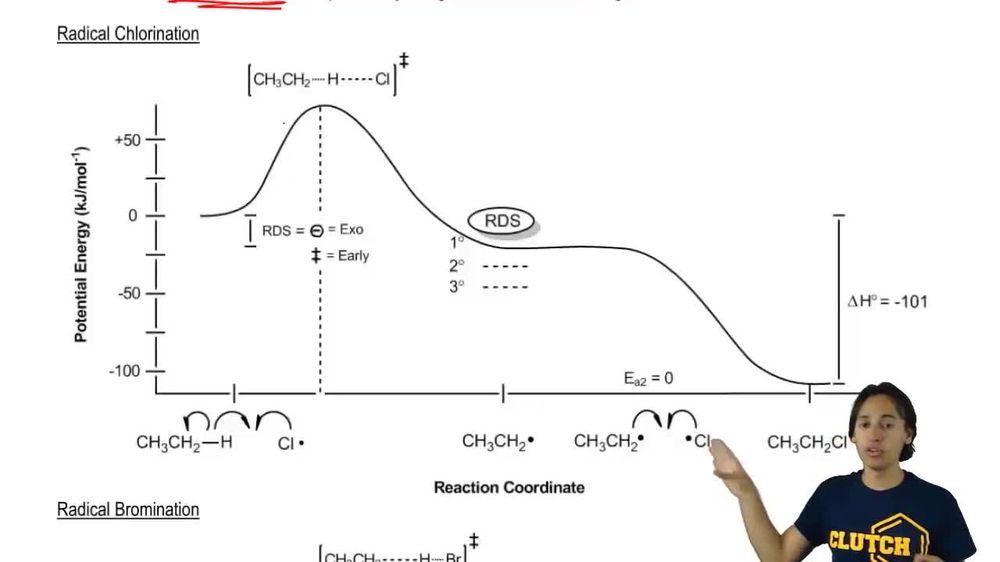
Free-radical chlorination is a reaction mechanism where chlorine atoms react with alkanes to form alkyl chlorides through a series of radical intermediates. This process involves three main steps: initiation, propagation, and termination. The rate of chlorination can be influenced by the type of hydrogen being abstracted, as seen in the comparison between methane and deuterated methane, where the presence of deuterium slows the reaction due to the stronger C-D bond.
Using the Hammond Postulate to describe radical chlorination.
Relative Rate of Reaction
The relative rate of reaction compares the speed of two or more reactions under similar conditions. It is often expressed as a ratio, indicating how many times faster one reaction occurs compared to another. In the context of chlorination of deuterioethane, calculating the relative rates of abstraction for hydrogen and deuterium allows chemists to understand the influence of isotopic substitution on reaction kinetics and to quantify the effects of the kinetic isotope effect.