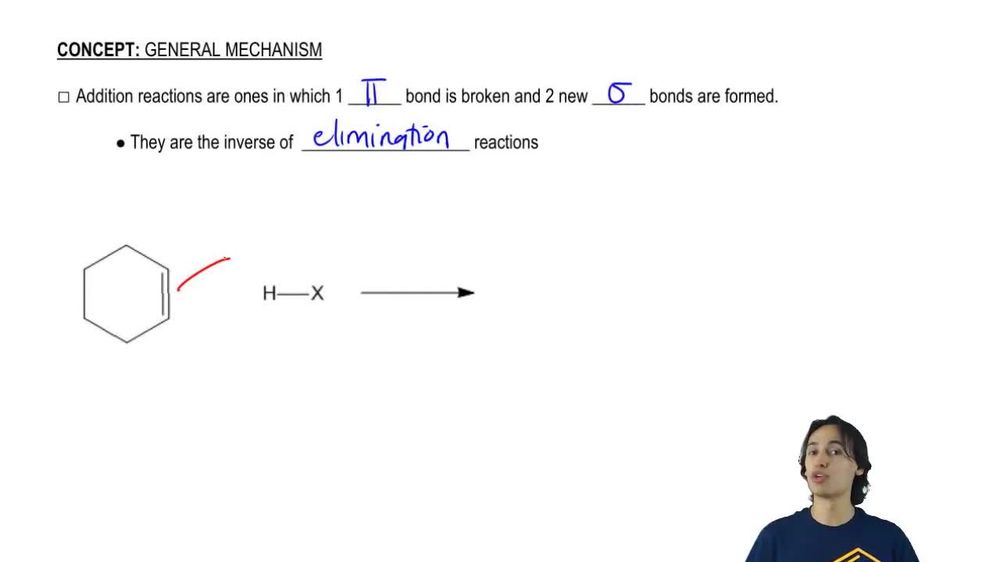
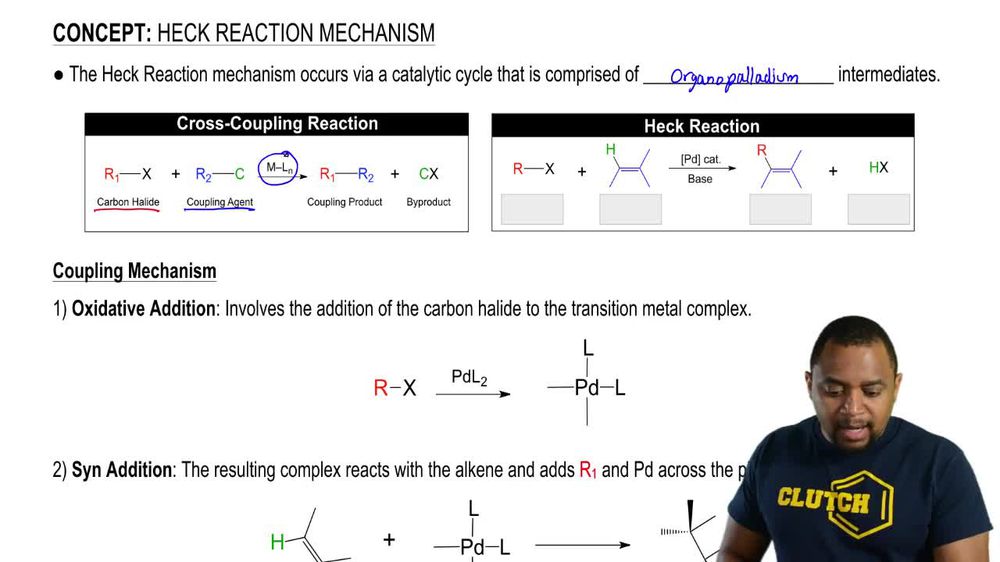
In contrast to the addition of Br₂ the addition of HBr [Section 8.3] is not stereospecific. Why?
Verified step by step guidance
1
The addition of Br₂ to an alkene is stereospecific because it proceeds through a bromonium ion intermediate. This intermediate is a three-membered ring structure that forces the incoming nucleophile (Br⁻) to attack from the opposite side of the ring, leading to anti-addition. This ensures a specific stereochemical outcome.
In contrast, the addition of HBr to an alkene is not stereospecific because it proceeds through a carbocation intermediate. The formation of the carbocation is planar, allowing the nucleophile (Br⁻) to attack from either side of the plane, leading to a mixture of stereoisomers.
The image shows that the addition of Br₂ results in a single stereochemical outcome (anti-addition), while the addition of HBr results in a mixture of stereoisomers due to the non-stereospecific nature of the reaction.
The key difference lies in the intermediates: the bromonium ion in the Br₂ addition restricts the approach of the nucleophile, while the planar carbocation in the HBr addition allows for attack from both sides.
Thus, the addition of HBr is not stereospecific because the planar carbocation intermediate does not impose any stereochemical constraints on the reaction.
Verified video answer for a similar problem:
This video solution was recommended by our tutors as helpful for the problem above
Video duration:
7m
Play a video:
0 Comments
Key Concepts
Here are the essential concepts you must grasp in order to answer the question correctly.
Stereospecificity
Stereospecificity refers to a reaction where the stereochemistry of the reactants influences the stereochemistry of the products. In stereospecific reactions, a specific stereoisomer of a reactant will yield a specific stereoisomer of the product. This is crucial in understanding reactions like the addition of Br₂, where the formation of a cyclic bromonium ion leads to a specific stereochemical outcome.
Electrophilic addition reactions involve the addition of an electrophile to a nucleophile, typically across a double bond. In the case of HBr addition, the hydrogen atom acts as the electrophile, while the double bond acts as the nucleophile. Unlike Br₂, which forms a cyclic intermediate leading to stereospecificity, HBr does not form such intermediates, resulting in a non-stereospecific addition.
The reaction mechanism describes the step-by-step process by which reactants are converted into products. For HBr addition, the mechanism involves the protonation of the alkene followed by nucleophilic attack by bromide. This mechanism does not favor a specific stereochemical pathway, leading to a mixture of products, unlike the more defined pathway seen in Br₂ addition.