

Ch. 16 - Reactions of Aldehydes and Ketones • More Reactions of Carboxylic Acid Derivatives
Bruice - Organic Chemistry 8th Edition
Bruice8th EditionOrganic ChemistryISBN: 9780135213711Not the one you use?Change textbook
Chapter 17, Problem 93a,b

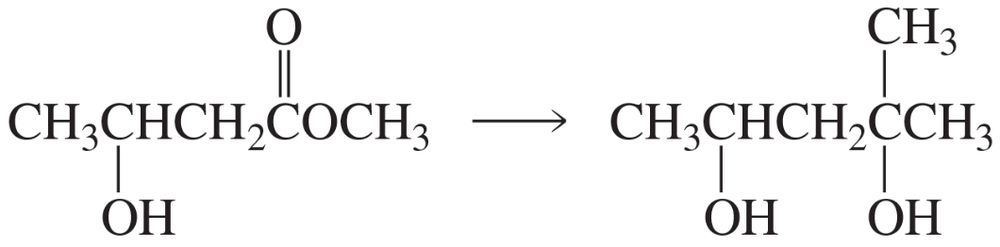
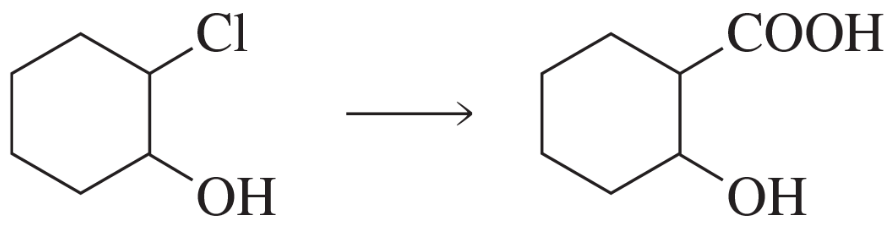
Show how each of the following compounds can be prepared from the given starting material. In each case, you will need to use a protecting group.
a.
b.

Verified step by step guidance
1
Step 1: Analyze the starting material and the target compound. The starting material contains a hydroxyl group (-OH) and an ester functional group. The target compound introduces a new hydroxyl group at a specific position, requiring selective reactivity.
Step 2: Protect the existing hydroxyl group in the starting material to prevent unwanted reactions. Use a protecting group such as a silyl ether (e.g., TBDMS-Cl) to temporarily mask the hydroxyl group.
Step 3: Perform the desired reaction to introduce the new hydroxyl group. This can be achieved through a selective reduction of the ester group using a reducing agent like DIBAL-H (Diisobutylaluminum hydride) to form an aldehyde intermediate, followed by further reduction to an alcohol using NaBH4 or LiAlH4.
Step 4: Remove the protecting group from the original hydroxyl group to restore its functionality. Use a mild acid or fluoride source (e.g., TBAF for silyl ethers) to deprotect the hydroxyl group.
Step 5: Verify the structure of the final compound to ensure it matches the target compound. Confirm that both hydroxyl groups are correctly positioned and the ester group has been converted to the desired alcohol.

Verified video answer for a similar problem:

This video solution was recommended by our tutors as helpful for the problem above.
Video duration:
4m
Was this helpful?

Key Concepts

Here are the essential concepts you must grasp in order to answer the question correctly.

Protecting Groups

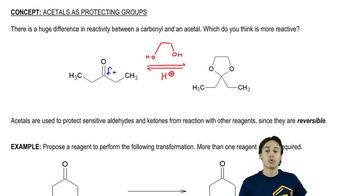
Protecting groups are temporary modifications used in organic synthesis to prevent certain functional groups from reacting during a chemical reaction. They allow chemists to selectively modify other parts of a molecule without interference. After the desired reaction is completed, the protecting group can be removed to restore the original functional group.
Recommended video:
Guided course
02:44
Protecting Groups

Silyl Ethers

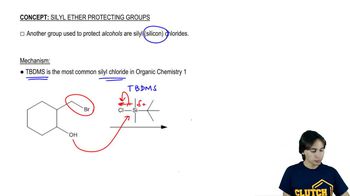
Silyl ethers are a class of protecting groups derived from silanes, commonly used to protect alcohols during chemical reactions. They are stable under a variety of reaction conditions and can be easily removed by hydrolysis or fluoride treatment. This makes them particularly useful in multi-step synthesis where selective reactivity is required.
Recommended video:
Guided course
07:16
Mechanism of Silyl Ether Protecting Groups.

Functional Group Interconversion

Functional group interconversion refers to the process of transforming one functional group into another through chemical reactions. This concept is crucial in organic synthesis as it allows chemists to create desired compounds by modifying existing structures. Understanding the reactivity and compatibility of different functional groups is essential for successful synthesis.
Recommended video:
Guided course
02:36
Identifying Functional Groups
Related Practice
Textbook Question

The pKa values of the carboxylic acid groups of oxaloacetic acid are 2.22 and 3.98.

b. The amount of hydrate present in an aqueous solution of oxaloacetic acid depends on the pH of the solution: 95% at pH 0, 81% at pH 1.3, 35% at pH 3.1, 13% at pH 4.7, 6% at pH 6.7, and 6% at pH 12.7. Explain this pH dependence.

1316
views
Textbook Question

What carbonyl compound and what phosphonium ylide are needed to synthesize the following compounds?

b.

1251
views
Textbook Question

The Baylis-Hillman reaction is a DABCO (1,4-diazabicyclo[2.2.2]octane) catalyzed reaction of an α,β-unsaturated carbonyl compound with an aldehyde to form an allylic alcohol. Propose a mechanism for the reaction. (Hint: DABCO serves as both a nucleophile and as a base in the reaction.)

74
views
Textbook Question

When a cyclic ketone reacts with diazomethane, the next larger cyclic ketone is formed. This is called a ring-expansion reaction. Draw a mechanism for the following ring-expansion reaction.

211
views
Textbook Question

Identify compounds A and B:

1026
views
Textbook Question

To solve this problem, you need to read the description of the Hammett σ\(\sigma\), ρ\(\rho\) treatment given in [Chapter 15, Problem 92]. When the rate constants for the hydrolysis of several morpholine enamines of para-substituted propiophenones are determined at pH 4.7, the ρ\(\rho\) value is positive; however, when the rates of hydrolysis are determined at pH 10.4, the ρ\(\rho\) value is negative.

b. What is the rate-determining step of the hydrolysis reaction when it is carried out in an acidic solution?

<IMAGE>

1251
views