Acetonitrile (CH3C≡N) is deprotonated by very strong bases. Write resonance forms to show the stabilization of the carbanion that results.
Verified step by step guidance
1
Identify the acidic hydrogen in acetonitrile (CH3C≡N). The hydrogen attached to the carbon adjacent to the nitrile group is the most acidic.
When a strong base deprotonates acetonitrile, it removes this acidic hydrogen, resulting in a carbanion at the carbon adjacent to the nitrile group.
Draw the structure of the carbanion: CH2=C≡N⁻. The negative charge is on the carbon that was deprotonated.
To show resonance stabilization, move the lone pair of electrons from the carbanion to form a double bond with the carbon of the nitrile group, resulting in a new resonance structure.
The new resonance structure will have a double bond between the two carbons (CH2=C=N⁻) and the negative charge will be on the nitrogen atom, showing the delocalization of the negative charge.
Verified video answer for a similar problem:
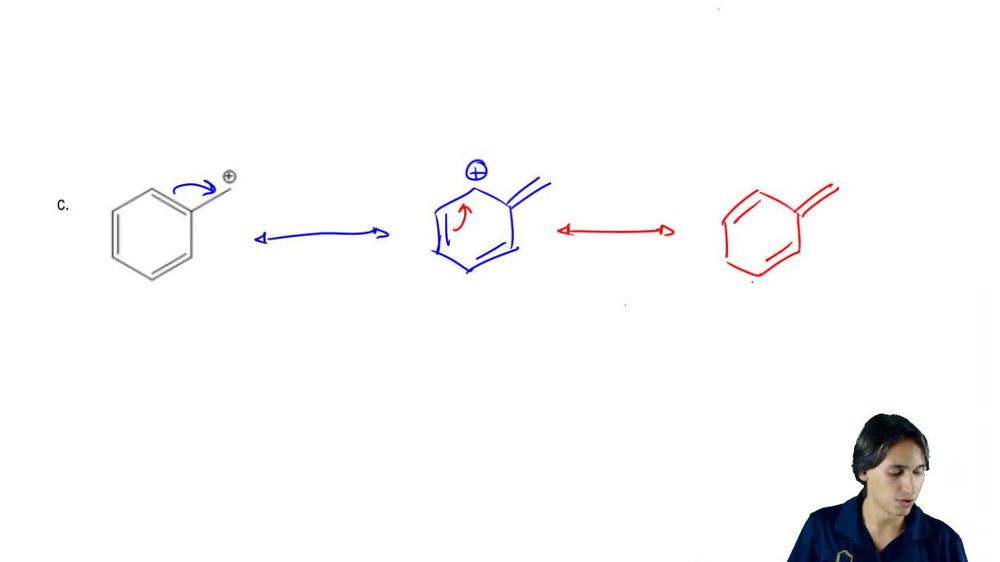
This video solution was recommended by our tutors as helpful for the problem above
Video duration:
5m
Play a video:
0 Comments
Key Concepts
Here are the essential concepts you must grasp in order to answer the question correctly.
Resonance
Resonance in organic chemistry refers to the delocalization of electrons across adjacent atoms in a molecule, which can be represented by multiple valid Lewis structures. These structures, known as resonance forms, depict the same molecule but with different arrangements of electrons, helping to illustrate the stability provided by electron delocalization.
A carbanion is an anion in which carbon has an unshared pair of electrons and bears a negative charge. Carbanions are typically formed by the removal of a proton from a carbon atom, and their stability is influenced by factors such as resonance, inductive effects, and the hybridization of the carbon atom bearing the negative charge.
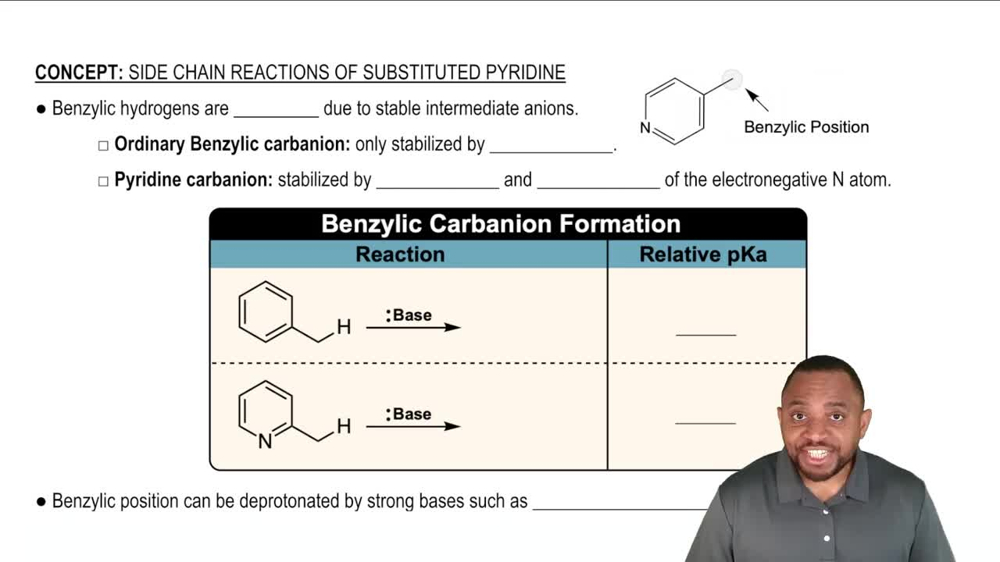
Side-Chain Reactions of Substituted Pyridines Concept 1
Deprotonation
Deprotonation is the removal of a proton (H⁺) from a molecule, resulting in the formation of a conjugate base. In the context of acetonitrile, deprotonation by a strong base leads to the formation of a carbanion, which can be stabilized through resonance, as the negative charge can be delocalized over the molecule.