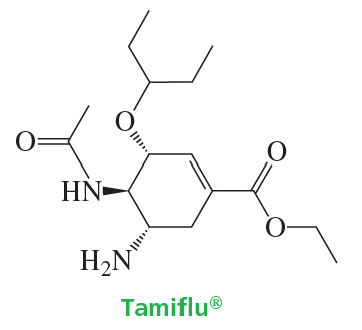
Tamiflu is used for the prevention and treatment of flu. What is the configuration of each of its asymmetric centers?
Verified step by step guidance
1
Identify the asymmetric centers in the Tamiflu structure. These are carbon atoms bonded to four different groups. In the given structure, the asymmetric centers are labeled as 'a' and 'b'.
Assign priorities to the substituents attached to each asymmetric center based on the Cahn-Ingold-Prelog (CIP) priority rules. These rules consider atomic number, connectivity, and double/triple bonds.
For asymmetric center 'a', determine the spatial arrangement of the substituents (OH group, cyclohexene ring, benzene ring with methoxy group, and the carbon bonded to the nitrogen group). Assign priorities and visualize the molecule in 3D.
For asymmetric center 'b', determine the spatial arrangement of the substituents (the nitrogen group, the carbon bonded to the OH group, the cyclohexene ring, and the hydrogen atom). Assign priorities and visualize the molecule in 3D.
Using the CIP rules, determine the configuration (R or S) for each asymmetric center by tracing the path from the highest priority substituent to the lowest priority substituent. Ensure the lowest priority group is oriented away from the viewer.
Verified video answer for a similar problem:
This video solution was recommended by our tutors as helpful for the problem above
Video duration:
6m
Play a video:
0 Comments
Key Concepts
Here are the essential concepts you must grasp in order to answer the question correctly.
Chirality and Asymmetric Centers
Chirality refers to the property of a molecule that makes it non-superimposable on its mirror image, often due to the presence of asymmetric centers (chiral centers). Each asymmetric center in a molecule can exist in two configurations, typically designated as 'R' (rectus) or 'S' (sinister), based on the Cahn-Ingold-Prelog priority rules. Understanding chirality is crucial for determining the stereochemistry of compounds like Tamiflu.
Cahn-Ingold-Prelog Priority Rules
The Cahn-Ingold-Prelog (CIP) priority rules are a set of guidelines used to assign priorities to the substituents attached to a chiral center. The priority is determined based on the atomic number of the atoms directly attached to the chiral carbon; higher atomic numbers receive higher priority. This system is essential for correctly identifying the 'R' or 'S' configuration of asymmetric centers in molecules such as Tamiflu.
Stereochemistry
Stereochemistry is the branch of chemistry that deals with the spatial arrangement of atoms in molecules and how this arrangement affects their chemical properties and reactions. In the context of Tamiflu, understanding stereochemistry is vital for determining the configuration of its asymmetric centers, which can influence the drug's efficacy and interaction with biological targets.