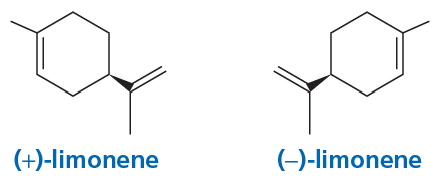
Limonene exists as two different stereoisomers. The R enantiomer is found in oranges and lemons, and the S enantiomer is found in spruce trees. Which of the following is found in oranges and lemons?
Verified step by step guidance
1
Step 1: Understand the problem. The question asks which stereoisomer of limonene is found in oranges and lemons. The R enantiomer is specified as the one found in these fruits.
Step 2: Recall the concept of stereoisomers. Stereoisomers are molecules with the same molecular formula and connectivity but differ in the spatial arrangement of atoms. Enantiomers are a type of stereoisomer that are non-superimposable mirror images of each other.
Step 3: Analyze the provided images. The images depict different molecules with stereocenters, but none of them represent limonene or its enantiomers. Therefore, the images are not directly relevant to identifying the R enantiomer of limonene.
Step 4: Apply the Cahn-Ingold-Prelog priority rules to determine the R or S configuration of a stereocenter. For limonene, the R configuration corresponds to the enantiomer found in oranges and lemons.
Step 5: Conclude that the R enantiomer of limonene is the correct answer based on the problem statement, regardless of the images provided.
Verified video answer for a similar problem:
This video solution was recommended by our tutors as helpful for the problem above
Video duration:
8m
Play a video:
0 Comments
Key Concepts
Here are the essential concepts you must grasp in order to answer the question correctly.
Stereoisomerism
Stereoisomerism refers to the phenomenon where compounds have the same molecular formula and connectivity of atoms but differ in the spatial arrangement of their atoms. This can lead to different physical and chemical properties, as seen in enantiomers, which are non-superimposable mirror images of each other. Understanding stereoisomerism is crucial for identifying the specific isomers of limonene found in different sources.
Enantiomers are a type of stereoisomer that are mirror images of each other and cannot be superimposed. They often exhibit different biological activities and properties, which is significant in organic chemistry and pharmacology. In the case of limonene, the R and S enantiomers have distinct sources, with the R enantiomer being found in oranges and lemons, while the S enantiomer is found in spruce trees.
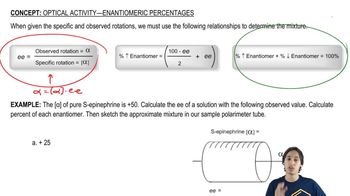
How to solve for the percentage of each enantiomer.
Chirality
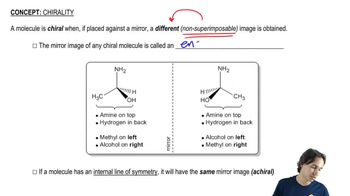
Chirality is a property of a molecule that has a non-superimposable mirror image, typically due to the presence of a chiral center, often a carbon atom bonded to four different substituents. This concept is fundamental in understanding the behavior of enantiomers, as chirality influences how molecules interact with biological systems. The chirality of limonene is key to determining which enantiomer is present in specific fruits.