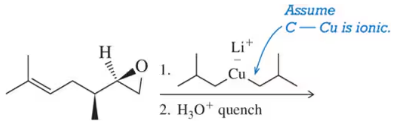
A variety of organometallics, which as strong nucleophiles can react with epoxides, are introduced in Chapter 16. Predict the product of these reactions. [Hint: Assume the carbon–metal bond in each is ionic, with the carbon possessing the negative charge.] (c)
Verified step by step guidance
1
Identify the organometallic reagent involved in the reaction. Organometallic compounds typically have a carbon-metal bond, where the carbon is more electronegative and carries a partial negative charge, acting as a nucleophile.
Recognize the epoxide structure in the reaction. Epoxides are three-membered cyclic ethers with significant ring strain, making them reactive towards nucleophiles.
Determine the site of nucleophilic attack. The nucleophile (carbon from the organometallic) will attack the less hindered carbon atom of the epoxide, leading to the opening of the epoxide ring.
Consider the stereochemistry of the reaction. The nucleophilic attack on the epoxide will occur from the opposite side of the leaving group (oxygen), resulting in an inversion of configuration at the carbon center being attacked.
Predict the final product. The result of the nucleophilic attack and ring opening will be an alcohol, where the oxygen from the epoxide becomes a hydroxyl group, and the carbon chain from the organometallic reagent is now attached to the former epoxide carbon.
Verified video answer for a similar problem:
This video solution was recommended by our tutors as helpful for the problem above
Play a video:
0 Comments
Key Concepts
Here are the essential concepts you must grasp in order to answer the question correctly.
Organometallic Compounds
Organometallic compounds are chemical species that contain a bond between a carbon atom of an organic molecule and a metal. These compounds are known for their strong nucleophilic properties, allowing them to react with electrophiles, such as epoxides. The reactivity of organometallics is largely due to the ionic character of the carbon-metal bond, which imparts a negative charge to the carbon atom.
Epoxides are three-membered cyclic ethers that are highly reactive due to the strain in their ring structure. They can undergo nucleophilic attack at the carbon atoms, which are electrophilic due to the ring strain. When a strong nucleophile, like an organometallic compound, attacks an epoxide, it typically opens the ring, leading to the formation of a more stable product.
Nucleophilic substitution is a fundamental reaction mechanism in organic chemistry where a nucleophile replaces a leaving group in a substrate. In the context of organometallics reacting with epoxides, the nucleophile attacks the less hindered carbon atom of the epoxide, resulting in the opening of the ring and the formation of an alcohol. Understanding this mechanism is crucial for predicting the products of such reactions.

 Verified step by step guidance
 02:50
02:50