What starting material is required in order to synthesize each of the following compounds by ring-closing metathesis? a.
Verified step by step guidance
1
Analyze the target compound: The structure provided is a six-membered ring containing a ketone group and an alkene. This suggests that the compound was likely formed via ring-closing metathesis (RCM) of a diene precursor.
Identify the functional groups: The ketone group is already present in the ring, and the alkene is formed during the RCM reaction. The precursor must contain two terminal alkenes that will undergo metathesis to form the cyclic structure.
Determine the precursor structure: To synthesize this compound, the starting material should be a linear diene with two terminal alkenes. The ketone group should already be present in the linear precursor.
Propose the starting material: The starting material would be a linear molecule with the following structure: CH2=CH-(CH2)3-CO-(CH2)2-CH=CH2. This molecule contains two terminal alkenes and a ketone group positioned appropriately to form the six-membered ring upon ring-closing metathesis.
Explain the reaction mechanism: During ring-closing metathesis, the two terminal alkenes in the diene precursor react in the presence of a metathesis catalyst (e.g., Grubbs catalyst) to form the cyclic structure. The ketone group remains unchanged during the reaction.
Verified video answer for a similar problem:
This video solution was recommended by our tutors as helpful for the problem above
Video duration:
4m
Play a video:
0 Comments
Key Concepts
Here are the essential concepts you must grasp in order to answer the question correctly.
Ring-Closing Metathesis (RCM)
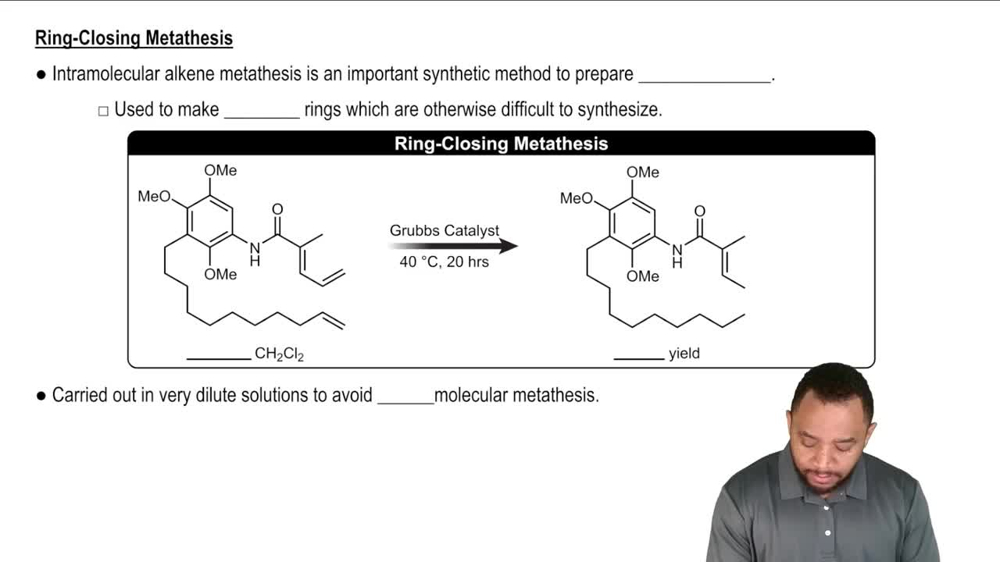
Ring-Closing Metathesis is a powerful synthetic method in organic chemistry that involves the formation of a ring by the exchange of alkene partners through the action of a catalyst, typically a transition metal complex. This reaction is particularly useful for synthesizing cyclic compounds from linear precursors, allowing for the creation of various ring sizes and functionalities.
The choice of starting materials in RCM is crucial, as they must contain two or more alkenes that can react to form a cyclic structure. Typically, these starting materials are diene or polyene compounds, which provide the necessary double bonds for the metathesis reaction to occur. The structure of the starting material directly influences the efficiency and selectivity of the ring formation.
Aromatic synthesis starting with benzene/benzene derivatives
Catalysts in RCM
Catalysts play a vital role in Ring-Closing Metathesis by facilitating the metathesis reaction without being consumed in the process. Common catalysts include Grubbs and Hoveyda-Grubbs catalysts, which are based on ruthenium. The choice of catalyst can affect the reaction conditions, such as temperature and solvent, and ultimately the yield and purity of the desired cyclic product.

 4:20 minutes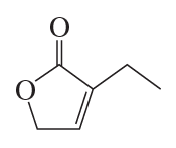
 Verified step by step guidance
 1:47
1:47