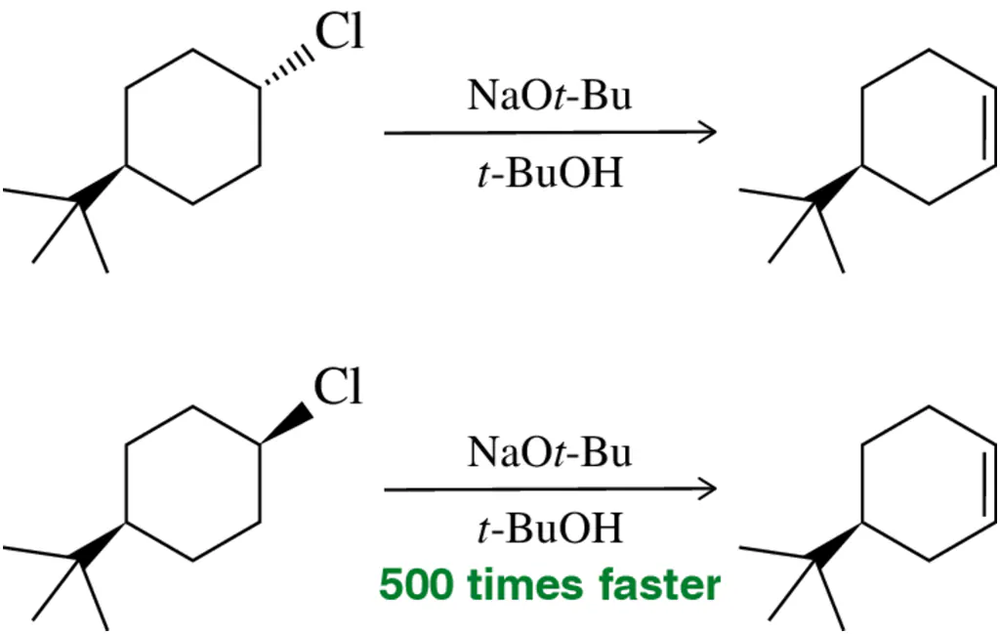
The cis-diastereomer undergoes E2 elimination 500 times faster than the trans form. Explain.
Verified step by step guidance
1
Understand the E2 elimination mechanism: E2 elimination is a bimolecular reaction where a base removes a proton (β-hydrogen) from the β-carbon, and simultaneously, the leaving group departs from the α-carbon, forming a double bond. The reaction requires a specific geometric arrangement called anti-periplanar geometry.
Recognize the importance of anti-periplanar geometry: In E2 elimination, the β-hydrogen and the leaving group must be positioned opposite to each other in the same plane (anti-periplanar) for the reaction to proceed efficiently. This geometry allows for optimal orbital overlap during the elimination process.
Analyze the cis-diastereomer: In the cis-diastereomer, the β-hydrogen and the leaving group are more likely to adopt the anti-periplanar geometry due to the spatial arrangement of substituents. This makes the elimination process faster because the required geometry is readily achieved.
Analyze the trans-diastereomer: In the trans-diastereomer, the β-hydrogen and the leaving group are less likely to adopt the anti-periplanar geometry due to steric hindrance or unfavorable spatial arrangement. This reduces the efficiency of the elimination process, making it slower compared to the cis-diastereomer.
Conclude the explanation: The cis-diastereomer undergoes E2 elimination 500 times faster than the trans form because the anti-periplanar geometry is more easily achieved in the cis-diastereomer, facilitating the elimination reaction. The trans-diastereomer faces geometric constraints that hinder the reaction.
Verified video answer for a similar problem:
This video solution was recommended by our tutors as helpful for the problem above
Play a video:
0 Comments
Key Concepts
Here are the essential concepts you must grasp in order to answer the question correctly.
Cis-Trans Isomerism
Cis-trans isomerism, also known as geometric isomerism, occurs in compounds with restricted rotation around a double bond or a ring structure. In this context, 'cis' refers to isomers where substituents are on the same side of the double bond, while 'trans' indicates they are on opposite sides. This spatial arrangement significantly influences the physical and chemical properties of the molecules, including their reactivity.
The E2 elimination mechanism is a type of bimolecular elimination reaction where a base removes a proton from a β-carbon, leading to the formation of a double bond and the expulsion of a leaving group. This mechanism is concerted, meaning that bond-breaking and bond-forming occur simultaneously. The stereochemistry of the substrate plays a crucial role in determining the reaction rate, with certain conformations favoring faster elimination.
Steric hindrance refers to the repulsion between bulky groups in a molecule that can impede reactions. In the context of E2 eliminations, the transition state is influenced by the spatial arrangement of substituents. The cis-diastereomer may have a more favorable transition state due to less steric hindrance compared to the trans form, allowing for a faster reaction rate in the elimination process.