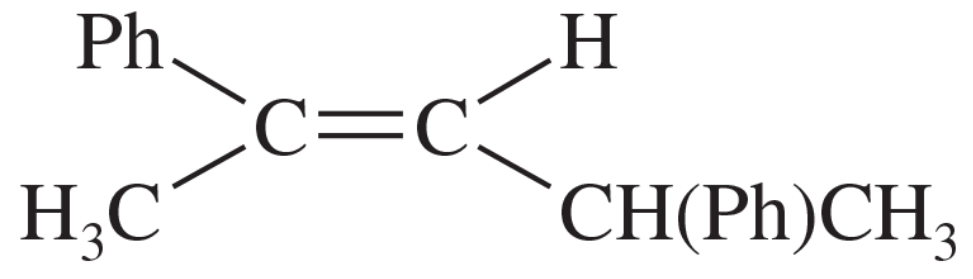
a. Design an alkyl halide that will give only 2,4-diphenylpent-2-ene upon treatment with potassium tert-butoxide (a bulky base that promotes E2 elimination). b. What stereochemistry is required in your alkyl halide so that only the following stereoisomer of the product is formed?
Verified step by step guidance
1
Step 1: Understand the reaction conditions. Potassium tert-butoxide is a bulky base that promotes E2 elimination. This means the reaction will proceed via a concerted mechanism where a proton is abstracted, and the leaving group departs simultaneously, forming a double bond. The bulky base favors elimination over substitution and prefers to abstract protons from less sterically hindered positions.
Step 2: Analyze the desired product. The product is 2,4-diphenylpent-2-ene, which has a double bond between carbons 2 and 3. To achieve this, the alkyl halide must have a leaving group (e.g., a halogen) on carbon 3, and a β-hydrogen must be present on carbon 2 to allow for elimination.
Step 3: Design the alkyl halide. To ensure the formation of 2,4-diphenylpent-2-ene, the starting alkyl halide should be 3-bromo-2,4-diphenylpentane. This structure places the bromine atom on carbon 3, which is adjacent to carbon 2, where the β-hydrogen is located. The bulky base will abstract the β-hydrogen, leading to the formation of the double bond between carbons 2 and 3.
Step 4: Address stereochemistry for part (b). To form a specific stereoisomer of the product, the stereochemistry of the starting alkyl halide must be controlled. For the desired stereoisomer of 2,4-diphenylpent-2-ene, the β-hydrogen and the leaving group (bromine) must be anti-periplanar in the transition state of the E2 elimination. This means the β-hydrogen on carbon 2 and the bromine on carbon 3 must be in opposite planes (one axial up and the other axial down in a Newman projection).
Step 5: Verify the stereochemistry. To ensure the correct stereoisomer is formed, the starting alkyl halide should have the β-hydrogen and bromine in the anti-periplanar arrangement. For example, if the β-hydrogen on carbon 2 is in the R-configuration, the bromine on carbon 3 should be in the S-configuration (or vice versa). This ensures that the elimination proceeds to give the desired stereoisomer of 2,4-diphenylpent-2-ene.
Verified video answer for a similar problem:

This video solution was recommended by our tutors as helpful for the problem above
Video duration:
7m
Play a video:
0 Comments
Key Concepts
Here are the essential concepts you must grasp in order to answer the question correctly.
E2 Elimination Mechanism
The E2 elimination mechanism is a bimolecular reaction where a base abstracts a proton from a β-carbon while a leaving group departs from the α-carbon, resulting in the formation of a double bond. This mechanism is favored by strong bases, such as potassium tert-butoxide, and typically requires that the hydrogen being removed and the leaving group are in an anti-periplanar arrangement for optimal overlap of orbitals.
Stereochemistry refers to the spatial arrangement of atoms in molecules and is crucial in determining the properties and reactivity of alkenes. In the context of the question, the stereochemistry of the starting alkyl halide must be configured to ensure that the elimination reaction leads to the desired stereoisomer of the alkene product, which may involve specific cis or trans arrangements of substituents around the double bond.
Bulky bases, like potassium tert-butoxide, are used in elimination reactions to favor the formation of alkenes over substitution products. Their size prevents them from easily accessing the substrate for nucleophilic attack, thus promoting the E2 mechanism, which leads to the formation of alkenes with specific stereochemical outcomes. Understanding the role of the base is essential for predicting the product of the reaction.