(A true story.) An inexperienced graduate student moved into a laboratory and began work. He needed some diethyl ether for a reaction, so he opened an old, rusty 1-gallon can marked 'ethyl ether' and found there was half a gallon left. To purify the ether, the student set up a distillation apparatus, started a careful distillation, and went to the stockroom for the other reagents he needed. While he was at the stockroom, the student heard a muffled "boom." He quickly returned to his lab to find a worker from another laboratory putting out a fire. Most of the distillation apparatus was embedded in the ceiling. (a) Explain what probably happened. (b) Explain how this near-disaster might have been prevented.
Verified step by step guidance
1
Step 1: Understand the chemical properties of diethyl ether. Diethyl ether is highly volatile and flammable, with a low boiling point. Over time, it can form peroxides when exposed to air and light. These peroxides are highly explosive and can detonate during distillation or heating.
Step 2: Analyze the situation described. The student used an old, rusty can of diethyl ether, which likely had been stored for a long time. This storage condition increases the likelihood of peroxide formation. During distillation, the heat applied to the ether could have caused the peroxides to detonate, leading to the explosion.
Step 3: Explain how the explosion occurred. The distillation process involves heating the liquid to separate components based on boiling points. If peroxides were present in the ether, the heat could have triggered their decomposition, releasing a large amount of energy and causing the explosion.
Step 4: Suggest preventive measures. To prevent such incidents, diethyl ether should always be tested for peroxide formation before use, especially if it has been stored for a long time. Peroxide test strips or chemical tests can be used to detect their presence. If peroxides are found, the ether should be disposed of safely according to hazardous waste protocols.
Step 5: Recommend proper storage and handling practices. Diethyl ether should be stored in tightly sealed containers, away from light and heat, and used within a reasonable timeframe. Laboratories should maintain a chemical inventory system to track the age of chemicals and ensure safe disposal of old or potentially hazardous substances.
Verified video answer for a similar problem:
This video solution was recommended by our tutors as helpful for the problem above
Video duration:
5m
Play a video:
0 Comments
Key Concepts
Here are the essential concepts you must grasp in order to answer the question correctly.
Volatility of Diethyl Ether
Diethyl ether is a highly volatile organic compound, meaning it readily evaporates at room temperature. This property can lead to the accumulation of flammable vapors in the air, especially in poorly ventilated spaces. When these vapors come into contact with an ignition source, they can ignite, causing explosions or fires. Understanding the volatility of diethyl ether is crucial for safe handling and storage.
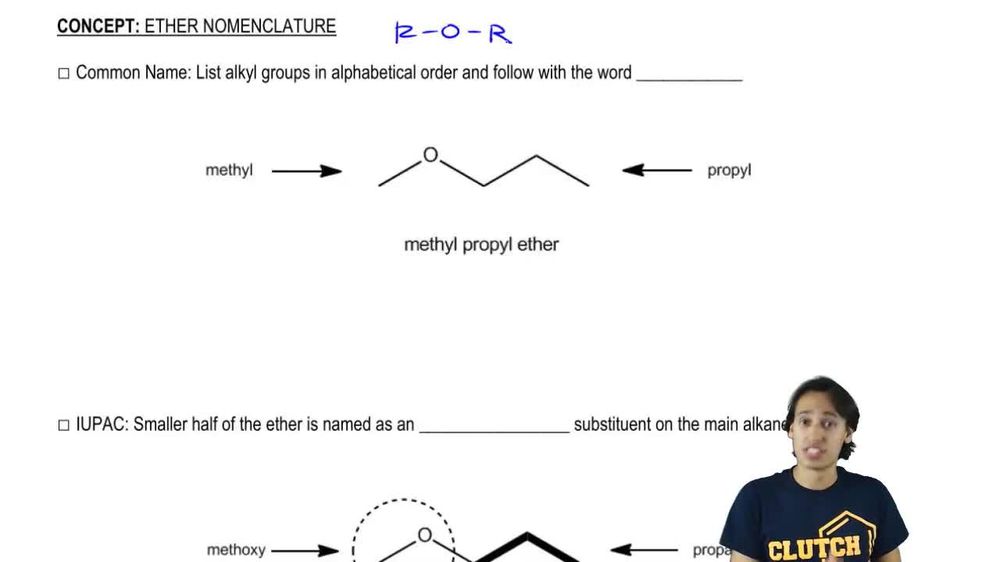
How to name ethers using the common naming system.
Distillation Process
Distillation is a separation technique that relies on differences in boiling points to purify liquids. In this process, the liquid is heated to create vapor, which is then cooled to form a liquid again. If not properly monitored, distillation can lead to overheating and the formation of flammable vapors, especially with substances like diethyl ether. Knowledge of the distillation process is essential to prevent accidents during purification.
Laboratory safety protocols are guidelines designed to minimize risks associated with chemical handling and experiments. These include proper ventilation, the use of fume hoods, and the importance of not leaving distillation setups unattended. Adhering to these protocols can significantly reduce the likelihood of accidents, such as fires or explosions, by ensuring that hazardous materials are managed safely and effectively.

 5:48 minutes
 Verified step by step guidance
 01:32
01:32