Would you expect the reactivity of a five-membered ring ether such as tetrahydrofuran (Table 10.2) to be more similar to the reactivity of an epoxide or to the reactivity of a noncyclic ether? Why?
Verified step by step guidance
1
Understand the structure of tetrahydrofuran (THF): THF is a five-membered cyclic ether with the molecular formula C4H8O. It contains an oxygen atom in the ring, making it a heterocyclic compound.
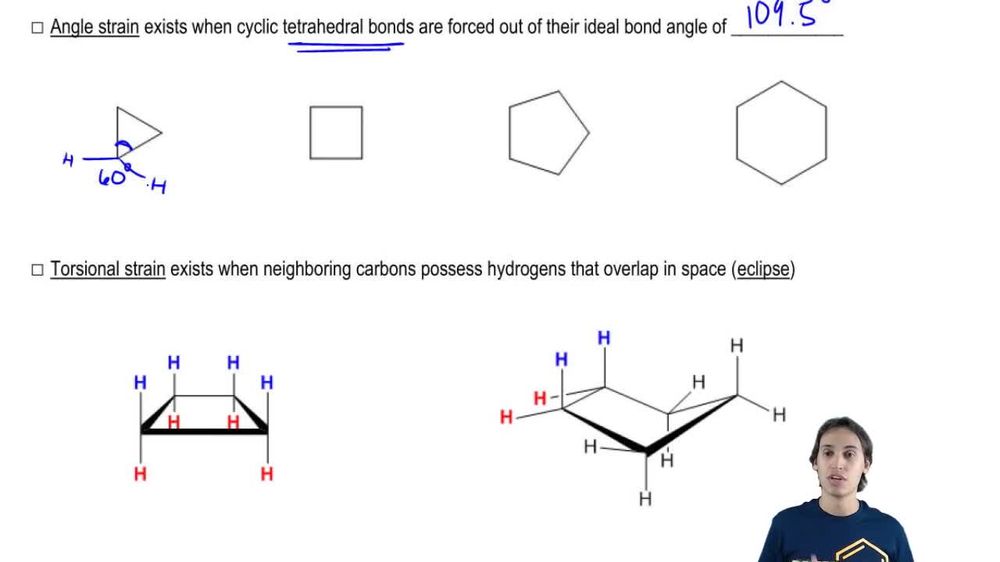
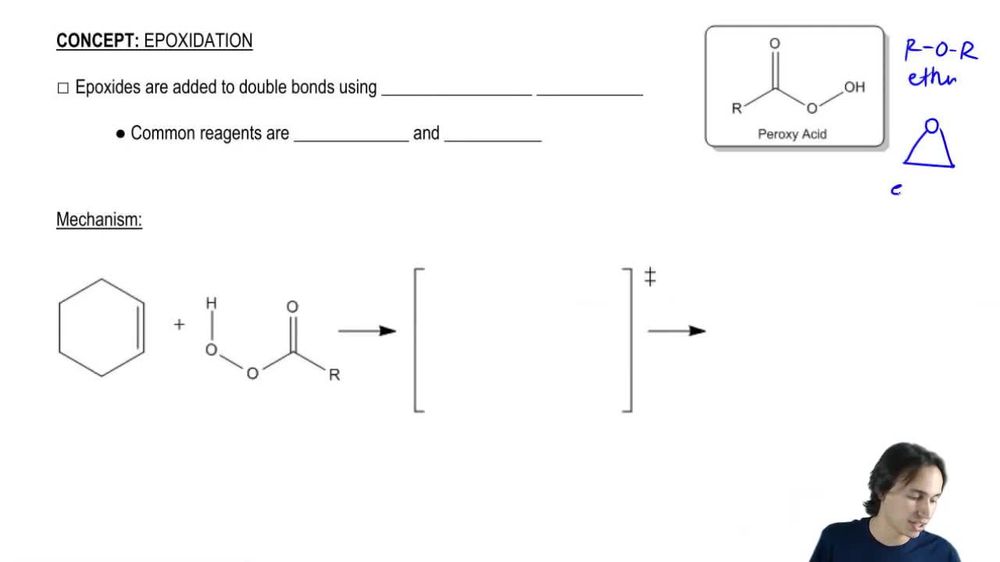
Compare THF to an epoxide: An epoxide is a three-membered cyclic ether with significant ring strain due to the small ring size and bond angles deviating from the ideal tetrahedral angle (109.5°). This ring strain makes epoxides highly reactive.
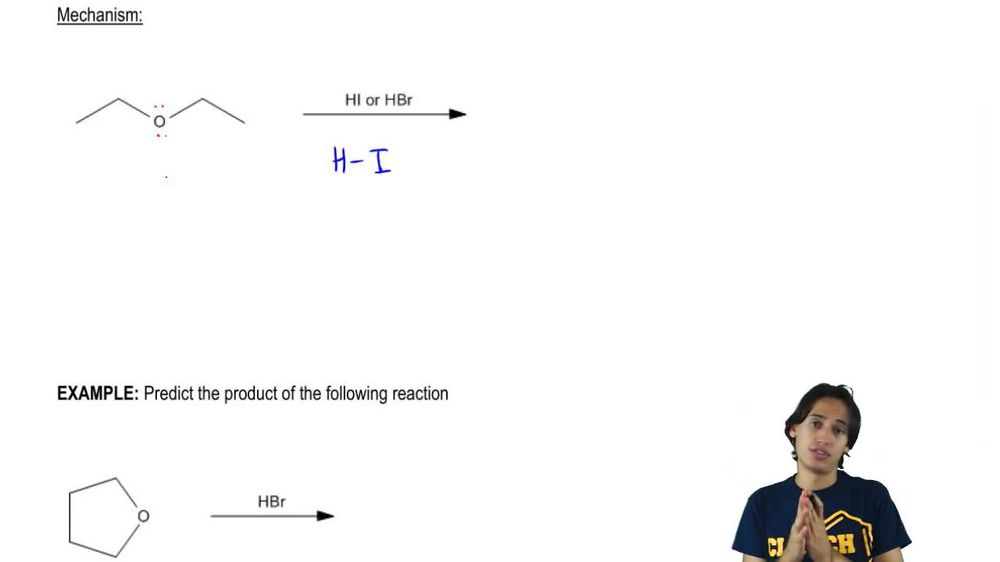
Compare THF to a noncyclic ether: Noncyclic ethers, such as diethyl ether, lack ring strain and are generally less reactive. Their reactivity is primarily determined by the lone pairs on the oxygen atom and their ability to act as a Lewis base or undergo substitution reactions.
Analyze the ring strain in THF: A five-membered ring like THF has minimal ring strain because its bond angles are close to the ideal tetrahedral angle. This makes its reactivity more similar to that of a noncyclic ether rather than an epoxide, which is highly reactive due to ring strain.
Conclude the reasoning: Since THF lacks significant ring strain and behaves more like a noncyclic ether in terms of stability and reactivity, its reactivity is expected to be more similar to that of a noncyclic ether rather than an epoxide.
Verified video answer for a similar problem:
This video solution was recommended by our tutors as helpful for the problem above
Video duration:
4m
Play a video:
0 Comments
Key Concepts
Here are the essential concepts you must grasp in order to answer the question correctly.
Reactivity of Ethers
Ethers are generally characterized by their relatively low reactivity due to the stability of the C-O bond. Noncyclic ethers, like diethyl ether, are less reactive than other functional groups, while cyclic ethers can exhibit different reactivity patterns based on ring strain and sterics. Understanding the basic reactivity of ethers is crucial for comparing the behavior of tetrahydrofuran with epoxides and noncyclic ethers.
Cyclic ethers, such as tetrahydrofuran, can exhibit unique reactivity due to ring strain, which can influence their susceptibility to nucleophilic attack. Tetrahydrofuran is a stable five-membered ring with minimal strain, while epoxides, which are three-membered cyclic ethers, have significant ring strain that makes them more reactive. This difference in ring strain is essential for understanding their reactivity patterns.
Epoxides are highly reactive due to their strained three-membered ring structure, which makes them more susceptible to nucleophilic attack compared to noncyclic ethers. The presence of the strained bond allows for easier opening of the ring under basic or acidic conditions, leading to various reaction pathways. This heightened reactivity contrasts with the more stable tetrahydrofuran, which behaves more like a noncyclic ether in many reactions.

 4:29 minutes
 Verified step by step guidance
 04:22
04:22