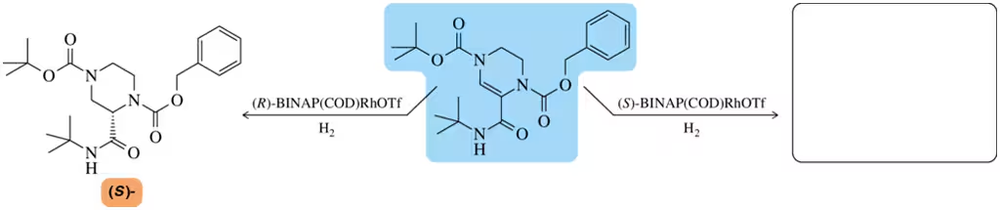
The chiral catalyst (R)-BINAP(COD)RhOTf was used in a hydrogenation reaction as part of the synthesis of fragment C of indinavir. Using the same alkene, predict the product that would be obtained if (S)-BINAP(COD)RhOTf were used instead.
Verified step by step guidance
1
Identify the role of the chiral catalyst in the reaction. In this case, (R)-BINAP(COD)RhOTf is used to induce chirality in the hydrogenation of an alkene, leading to a specific enantiomer of the product.
Understand the concept of enantiomers. Enantiomers are pairs of molecules that are mirror images of each other and cannot be superimposed. The use of a chiral catalyst can lead to the formation of one enantiomer preferentially over the other.
Recognize that (S)-BINAP(COD)RhOTf is the enantiomer of (R)-BINAP(COD)RhOTf. This means that using (S)-BINAP(COD)RhOTf will favor the formation of the opposite enantiomer of the product compared to using (R)-BINAP(COD)RhOTf.
Predict the stereochemistry of the product. Since (R)-BINAP(COD)RhOTf leads to one enantiomer, using (S)-BINAP(COD)RhOTf will result in the formation of the enantiomeric product with the opposite configuration at the chiral center.
Consider the implications of this change in stereochemistry for the synthesis of fragment C of indinavir. The stereochemistry of the product is crucial for the biological activity of the final compound, so using the correct enantiomer of the catalyst is essential for the desired outcome.
Verified video answer for a similar problem:
This video solution was recommended by our tutors as helpful for the problem above
Play a video:
0 Comments
Key Concepts
Here are the essential concepts you must grasp in order to answer the question correctly.
Chirality in Catalysts
Chirality refers to the geometric property where a molecule is not superimposable on its mirror image, much like left and right hands. In catalysis, chiral catalysts can induce stereoselectivity, leading to the preferential formation of one enantiomer over another in a chemical reaction. This is crucial in synthesizing compounds with specific desired properties, such as pharmaceuticals.
Enantioselective hydrogenation is a process where a chiral catalyst is used to selectively hydrogenate one enantiomer of an unsaturated compound over the other. This reaction is important in producing enantiomerically pure compounds, which are often required in drug synthesis. The choice of catalyst, such as (R)-BINAP or (S)-BINAP, determines the stereochemistry of the product.
BINAP (2,2'-bis(diphenylphosphino)-1,1'-binaphthyl) is a chiral ligand used in asymmetric catalysis. It forms complexes with metals like Rhodium, which can then catalyze reactions with high enantioselectivity. The (R) or (S) configuration of BINAP influences the spatial arrangement of the reactants, thus determining the stereochemistry of the hydrogenation product.