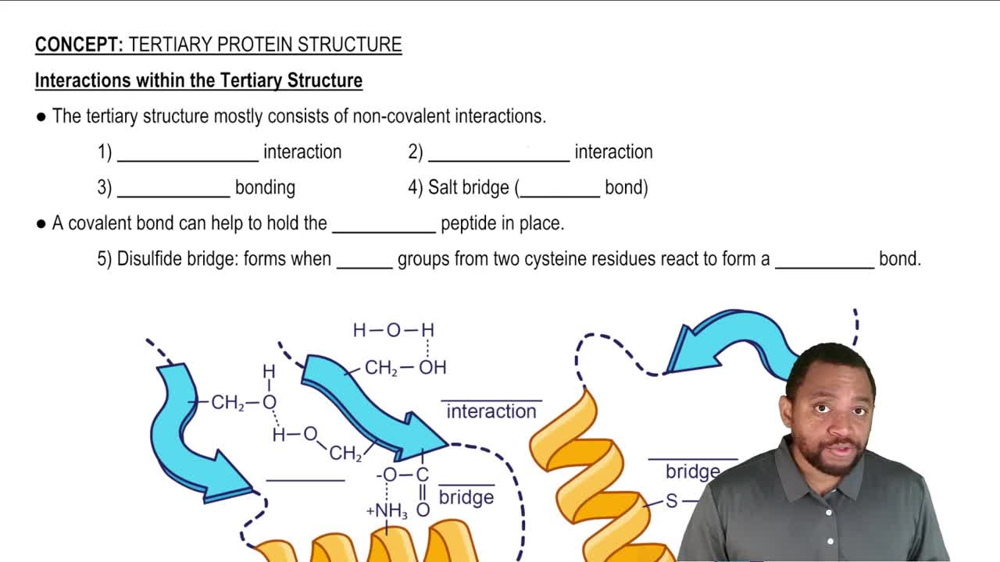
How would a protein that resides in the nonpolar interior of a membrane fold compared with the water-soluble protein just discussed?
Verified step by step guidance
1
Understand the environment: A protein residing in the nonpolar interior of a membrane is exposed to a hydrophobic (nonpolar) environment, unlike a water-soluble protein, which is surrounded by a polar (aqueous) environment. This difference in surroundings will influence the folding and structure of the protein.
Analyze the role of hydrophobic and hydrophilic residues: In a membrane protein, the hydrophobic (nonpolar) amino acid residues will be oriented outward to interact with the nonpolar lipid bilayer, while the hydrophilic (polar) residues will be buried or located in regions that interact with the aqueous environment (e.g., at the membrane surface or in channels).
Consider secondary structure elements: Membrane proteins often adopt specific secondary structures, such as α-helices or β-barrels, that allow their hydrophobic side chains to face outward and interact with the lipid bilayer. These structures also help stabilize the protein in the membrane environment.
Compare with water-soluble proteins: In contrast, water-soluble proteins fold in a way that places hydrophilic residues on the exterior to interact with water, while hydrophobic residues are buried in the protein's core to avoid contact with the aqueous environment. This is the opposite of the folding pattern seen in membrane proteins.
Relate to function: The folding of a membrane protein is not only influenced by the environment but also by its function. For example, if the protein forms a channel or pore, it may have hydrophilic residues lining the interior of the channel to allow the passage of polar molecules, while the exterior remains hydrophobic to interact with the membrane.
Verified video answer for a similar problem:
This video solution was recommended by our tutors as helpful for the problem above
Video duration:
2m
Play a video:
0 Comments
Key Concepts
Here are the essential concepts you must grasp in order to answer the question correctly.
Protein Folding
Protein folding is the process by which a polypeptide chain acquires its functional three-dimensional structure. This process is influenced by the sequence of amino acids and their interactions, including hydrophobic and hydrophilic interactions. In the case of membrane proteins, the folding is adapted to accommodate the nonpolar environment of the membrane, often resulting in the formation of alpha-helices or beta-barrels.
Hydrophobic interactions occur between nonpolar molecules or regions of molecules that tend to avoid water, while hydrophilic interactions involve polar molecules that interact favorably with water. In membrane proteins, hydrophobic regions typically reside within the lipid bilayer, while hydrophilic regions are exposed to the aqueous environment, influencing how the protein folds and functions within the membrane.
Interactions within the Tertiary Structure Concept 2
Membrane Structure
Cell membranes are primarily composed of a phospholipid bilayer, which creates a nonpolar interior that separates the internal cellular environment from the external surroundings. This structure is crucial for the function of membrane proteins, which must adapt their folding patterns to interact appropriately with both the hydrophobic core of the membrane and the aqueous environments on either side.

 2:53 minutes
 Verified step by step guidance
 1:17
1:17