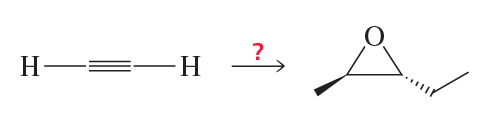
Show how the following compound can be prepared from the given starting material. Draw the structure of the compound that is formed in each step of the synthesis.
Verified step by step guidance
1
Step 1: Begin with the starting material, prop-1-yne. The goal is to transform the triple bond into a structure that can lead to the formation of the final compound, a substituted epoxide.
Step 2: Perform hydroboration-oxidation on prop-1-yne. Use a bulky borane reagent like disiamylborane (Sia2BH) to selectively add across the triple bond, followed by oxidation with hydrogen peroxide (H2O2) and sodium hydroxide (NaOH). This will yield an anti-Markovnikov aldehyde, propanal.
Step 3: Convert the aldehyde (propanal) into a secondary alcohol. Use a Grignard reagent, such as methylmagnesium bromide (CH3MgBr), to add a methyl group to the carbonyl carbon, followed by acidic workup. This will produce 2-butanol.
Step 4: Oxidize the secondary alcohol (2-butanol) to a ketone. Use an oxidizing agent like PCC (pyridinium chlorochromate) or Jones reagent (CrO3/H2SO4) to convert the alcohol into 2-butanone.
Step 5: Perform epoxidation of the ketone (2-butanone). Use a reagent like a peracid (e.g., mCPBA) to form the epoxide ring, resulting in the final compound, 2,2-dimethyloxirane.
Verified video answer for a similar problem:
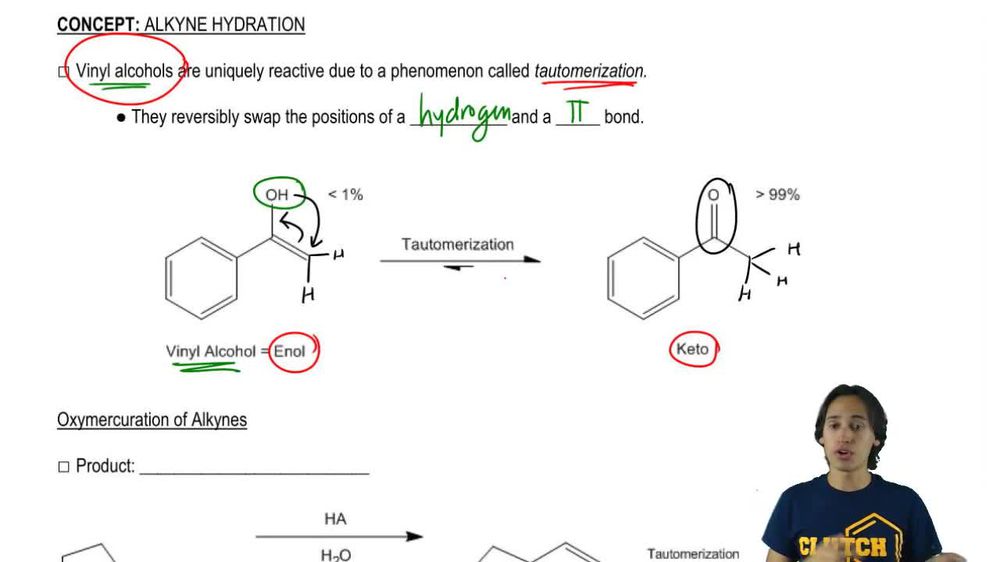
This video solution was recommended by our tutors as helpful for the problem above
Video duration:
6m
Play a video:
0 Comments
Key Concepts
Here are the essential concepts you must grasp in order to answer the question correctly.
Alkyne Reactivity
Alkynes, such as prop-1-yne, are hydrocarbons containing a carbon-carbon triple bond. This triple bond makes them highly reactive, allowing them to undergo various reactions, including addition reactions. Understanding the reactivity of alkynes is crucial for predicting the products formed during synthesis, especially when converting them into functionalized compounds like carbonyls.
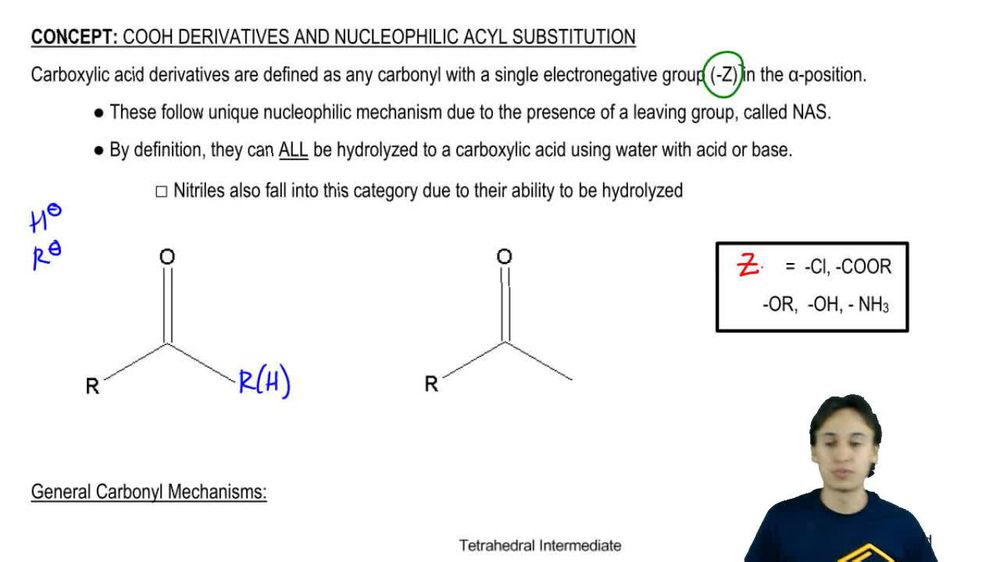
The carbonyl group (C=O) is a functional group found in aldehydes and ketones, which are important in organic synthesis. The formation of a carbonyl group from an alkyne typically involves oxidation reactions. Recognizing the mechanisms that lead to carbonyl formation is essential for successfully completing the synthesis from prop-1-yne to the desired product.
Synthesis pathways outline the step-by-step reactions needed to convert one compound into another. In organic chemistry, understanding how to draw and interpret these pathways is vital for visualizing the transformation of reactants into products. This includes identifying intermediates and the reagents required at each stage, which is key to solving the given synthesis problem.