

Ch.9 - Alkynes
Wade - Organic Chemistry 9th Edition
Wade9th EditionOrganic ChemistryISBN: 9780135213728Not the one you use?Change textbook
Chapter 9, Problem 8b

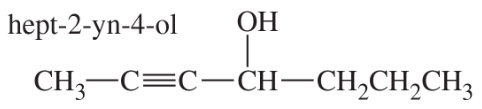
Show how you would synthesize each compound, beginning with acetylene and any necessary additional reagents
(b)

Verified step by step guidance
1
Step 1: Begin with acetylene (C≡CH) as the starting material. Perform an alkylation reaction by treating acetylene with sodium amide (NaNH₂) to generate the acetylide ion (C≡C⁻). Then, react the acetylide ion with 1-bromopropane (CH₃CH₂CH₂Br) to introduce the propyl group, forming CH₃CH₂CH₂C≡CH.
Step 2: Perform a second alkylation reaction. Treat the terminal alkyne (CH₃CH₂CH₂C≡CH) with sodium amide (NaNH₂) again to generate the acetylide ion (CH₃CH₂CH₂C≡C⁻). React this ion with methyl iodide (CH₃I) to introduce the methyl group, forming CH₃C≡CCH₂CH₂CH₃.
Step 3: To introduce the hydroxyl group at the 4-position, perform a hydroboration-oxidation reaction. First, treat the alkyne (CH₃C≡CCH₂CH₂CH₃) with disiamylborane (a sterically hindered borane reagent) to selectively add boron to the less substituted carbon of the triple bond. Then, oxidize the organoborane intermediate using hydrogen peroxide (H₂O₂) and sodium hydroxide (NaOH) to form the alcohol group, yielding CH₃C≡CCH(OH)CH₂CH₂CH₃.
Step 4: Verify the structure of the product. The final compound should be hept-2-yn-4-ol, with the hydroxyl group (-OH) attached to the 4th carbon and the triple bond between the 2nd and 3rd carbons.
Step 5: Ensure proper purification and characterization of the product using techniques such as distillation or chromatography, and confirm the structure using spectroscopic methods like NMR and IR.

Verified video answer for a similar problem:

This video solution was recommended by our tutors as helpful for the problem above.
Video duration:
7m
Was this helpful?

Key Concepts

Here are the essential concepts you must grasp in order to answer the question correctly.

Alkynes

Alkynes are hydrocarbons that contain at least one carbon-carbon triple bond. They are unsaturated compounds and are characterized by the general formula CnH2n-2. In synthesis, alkynes can undergo various reactions, including addition reactions, which are crucial for forming more complex molecules from simpler starting materials like acetylene.
Recommended video:
Guided course
09:11
Alkyne Hydration

Functional Groups

Functional groups are specific groups of atoms within molecules that are responsible for the characteristic chemical reactions of those molecules. In the compound hept-2-yn-4-ol, the hydroxyl group (-OH) is a functional group that indicates the presence of an alcohol, influencing the compound's reactivity and properties. Understanding functional groups is essential for predicting the outcomes of chemical reactions.
Recommended video:
Guided course
02:36
Identifying Functional Groups

Synthesis Pathways

Synthesis pathways refer to the step-by-step methods used to construct complex organic molecules from simpler precursors. In organic chemistry, synthesizing a compound like hept-2-yn-4-ol from acetylene involves a series of reactions, including alkylation and functional group transformations. Mastery of synthesis pathways is vital for designing efficient routes to target compounds.
Recommended video:
2:13
Energy Production In Biochemical Pathways Concept 1