What is the configuration about each of the asymmetric centers in aspartame?
Verified step by step guidance
1
Identify the asymmetric centers in aspartame. Aspartame is a dipeptide composed of aspartic acid and phenylalanine methyl ester. Look for carbon atoms that are bonded to four different groups, as these are the chiral centers.
Label the asymmetric centers. In aspartame, there are two chiral centers: one in the aspartic acid portion (the α-carbon) and one in the phenylalanine portion (the α-carbon).
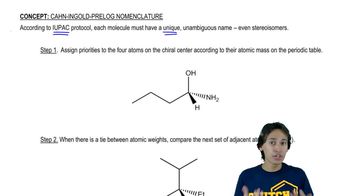
Assign priorities to the groups attached to each chiral center using the Cahn-Ingold-Prelog (CIP) priority rules. These rules prioritize groups based on the atomic number of the atoms directly attached to the chiral center. If two atoms are the same, move outward to the next set of atoms until a difference is found.
Determine the configuration (R or S) for each chiral center. Orient the molecule so that the group with the lowest priority is pointing away from you. Then, trace a path from the highest priority group (1) to the second (2) and third (3). If the path is clockwise, the configuration is R; if counterclockwise, it is S.
Repeat the process for both chiral centers in aspartame. Carefully analyze the groups attached to each center and assign the correct configuration for each one.
Verified video answer for a similar problem:
This video solution was recommended by our tutors as helpful for the problem above
Video duration:
3m
Play a video:
0 Comments
Key Concepts
Here are the essential concepts you must grasp in order to answer the question correctly.
Asymmetric Centers
Asymmetric centers, or chiral centers, are carbon atoms bonded to four different substituents, leading to non-superimposable mirror images known as enantiomers. In organic molecules, the configuration of these centers is crucial for determining the molecule's stereochemistry and biological activity. Understanding how to identify and describe these centers is essential for analyzing compounds like aspartame.
Stereochemistry is the study of the spatial arrangement of atoms in molecules and how this arrangement affects their chemical properties and reactions. It encompasses concepts such as chirality, enantiomers, and diastereomers. For aspartame, knowing the stereochemical configuration of its asymmetric centers is vital for understanding its sweetness and interaction with taste receptors.
The Cahn-Ingold-Prelog (CIP) priority rules are a set of guidelines used to assign priorities to substituents attached to chiral centers based on atomic number and connectivity. These rules help determine the R or S configuration of each asymmetric center. Applying these rules is essential for accurately describing the stereochemistry of aspartame and understanding its molecular behavior.