Draw a perspective formula for each of the following: a. (S)-3-chloro-1-pentanol b. (2R,3R)-2,3-dibromopentane
Verified step by step guidance
1
Step 1: Understand the stereochemical notation. The (R) and (S) designations refer to the absolute configuration of a chiral center, determined using the Cahn-Ingold-Prelog priority rules. For each chiral center, assign priorities to the substituents based on atomic number and determine the configuration by observing the arrangement in 3D space.
Step 2: For (S)-3-chloro-1-pentanol, start by drawing the carbon chain of pentane (a five-carbon chain). Place a hydroxyl group (-OH) on the first carbon and a chlorine atom (-Cl) on the third carbon. Ensure the stereochemistry at the third carbon is (S) by arranging the substituents in 3D space such that the lowest priority group (usually hydrogen) is pointing away from you, and the remaining groups follow a counterclockwise order of priority.
Step 3: For (2R,3R)-2,3-dibromopentane, begin by drawing the pentane backbone. Add a bromine atom (-Br) to the second and third carbons. Assign the (R) configuration to both chiral centers by arranging the substituents in 3D space such that the lowest priority group (hydrogen) is pointing away from you, and the remaining groups follow a clockwise order of priority.
Step 4: Use wedge-and-dash notation to represent the 3D arrangement of substituents. A solid wedge indicates a bond coming out of the plane of the paper (toward the viewer), while a dashed wedge indicates a bond going behind the plane of the paper (away from the viewer). Ensure the stereochemistry matches the (R) or (S) designation for each chiral center.
Step 5: Double-check your perspective formulas by verifying the priority order of substituents and the stereochemical configurations. Ensure that the drawn structures accurately represent the given stereochemical designations (S for part a and R,R for part b).
Verified video answer for a similar problem:
This video solution was recommended by our tutors as helpful for the problem above
Video duration:
6m
Play a video:
0 Comments
Key Concepts
Here are the essential concepts you must grasp in order to answer the question correctly.
Stereochemistry
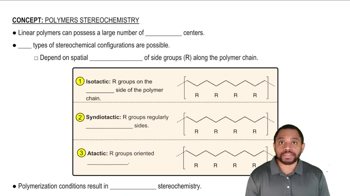
Stereochemistry is the study of the spatial arrangement of atoms in molecules and how this affects their chemical behavior. It is crucial for understanding chiral molecules, which have non-superimposable mirror images. The designation of (S) or (R) refers to the specific configuration of chiral centers, indicating the orientation of substituents around the central carbon atom.
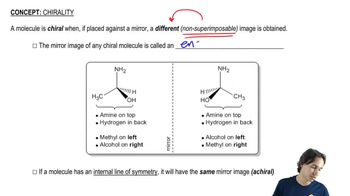
Chirality is a property of a molecule that makes it non-superimposable on its mirror image, much like left and right hands. Chiral molecules typically contain at least one carbon atom bonded to four different substituents, leading to two possible configurations. Recognizing chirality is essential for drawing perspective formulas, as it determines the correct representation of the molecule's three-dimensional structure.
A perspective formula is a two-dimensional representation of a three-dimensional molecular structure, illustrating the arrangement of atoms and bonds. It often employs wedge and dashed lines to indicate bonds that project out of or into the plane of the paper, respectively. This visual representation is vital for conveying the stereochemistry of chiral compounds, allowing for a clearer understanding of their spatial orientation.