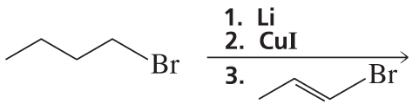
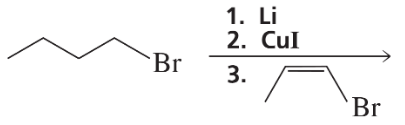
What are the products of the following reactions? a. b.
Verified step by step guidance
1
Step 1: Analyze the starting material, which is an alkyl bromide (CH3CH2CH2Br). This compound contains a bromine atom attached to a propyl chain.
Step 2: The first reagent, lithium (Li), reacts with the alkyl bromide to form an organolithium compound (CH3CH2CH2Li). This is a nucleophilic species formed by replacing the bromine atom with lithium.
Step 3: The second reagent, copper(I) iodide (CuI), reacts with the organolithium compound to form a Gilman reagent (CH3CH2CH2)2CuLi. Gilman reagents are useful for coupling reactions.
Step 4: The third step involves the reaction of the Gilman reagent with the alkyl bromide provided in the reaction scheme (CH2=CHCH2Br or CH2=CHCHBrCH3). This is a coupling reaction where the Gilman reagent replaces the bromine atom in the alkyl bromide with the alkyl group from the Gilman reagent.
Step 5: The final product is formed by combining the alkyl group from the Gilman reagent with the alkyl bromide, resulting in a new carbon-carbon bond. The specific product depends on the structure of the alkyl bromide used in the third step.
Verified video answer for a similar problem:
This video solution was recommended by our tutors as helpful for the problem above
Video duration:
5m
Play a video:
0 Comments
Key Concepts
Here are the essential concepts you must grasp in order to answer the question correctly.
Organolithium Reagents
Organolithium reagents, such as those formed from lithium and organic halides, are highly reactive compounds used in organic synthesis. They act as strong nucleophiles, facilitating the formation of carbon-carbon bonds by attacking electrophiles. In the given reaction, lithium likely helps to generate a lithium alkyl intermediate that can further react with copper(I) iodide.
Cuprate reagents, formed from the reaction of organolithium compounds with copper(I) halides, are important in organic synthesis for their ability to participate in nucleophilic substitutions. They can react with alkyl halides to form new carbon-carbon bonds, allowing for the construction of more complex molecules. The use of CuI in the reaction indicates a pathway to generate a new alkyl group.
Nucleophilic substitution reactions involve the replacement of a leaving group (like bromine) by a nucleophile. In this context, the organolithium and cuprate reagents act as nucleophiles that attack the carbon atom bonded to the bromine, leading to the formation of new carbon-carbon bonds. Understanding the mechanism of these reactions is crucial for predicting the products of the given transformations.